


 INVEST
 PLANT
PLANT
 SOFTWOODS
 HARDWOODS
 CALCULATORS
 RESOURCES
 PROGRAMS

Softwoods
Learn More
EBONY • RARE HARDWOOD • HIGH VALUE
Wondering why black ebony wood is so valuable? Black ebony (Diospyros ebenum) is one of the rarest and most valuable hardwoods in the world, known for its deep black color, extreme density, and slow growth.
🪵 Quick answer: Ebony is highly valuable because it is exceptionally dense, naturally durable, visually striking, and extremely rare— often taking 100–200 years to develop premium heartwood.
Examples: Ebony is used in musical instruments (piano keys, fingerboards), luxury furniture, fine carvings, and decorative inlays where strength, precision, and appearance matter.
The black ebony tree (Diospyros ebenum), native to parts of Southeast Asia and Africa, grows in tropical and subtropical forests where humidity and rainfall support slow but steady development of its famous dark heartwood.
Unfortunately, the same qualities that make ebony so valuable—its rarity, density, and striking color— have also made it a target for illegal logging, habitat destruction, and severe population decline across many regions.
Black ebony is considered one of the slowest-growing and rarest hardwood trees in the world. Many species in the Diospyros genus require 80–200 years to develop the dense, jet-black heartwood prized for luxury woodworking and musical instruments. Because of this slow growth and centuries of harvesting, natural ebony forests are increasingly rare, making sustainable plantations and conservation programs essential.
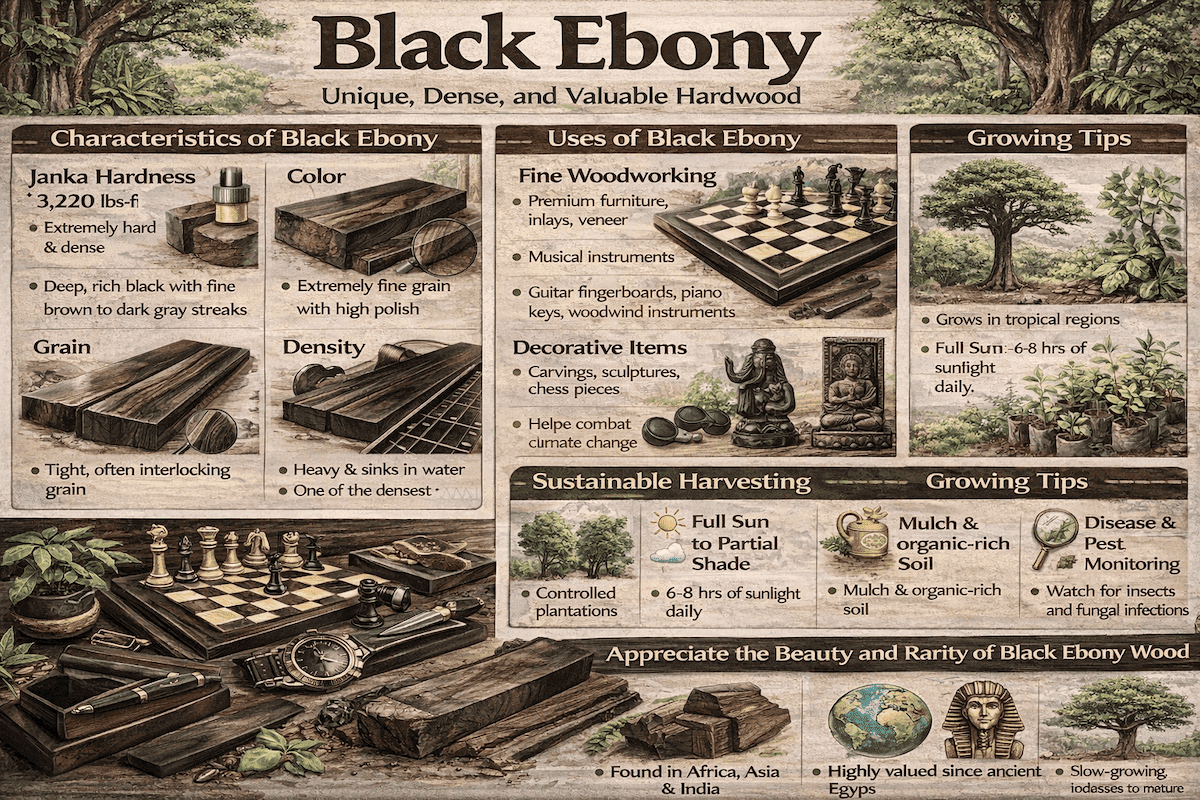
Black ebony wood is prized for its deep jet-black color, exceptionally fine grain, and extraordinary density. With a Janka hardness rating of approximately 3,220 lbf, ebony is significantly harder than many common hardwoods such as oak.
Ebony is also naturally resistant to moisture, decay, and insect damage, allowing it to maintain a smooth polished finish and structural stability over long periods.
However, this value comes with a tradeoff. A single ebony tree may require 150 years or more to reach maturity. Because the darkest heartwood is most valuable, trees are often harvested prematurely, placing additional pressure on already limited populations.
Feel free to share this black ebony infographic on your website or blog. Please include a link back to this page as the source.
Because of its extraordinary value, black ebony has become a major target for illegal logging operations around the world. Criminal syndicates, corrupt officials, and organized timber traffickers often operate deep within remote forests to harvest ebony trees without permits, environmental oversight, or reforestation plans. In countries such as Madagascar, Cameroon, and the Democratic Republic of Congo, poachers frequently cut mature ebony trees and move the wood through complex international black-market supply chains.
These same regions are also home to other highly prized African hardwoods, including African zebrawood , which—like ebony—has faced increasing pressure from illegal harvesting and unsustainable timber trade. As global demand for rare tropical hardwoods continues to rise, many forest ecosystems across Central and West Africa remain vulnerable to exploitation.
Madagascar—home to several of the world’s most endangered ebony species—has struggled with illegal logging for decades. Despite government bans on ebony exports, illegal loggers continue to harvest and smuggle the wood out of protected forests. In many cases these operations involve corrupt officials and international buyers, making enforcement extremely difficult.
Entire sections of Madagascar’s Masoala and Marojejy National Parks, both UNESCO World Heritage Sites, have been affected by illegal timber harvesting. This destruction not only removes valuable trees but also threatens fragile ecosystems and endemic wildlife species such as lemurs.
Cameroon and the Democratic Republic of Congo are also major sources of illegally harvested ebony entering international markets, particularly in Asia and Europe. Timber trafficking networks often rely on bribery, forged export documents, and fraudulent permits to transport ebony across borders and into global supply chains.
Local communities frequently bear the greatest burden. Illegal logging operations strip forests of valuable resources, leaving degraded landscapes behind. In some regions villagers are pressured to assist logging operations for minimal wages while the largest profits flow to international timber buyers.
Illegal logging of ebony has serious environmental and social consequences beyond the loss of valuable wood. In many cases, trees are cut quickly and processed on-site—sometimes reduced to scrap pieces used only as kindling or discarded during transport—wasting a resource that took centuries to grow.
Several international initiatives aim to reduce illegal harvesting and promote sustainable forestry practices.
Because of its rarity and demand, a single mature ebony tree can be worth hundreds of thousands of dollars—and in rare cases even more—on international markets. Without responsible forestry and conservation programs, many ebony species could disappear from natural forests within the next century.
Protecting ebony trees requires a combination of sustainable forestry, ethical sourcing, stronger environmental laws, and global cooperation. Consumers, businesses, and governments all play a role in ensuring that the world’s remaining ebony forests are preserved for future generations.
Black ebony is one of the most valuable and expensive hardwoods in the world, prized for its deep jet-black heartwood, exceptional density, and smooth, fine texture. For centuries this remarkable wood has been used for charcoal, traditional carvings, combs, needles, cups, and knife handles in regions where the tree naturally grows.
Because of its extreme hardness, stability, and natural waxy surface, ebony is especially valued in precision woodworking. It is widely used in the manufacture of woodwind musical instruments such as clarinets and oboes, where the dense wood produces excellent acoustic qualities and durability. Ebony is also prized for guitar fretboards and instrument fittings because it holds metal frets securely while maintaining a smooth playing surface. In addition, its striking dark color and tight grain make ebony a luxury material for fine furniture, decorative inlays, and high-end craftsmanship.

Because of its extreme rarity and exceptional density, black ebony wood commands some of the highest prices of any hardwood in the world. Historical estimates suggest sawn ebony logs have sold for as much as US $300,000 per cubic meter, while specialized processed timber used for precision musical instruments such as clarinets has reached values of up to US $450,000 per cubic meter. (Source: Sebastian M. M. Chuwa — Conservation of the Mpingo Tree (Dalbergia melanoxylon), Tanzania).
To put this into perspective, high-quality veneer-grade white oak sawlogs typically sell for around US $120 per cubic meter. (MJK Marketing). Because of the extraordinary value of ebony, many species have been heavily harvested over the past several centuries. As a result, several ebony species are now extinct, endangered, or considered vulnerable in their native habitats across regions that include parts of Africa’s native tree ecosystems.
“Black ebony has been a wood that for two, or three, or four hundred years we’ve gone into countries and used until it was all gone—literally. Then we move into another country and harvest their ebony until it’s gone.” — Bob Taylor (Taylor Guitars)
Several ebony species are now listed on the endangered species list published by the IUCN Red List of Threatened Species.
Gaboon Ebony is listed under CITES Appendix III and also appears on the IUCN Red List. Due to intensive logging over the past century, the species has been severely depleted and is considered endangered in much of its native range.
Ebony wood is also one of the densest woods on Earth, weighing more than 70 pounds per cubic foot. By comparison, balsa wood is one of the lightest commercial woods, weighing less than 1 pound per cubic foot. Interestingly, a tree’s growth rate often correlates with wood density. Because ebony produces such dense wood, it is also among the slowest-growing trees in the world, increasing in diameter by only about ½ inch per year. Balsa trees, by contrast, may grow more than 10 feet per year.
Mun Ebony is one of a small number of ebony species native to Asia, particularly Vietnam and Laos. Due to heavy exploitation and dramatic population declines, export of this species has been banned. It is currently listed as critically endangered on the IUCN Red List following an estimated population reduction of more than 80% over three generations.
Makassar Ebony was once widely promoted as a substitute for African ebony to meet growing global demand. However, overharvesting has also reduced its populations significantly, and it now appears on the IUCN Red List following a decline of more than 50% over the past three generations.
African Black Ebony (often called Mpingo) is classified as vulnerable due to unsustainable harvesting practices. If current trends continue, industry experts warn the species could face severe depletion within the coming decades. (Source: American University; African Timber Ban — Uta Saoshiro) (African Blackwood – Mpingo)
Wild Dwarf Ebony is already extinct in the wild. Experimental artificial cultivation programs have attempted to reintroduce cloned individuals into suitable habitats.
Black ebony trees typically grow as scattered individuals rather than dense forest stands. They often establish themselves in rocky or nutrient-poor soils where competition from other plants is limited. During early development the tree forms an extensive root system that helps it survive the long dry seasons common in African savannah ecosystems.
Growth is extremely slow. Ebony trees generally require 70–200 years to reach a harvestable size, and mature specimens rarely exceed 9 meters (about 30 feet) in height and 0.3 meters (about 1 foot) in trunk diameter.
Exceptional specimens have occasionally been reported with diameters approaching 1 meter (3 feet) and clear boles up to 5 meters (16 feet), but these were rare treasures of once-undisturbed savannah forests.

Black ebony is typically a multi-branched, many-stemmed, spiny tree or shrub that grows in dry woodlands and savannah ecosystems. During extended dry seasons the tree often sheds its leaves to conserve moisture. Its foliage consists of pinnate leaves with 3–5 leaflets, while the flowers are small, white, and sweetly scented. The fruit develops as a blunt, flattened pod containing 1–4 seeds, which are relatively scarce in the wild.
Flowering usually occurs during the second dry season, when the branches may become densely covered with flowers while the tree is largely leafless—similar to the dramatic bloom display seen in many temperate fruit trees. After pollination, seed pods typically mature about seven months after flowering.
The trunk and tree bark are generally pale gray to light brown, and the bole is often deeply fluted. In natural habitats the trunk is commonly less than 5 feet tall before the first major branch, with diameters frequently under 11 inches. The bark surface may appear finely scored or textured, especially in mature trees.
Black ebony trees commonly develop multiple stems. Larger specimens may produce small buttresses near the base of the trunk, particularly on younger trees. As the tree ages it becomes heavily branched and forms a well-developed crown, contributing to its distinctive appearance in woodland landscapes.
Black ebony wood is one of the most valuable and rare hardwoods in the world, prized for its deep jet-black color, exceptional density, and extremely fine grain. Mature ebony trees develop these qualities slowly as the tree ages, producing dense heartwood that forms over decades through natural growth processes visible in the tree’s tree rings. Because ebony grows slowly and regenerates naturally from tree seeds, supply is limited, making high-quality ebony especially valuable in global markets.
Ebony wood is graded primarily based on its color, density, grain uniformity, and age. The darker and more uniform the wood, the higher its value. Older ebony trees develop large, stable trunks supported by deep tap roots, allowing the tree to grow slowly while producing the dense heartwood prized by woodworkers. Below is a breakdown of the most common ebony wood grades:
True jet-black ebony is rare because the tree grows extremely slowly. Many ebony species require 80–200 years to produce large sections of dense black heartwood. Overharvesting in past centuries removed many mature trees from natural forests, leaving relatively few old-growth specimens today.
Modern conservation programs now regulate harvesting and promote sustainable plantations to protect remaining ebony populations while allowing responsible wood production.
Because of its density, durability, and smooth polished finish, ebony is widely considered a luxury hardwood used in specialized applications such as:
As natural ebony forests decline, forestry organizations and conservation groups are investing in sustainable ebony plantations and reforestation programs. These initiatives focus on planting new trees and managing forests responsibly so ebony can continue to be harvested without damaging natural ecosystems.
Plantation systems allow young ebony trees to be cultivated under controlled conditions, ensuring long-term supply while reducing pressure on wild forests. Responsible sourcing and certification programs also help prevent illegal logging.
Because of its rarity and demand, ebony wood commands some of the highest prices in the hardwood market—especially when the wood is pure jet-black and free from streaks.
Note: Market prices vary depending on supply, wood quality, origin, and availability in international timber markets.
One intriguing way to help preserve the rare and slow-growing Black Ebony tree is through bonsai cultivation. Native to parts of Africa and Asia and often discussed among notable African trees, black ebony naturally grows extremely slowly, which makes it surprisingly well suited to the art of bonsai. When grown in containers and carefully pruned, these trees can remain compact, typically reaching just 3–4 feet in height while developing a thick trunk and dense branching structure.
Through annual pruning and careful shaping, growers can maintain a small, sculptural tree while encouraging trunk thickening—an attribute highly valued in both bonsai aesthetics and future wood formation. Because ebony thrives in warm climates, it can also be successfully cultivated indoors, in greenhouses, or in controlled environments where temperatures and humidity can be maintained.
If even a few thousand enthusiasts cultivated Black Ebony bonsai trees, it could contribute to the long-term conservation of this valuable hardwood species. Many ebony populations have declined due to overharvesting, habitat loss, and slow natural regeneration. Some conservation researchers warn that certain wild ebony populations could face severe depletion within decades without sustainable cultivation and replanting efforts.
Black ebony bonsai trees are prized for their dramatic appearance, dark bark, and exceptionally dense wood. Because ebony trees grow slowly, it may take many years for a bonsai specimen to mature and develop the distinctive character that collectors seek. For this reason, well-developed ebony bonsai specimens can be highly valued among serious bonsai enthusiasts and collectors.
However, ethical sourcing is essential. Illegal harvesting and trade of ebony wood remains a serious issue in many regions. Anyone interested in growing or acquiring a black ebony bonsai should ensure the trees come from sustainable nurseries or legally propagated stock. Responsible cultivation, propagation, and planting programs can help ensure that this extraordinary hardwood tree remains part of the world’s forests for generations to come.
Ebony wood is among the rarest hardwoods in the world primarily because ebony trees grow extremely slowly. Many species in the Diospyros genus require 80 to 200 years to produce the dense black heartwood that makes ebony so valuable for musical instruments, luxury furniture, carvings, and fine woodworking.
For centuries, ebony was harvested from wild forests across Africa and Asia without large-scale replanting programs. Combined with habitat loss and the tree’s slow growth cycle, this led to severe declines in natural populations. Today, sustainable plantations, conservation programs, and responsible cultivation — including bonsai propagation — are becoming important tools for protecting ebony trees for future generations.

One of the most practical ways to support the future of black ebony is through bonsai-based conservation. As shown on our bonsai trees page, rare and endangered species can be cultivated in miniature form while still maturing biologically, flowering, and producing viable seed for future restoration projects.
For a slow-growing hardwood like ebony, this approach offers more than visual beauty—it creates a living conservation collection. Carefully grown black ebony bonsai trees can help preserve genetics, support seed banking, and keep one of the world’s most threatened luxury woods in active cultivation rather than leaving its future entirely to shrinking wild populations.
In this model, each tree becomes more than an ornamental specimen. It becomes part of a living archive of endangered trees, helping protect rare species while also educating growers, collectors, and visitors about why sustainable propagation matters. This idea aligns closely with the Bonsai Sanctuary concept, where miniature trees help support long-term biodiversity protection and future forest restoration.
Ebony may take 80–200 years to produce the dense dark heartwood valued by woodworkers. Conservation bonsai provide a way to keep rare trees growing, preserve seed, and expand future replanting options rather than relying only on dwindling wild stands.
From maple to oak, hardwoods whisper of centuries past, their slow growth a testament to patience and value over time.
Copyright © All rights reserved Tree Plantation