 INVEST
 PLANT
PLANT
 SOFTWOODS
 HARDWOODS
 CALCULATORS
 RESOURCES
 PROGRAMS

Softwoods
Learn More




A climate-smart conservation initiative to protect Brazilian rosewood and endangered rainforest trees through a living genetic sanctuary, reforestation systems, and sustainable forest restoration in Costa Rica
The Brazilian rainforest is one of the most biologically rich ecosystems on Earth, home to an extraordinary diversity of plant life, including more than 16,000 known tree species. Many of these species exist nowhere else, making the region an irreplaceable reservoir of global biodiversity. Yet this extraordinary natural heritage is under increasing pressure. Widespread deforestation, illegal logging, land conversion, wildfire, and climate disruption are accelerating the loss of rare and valuable tree species at an alarming rate.
As native habitats continue to shrink, the need for active conservation strategies becomes more urgent. Protecting endangered rainforest trees is no longer only a regional concern—it is a global responsibility tied to biodiversity preservation, climate resilience, watershed protection, and the future of ecological restoration. Establishing a biological conservancy in Costa Rica for select endangered Brazilian rainforest trees offers a forward-looking model for safeguarding rare genetics, supporting research, and creating a living refuge for species at risk.
Among the most iconic and imperiled of these trees is Brazilian rosewood (Dalbergia nigra). Celebrated for its deep coloration, striking grain, exceptional density, and legendary tonal qualities, Brazilian rosewood has long been prized for use in fine furniture, luxury interiors, and high-end musical instruments. Decades of overharvesting, however, pushed the species toward collapse in its native range. Today, it is listed under CITES Appendix I, the highest level of international protection, meaning commercial international trade is prohibited because the species is threatened with extinction.
The story of Brazilian rosewood illustrates the larger crisis facing many tropical hardwood species : trees of immense ecological and cultural value are often driven toward rarity precisely because they are so desirable. A well-designed biological conservancy can help change that trajectory by shifting the focus from extraction to preservation, propagation, education, and long-term stewardship. In this context, Costa Rica offers a compelling setting—combining tropical growing conditions, strong conservation values, and an international reputation for environmental leadership.
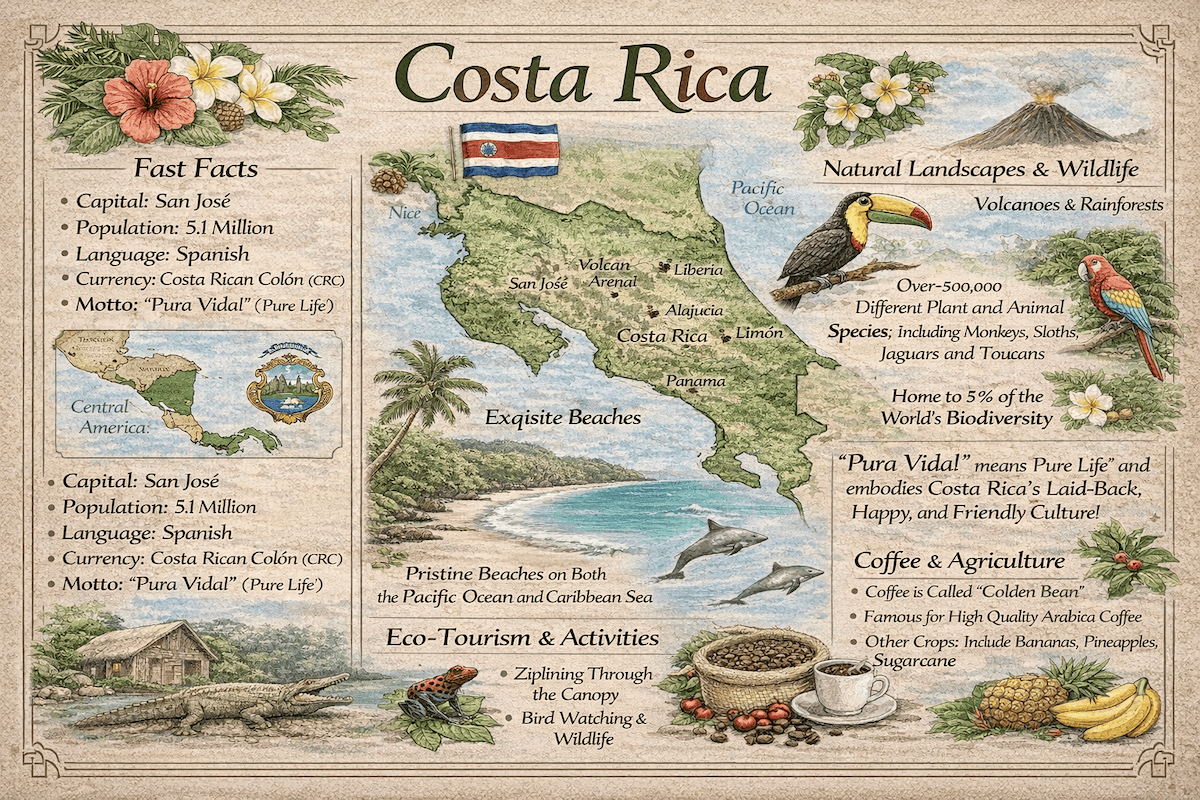
Feel free to share this Costa Rica infographic on your website or blog. Please include a link back to this page as the source.

This initiative proposes the creation of a biological preserve within Costa Rica’s protected forest system—a forward-thinking conservation model designed to safeguard endangered Brazilian rainforest tree species outside their increasingly threatened native range. As deforestation, climate pressure, and illegal harvesting continue to impact critical habitats, establishing protected “satellite ecosystems” offers a powerful strategy for preserving rare genetics and ensuring long-term species survival.
Costa Rica is uniquely positioned to serve as this safe haven. Internationally recognized for its leadership in conservation, biodiversity protection, and sustainable forest management, the country has successfully restored large portions of its forest cover through national parks, biological reserves, and innovative environmental policies. Its stable governance, strong environmental protections, and diverse microclimates make it an ideal location to host and nurture high-value and at-risk tropical tree species.
The proposed preserve would function as a living gene bank, protecting the genetic integrity of endangered species such as Brazilian rosewood (Dalbergia nigra) while creating a controlled environment for propagation and long-term study. By cultivating these trees in protected conditions, the preserve reduces pressure on wild populations while enabling responsible research into growth patterns, disease resistance, and climate adaptability.
Beyond preservation, the project is designed as a multi-dimensional platform for education, research, and regenerative development. It can support:
By bridging conservation with education and sustainable economics, this biological preserve represents more than protection—it is a scalable model for global forest restoration. It demonstrates how countries like Costa Rica can play a critical role in preserving endangered species not only within their borders, but as part of a broader international effort to protect the world’s most valuable and vulnerable tree ecosystems.
For some international investors, Costa Rica timber investment can offer more than exposure to long-duration natural assets. Depending on the structure, size, and legal qualification of the investment, certain forestry, reforestation, land, or business investments may also support an application for temporary investor residency in Costa Rica.
Costa Rica’s investor residency category is designed for foreign nationals who make a qualifying investment in the country. Recent guidance and legal commentary consistently describe a general threshold of US$150,000 for qualifying investments, while some sources note that certain forestry plantation projects have historically been discussed under specialized treatment. Because immigration rules, documentation standards, and qualifying asset structures can change, any residency strategy should be reviewed with qualified Costa Rican immigration and legal counsel before capital is committed.
Residency eligibility does not arise simply from an interest in timber or conservation. The investment must be structured in a way that satisfies Costa Rica’s current immigration rules, ownership requirements, and documentation standards. Investors should treat residency as a potential strategic benefit of a properly qualified project—not as a substitute for formal legal advice.
In the context of this project, that means the residency conversation should be positioned as part of a broader natural capital strategy: investment in protected land, productive forestry systems, nursery infrastructure, reforestation assets, or approved project structures may support both long-term asset development and, in some cases, a lawful residency pathway.
This is particularly relevant for investors who want more than passive exposure. Costa Rica offers a compelling combination of political stability, strong environmental governance, tropical growing conditions, and global conservation credibility. For families, founders, and long-horizon investors, that creates the possibility of aligning capital deployment, land stewardship, and residency planning within one jurisdiction.
For this reason, investment in timber residency should be understood as a strategic layer—not the primary thesis. The core thesis remains the same: build valuable, climate-aligned, biologically productive tree-based assets in a jurisdiction known for environmental leadership. Residency, where available, can be an additional advantage for qualified participants.
At the heart of this initiative is a focused commitment to Brazilian rosewood (Dalbergia nigra)—one of the most revered and critically endangered hardwood species in the world. Once abundant across Brazil’s Atlantic rainforest, this extraordinary tree became synonymous with luxury, craftsmanship, and musical excellence. Its deep, rich coloration, complex grain patterns, and unmatched tonal qualities made it the material of choice for fine furniture, heirloom pieces, and high-end instruments. Today, however, decades of overharvesting have pushed the species to the brink, placing it under the highest level of international protection.
This project seeks to reverse that trajectory by establishing a protected cultivation program in Costa Rica’s compatible tropical zones, effectively creating a “backup forest” for Brazilian rosewood. By relocating propagation efforts to a stable and conservation-driven environment, the initiative reduces pressure on remaining wild populations while ensuring that the species’ genetic legacy is preserved and strengthened.
Restoration efforts will be guided by careful seed sourcing, genetic selection, and advanced propagation techniques. Emphasis will be placed on maintaining genetic diversity, improving resilience, and adapting planting strategies to local microclimates. Through a combination of nursery cultivation, phased field planting, and long-term forest management, these trees will be re-established within a secure and protected sanctuary designed for multi-generational growth.
Beyond preservation, Brazilian rosewood serves as a powerful flagship species for broader conservation efforts. Its story highlights the consequences of unsustainable extraction while offering a path forward rooted in restoration, stewardship, and innovation. As these trees mature, they will contribute not only to biodiversity and habitat creation, but also to carbon sequestration, ecological balance, and the long-term viability of sustainable hardwood systems.
In this way, the project transforms Brazilian rosewood from a symbol of depletion into a living model of regeneration—demonstrating how endangered species can be protected, restored, and responsibly integrated into the future of global forestry.
Central to the initiative is the deployment of proprietary agroforestry technology designed to accelerate tree growth while restoring forest ecosystems. Key components include:
Together, these systems can shorten the time needed to establish healthy forest structure, increase carbon capture potential, and strengthen long-term ecological restoration outcomes. The broader goal is to show how technology-driven rewilding can support both biodiversity recovery and climate-smart land stewardship.
Beyond ecological goals, the project is designed to create meaningful social and economic value through:
This approach helps ensure that restoration is not imposed from the outside, but developed as a shared mission that supports local livelihoods, cultural knowledge, and long-term community participation.
This initiative supports multiple UN SDGs, directly linking forest conservation to global priorities:
SDG 13 – Climate Action: Accelerates reforestation and carbon offsetting.
SDG 15 – Life on Land: Preserves endangered species and restores biodiversity.
SDG 8 – Decent Work and Economic Growth: Creates green jobs and rural economic opportunities.
SDG 12 – Responsible Consumption and Production: Encourages sustainable timber cultivation.
SDG 17 – Partnerships for the Goals: Fosters international cooperation in environmental preservation.
This calculator allows token holders to gain insights into potential long-term returns and track the appreciation of their investment as the plantation matures. The token’s worth evolves alongside the trees, ensuring transparency and real-world asset growth.
This forward-looking conservation model demonstrates how climate-compatible relocation, smart forest technology, and transnational collaboration can reimagine the future of endangered species protection. In focusing on Brazilian rosewood, the project highlights how the fate of one tree can represent the health of an entire biome. It’s not just about saving a species—it’s about rebuilding forests, restoring balance, and redefining global stewardship.
Whether you are a policymaker, investor, scientist, or concerned citizen, this project is an invitation to engage in meaningful, high-impact environmental action. Together, we can protect biodiversity, empower communities, and regenerate forests - one tree, one preserve, and one planet at a time.
Copyright © All rights reserved Tree Plantation



