


 INVEST
 PLANT
PLANT
 SOFTWOODS
 HARDWOODS
 CALCULATORS
 RESOURCES
 PROGRAMS

Softwoods
Learn More
BIODIVERSITY • HOTSPOTS • CONSERVATION
Wondering what biodiversity hotspots are and why they matter? Biodiversity hotspots are regions with exceptionally high numbers of endemic species found nowhere else on Earth that have also lost a large portion of their natural habitat. These areas are among the highest priority regions for global conservation.
🌍 Quick answer: Biodiversity hotspots matter because they protect rare species, ecosystem stability, climate regulation, and essential natural resources despite covering only a small percentage of the Earth’s surface.
Although biodiversity hotspots cover a relatively small portion of the planet, they support a disproportionate share of the world’s plant and animal species.
These ecosystems help sustain clean water, pollination, climate regulation, medicine, and food systems, making them essential not just for wildlife—but for human survival.
Protecting hotspots means preserving irreplaceable ecosystems that cannot be recreated once lost.
The concept of biodiversity hotspots was introduced by ecologist Norman Myers in 1988 to identify regions where conservation efforts would have the greatest impact. Today, hotspots are defined by both their biological richness and the extent of habitat loss they have experienced.
These regions are home to high concentrations of endemic plants and animals—species that exist nowhere else on Earth. Because of this, biodiversity hotspots represent irreplaceable reservoirs of life and play a critical role in maintaining ecosystem balance, climate stability, and global biodiversity.
Key insight: Biodiversity hotspots may occupy a small footprint, but they hold a massive share of the planet’s biological value—making their protection essential.
Endemic species are unique plants and animals that are found exclusively in a particular geographic area and nowhere else in the world. These species evolve in isolation over long periods, shaped by the specific climate, geography, and ecological conditions of their environment. This isolation often leads to highly specialized adaptations that make them uniquely suited to their habitat—but also highly vulnerable to change.
Many endemic species are concentrated within biodiversity hotspots—regions that are both biologically rich and under significant threat from deforestation, climate change, and human development. These hotspots are essential because they contain a high percentage of the world’s rare and irreplaceable life forms within relatively small geographic areas.
The importance of endemic species goes beyond their rarity. They often play critical roles in maintaining ecosystem stability, including pollination, seed dispersal, soil health, and serving as key links in food chains. The loss of even a single endemic species can trigger cascading effects, disrupting entire ecosystems and reducing biodiversity resilience.
For example, the Galápagos Islands are one of the most famous biodiversity hotspots in the world. They are home to the iconic Galápagos tortoise, known for its large size and remarkable lifespan. Each island hosts distinct subspecies that have evolved to match local environmental conditions.
Another extraordinary example is the Galápagos marine iguana—the only sea-going lizard on Earth. These iguanas have developed unique adaptations, including the ability to swim, dive, and feed on marine algae, demonstrating how isolation can drive evolutionary innovation.
Another powerful example can be found in Costa Rica , a country that lies within the Mesoamerican biodiversity hotspot. Despite its small size, Costa Rica is home to an extraordinary range of endemic and highly specialized species, particularly in its tropical rainforests and cloud forests.
One notable example is the resplendent quetzal, a striking bird revered for its vibrant green plumage and long tail feathers. Found primarily in high-elevation cloud forests, the quetzal depends on specific tree species for food and nesting, highlighting the delicate relationships that define hotspot ecosystems.
Costa Rica is also home to unique amphibians such as the red-eyed tree frog, known for its vivid coloration and nocturnal behavior. These species have evolved to thrive in highly specific microclimates, making them especially sensitive to environmental changes such as deforestation and climate shifts.
These examples demonstrate how biodiversity hotspots like Costa Rica support not only a high number of species, but also highly specialized organisms whose survival depends on the preservation of their natural habitats.
These examples highlight a broader truth: protecting endemic species means protecting entire ecosystems. By conserving biodiversity hotspots, we preserve not only rare species but also the ecological processes that support life on Earth.
Feel free to share this diversity hotspots infographic on your website or blog. Please include a link back to this page as the source.
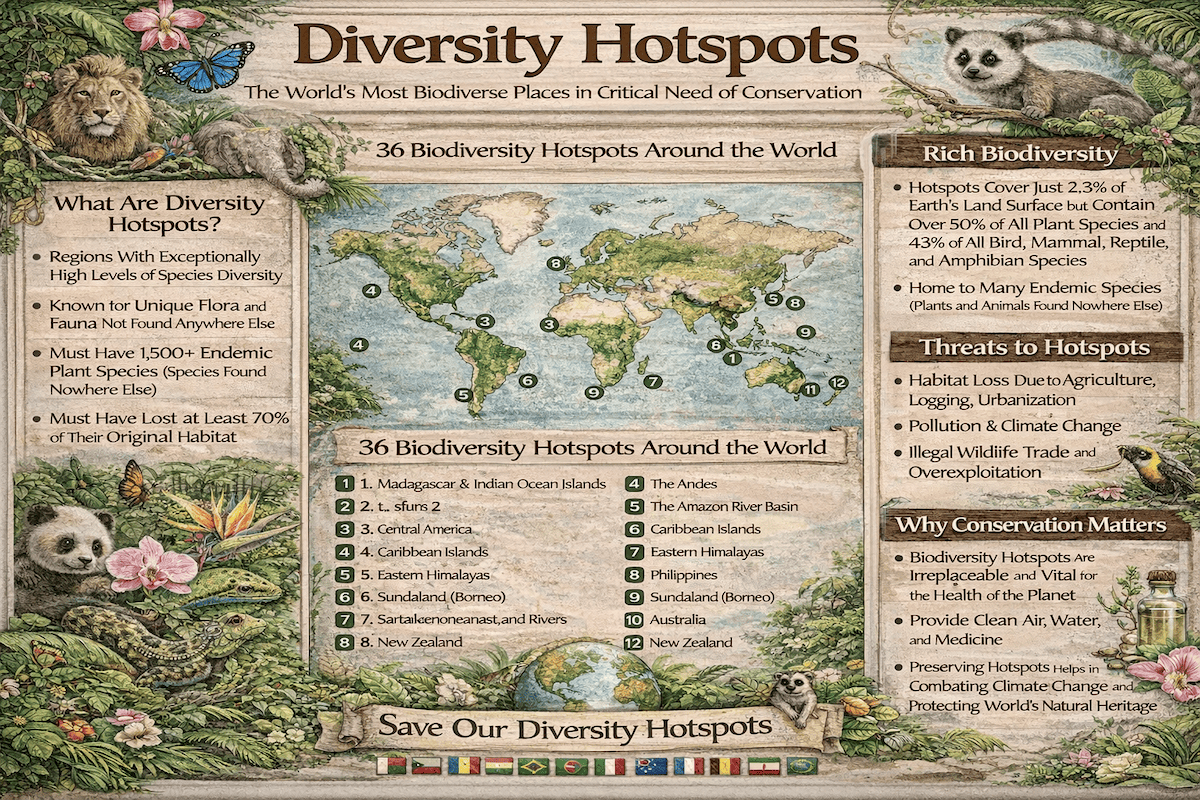

Biodiversity hotspots are distributed across every continent, with the highest concentrations found in tropical forests, island ecosystems, mountainous regions, and coastal zones. While they cover only a small fraction of the Earth's surface, they contain a remarkable share of global biodiversity.
Below is a simplified global overview of major biodiversity hotspot regions. Each plays a critical role in supporting endemic species, regulating climate systems, and maintaining ecological balance.
Includes the Amazon Rainforest, Tropical Andes, Mesoamerica, and Caribbean Islands—home to some of the highest biodiversity densities on Earth.
Features Madagascar, the Eastern Afromontane region, and the Congo Basin, rich in endemic wildlife, rare forests, and globally important carbon-storing ecosystems.
Includes Southeast Asia, Sundaland, Wallacea, and the Coral Triangle—recognized as the epicenter of marine biodiversity and tropical rainforest diversity.
Islands such as Madagascar, Hawaii, and Pacific archipelagos contain extremely high levels of endemic species due to long-term geographic isolation.
Regions like the Himalayas and Andes create unique microclimates that support specialized species adapted to narrow ecological conditions.
Coral reefs, mangroves, and coastal ecosystems—especially in the Coral Triangle—support immense biodiversity and provide food security for millions of people.
These regions are not isolated—they are deeply interconnected through global climate systems, migration patterns, and ecological processes. The loss of biodiversity in one hotspot can have ripple effects across the planet, impacting food systems, water resources, climate stability, and economic livelihoods.
Protecting biodiversity hotspots is therefore not just about conserving nature—it is about preserving the life-support systems that sustain humanity.

The Amazon Rainforest is one of the most important biodiversity hotspots on Earth, containing an extraordinary concentration of plant and animal life found across a vast mosaic of forests, rivers, wetlands, and floodplains. Spanning more than 5.5 million square kilometers across nine South American countries, the Amazon supports roughly 10% of all known species on the planet, making it one of the greatest living reservoirs of biodiversity ever known.
This immense tropical system is home to an astonishing range of organisms, from iconic mammals such as jaguars and pink river dolphins to brilliantly colored macaws, rare orchids, giant trees, and countless aquatic species. The Amazon also shelters extraordinary plant life such as the Amazonian water lily, famous for its enormous floating leaves and remarkable adaptation to slow-moving tropical waters. These unique species help illustrate the Amazon’s ecological richness and the evolutionary creativity that thrives in stable, complex rainforest environments.
In addition to its larger and more visible wildlife, the Amazon is sustained by millions of smaller organisms that are equally important to ecosystem function. Vast populations of forest insects drive pollination, decomposition, nutrient cycling, and food-web stability, while amphibians such as tree frogs play critical roles as both predators and prey in rainforest canopies and wetlands. These often-overlooked species are essential indicators of ecosystem health and are highly sensitive to habitat disruption, pollution, and climate instability.
The Amazon’s biodiversity is not only biologically impressive—it is also globally important. Its forests help regulate rainfall patterns across South America, store immense quantities of carbon, influence atmospheric circulation, and support freshwater systems that millions of people depend on. The region also contains thousands of plants with nutritional, medicinal, and scientific value, many of which remain understudied or undiscovered. Protecting the Amazon therefore means protecting one of the world’s most important natural systems for climate regulation, ecological stability, and future biological discovery.
Yet despite its global importance, the Amazon faces escalating threats from deforestation, illegal mining, road expansion, land conversion, fires, and climate change. As habitat fragments and ecological stress intensifies, many endemic and highly specialized species become increasingly vulnerable. This makes conservation, restoration, and sustainable land stewardship essential not only for the Amazon itself, but for the long-term health of the planet.

Madagascar and the Indian Ocean Islands represent one of the most unique and fragile biodiversity hotspots on Earth. Due to millions of years of geographic isolation, Madagascar has evolved an extraordinary array of endemic species—approximately 90% of its wildlife exists nowhere else on the planet. From lemurs and chameleons to baobab trees and rare forest ecosystems, this region stands as a powerful example of how biodiversity hotspots function as centers of evolution, adaptation, and ecological specialization.
Yet this remarkable biodiversity exists alongside growing environmental and humanitarian challenges. Southern Madagascar has experienced severe and prolonged drought, contributing to widespread food insecurity and famine. As explored in Madagascar drought and famine relief efforts , the loss of vegetation, soil degradation, and shifting climate patterns are deeply interconnected with human survival. When ecosystems collapse, communities lose access to food, water, and stable livelihoods.
Water scarcity is one of the most critical challenges facing the region. Innovative, low-cost solutions such as rainwater harvesting techniques are helping communities capture and store seasonal rainfall, improving resilience in areas where water access is unpredictable. These approaches not only support agriculture and health, but also reduce pressure on surrounding ecosystems, allowing degraded landscapes to begin recovering.
At the same time, broader global agricultural practices are contributing to ecosystem stress beyond Madagascar. Excess fertilizer use, for example, has been linked to widespread nutrient runoff that flows into rivers and oceans, fueling algal blooms and creating oxygen-depleted “dead zones” where marine life cannot survive. This growing issue is explored in fertilizers impacting ocean ecosystems . Scientific research shows that excess nitrogen and phosphorus from fertilizers can trigger algal overgrowth, which depletes oxygen and harms aquatic life.
These interconnected challenges highlight a critical reality: biodiversity loss, water scarcity, and unsustainable agricultural practices are not isolated issues—they are part of a global system that directly affects both ecosystems and human communities. In Madagascar, as in many biodiversity hotspots, solutions must address all of these factors together.
Conservation efforts are increasingly focused on integrated strategies—combining reforestation, water management, sustainable agriculture, and community-led initiatives to restore ecological balance. By protecting forests, improving water systems, and reducing harmful inputs into the environment, it is possible to preserve these fragile ecosystems while building long-term resilience for the people who depend on them.
This case study serves as both a warning and a model: protecting biodiversity hotspots requires solutions that connect environmental restoration with human well-being. Madagascar’s future—and the future of many similar regions—depends on our ability to restore this balance.

The South Pacific Islands are among the most ecologically unique and vulnerable biodiversity hotspots on Earth. These islands support extraordinary levels of endemism, with species that evolved in isolation over thousands of years. From coral reef systems and coastal forests to inland tropical ecosystems, the region is rich in biodiversity—but also highly sensitive to environmental change.
Today, many of these island ecosystems face mounting pressure from invasive species, overfishing, land degradation, and climate change. Rising sea levels and ocean acidification are already impacting coral reefs, coastal habitats, and freshwater systems, threatening both biodiversity and the communities that depend on these environments for food and survival.
Across the Pacific, these environmental challenges are closely tied to food security. Many island nations rely heavily on imported food, making them vulnerable to supply disruptions, rising costs, and nutritional challenges. Initiatives like Feed An Island are working to address this by promoting sustainable, locally grown food systems that reduce dependence on imports while restoring ecological balance.
In Nauru, for example, decades of phosphate mining have left large portions of the island environmentally degraded, limiting agricultural potential and food production. Efforts highlighted at Feed An Island Nauru focus on rebuilding soil health, restoring productive land, and introducing efficient growing systems that can thrive even in challenging conditions.
In Hawaii, a different but equally urgent set of challenges exists. Once self-sufficient, the islands now import a significant percentage of their food, leaving them vulnerable to supply chain disruptions. Programs such as Feed An Island Hawaii aim to revitalize local agriculture, strengthen food resilience, and reconnect communities with sustainable land-use practices that support both people and ecosystems.
Similar approaches are being explored in other regions facing ecological stress and food insecurity. In Madagascar, where biodiversity loss and drought intersect, Feed An Island Madagascar highlights the importance of integrating conservation, water management, and regenerative agriculture to restore both ecosystems and livelihoods.
These examples illustrate a critical global insight: protecting biodiversity hotspots requires more than conservation alone. It requires integrated solutions that address food security, land restoration, water management, and sustainable agriculture. By rebuilding local food systems and reducing environmental pressures, island communities can become more resilient while preserving the unique ecosystems that make them so valuable.
The South Pacific Islands stand as both a warning and an opportunity—demonstrating the urgency of environmental action, and the powerful potential of innovative, community-driven solutions to restore balance between people and nature.

Borneo and the Coral Triangle represent one of the most biologically rich regions on Earth, spanning tropical rainforests, mangrove systems, and some of the most diverse marine ecosystems ever recorded. The Coral Triangle—covering parts of Indonesia, Malaysia, the Philippines, Papua New Guinea, Timor-Leste, and the Solomon Islands—is widely recognized as the global epicenter of marine biodiversity, containing over 75% of the world’s coral species and thousands of species of fish, mollusks, and marine invertebrates.
These ecosystems are not only ecologically extraordinary but also essential to human survival. Coral reefs and coastal habitats provide food, storm protection, and economic livelihoods for millions of people across Southeast Asia and the Pacific. Mangroves and seagrass beds serve as critical nursery habitats, supporting fisheries that sustain both local communities and global seafood markets.
However, this region faces mounting pressure from overfishing, destructive fishing practices, coastal development, pollution, and climate change. Rising ocean temperatures are causing widespread coral bleaching, while ocean acidification weakens reef structures and reduces their ability to recover. At the same time, land-based agricultural runoff is increasingly contributing to marine ecosystem decline. Excess nutrients from fertilizers can wash into rivers and coastal waters, fueling algal blooms that deplete oxygen and create “dead zones” where marine life cannot survive. This growing global issue is explored in fertilizers impacting ocean ecosystems , highlighting how unsustainable agricultural practices on land can directly affect ocean health.
The degradation of coral reefs has far-reaching consequences. Beyond the loss of unique marine species, reef collapse reduces fish populations, weakens coastal protection, and threatens food security for millions of people who rely on these ecosystems. As biodiversity declines, the resilience of both natural systems and human communities is significantly reduced.
In response, conservation efforts are increasingly focusing on integrated solutions that address both land and sea. Initiatives such as rewilding island ecosystems emphasize restoring native vegetation, rebuilding soil health, and reducing harmful inputs that ultimately impact surrounding marine environments. By reconnecting terrestrial and marine conservation strategies, these approaches aim to restore ecological balance across entire island systems.
This case study highlights a critical global insight: the health of marine ecosystems is directly tied to how we manage land-based systems. Protecting biodiversity hotspots like Borneo and the Coral Triangle requires coordinated efforts that reduce pollution, restore habitats, and promote sustainable practices both on land and in the ocean.
As one of the most important marine biodiversity regions on Earth, the Coral Triangle stands as both a warning and an opportunity—demonstrating the urgency of protecting these ecosystems and the potential to restore them through innovative, integrated conservation strategies.

Climate change is one of the most significant and far-reaching threats to biodiversity hotspots worldwide. As global temperatures rise and weather patterns become more unpredictable, ecosystems are undergoing rapid transformations that disrupt the delicate balance required for many species to survive. Even small shifts in temperature or rainfall can alter flowering cycles, migration patterns, breeding seasons, and food availability—creating cascading effects throughout entire ecosystems.
In marine environments, these impacts are especially visible. Coral reef systems, such as the Great Barrier Reef, are experiencing widespread coral bleaching as rising ocean temperatures stress coral organisms and cause them to expel the symbiotic algae they depend on. Ocean acidification further weakens reef structures, reducing their ability to support marine biodiversity and protect coastlines.
On land, mountainous regions like the Himalayas are also being reshaped by climate change. As temperatures rise, many species are forced to migrate to higher elevations in search of suitable habitat. However, for species already living near mountain peaks, there is often nowhere left to go. These shifts can create mismatches between species and their environment, reducing survival rates and increasing the risk of extinction.
In addition to gradual changes, extreme weather events—such as hurricanes, droughts, floods, and wildfires—are becoming more frequent and intense. These events can rapidly degrade habitats, fragment ecosystems, and place additional stress on already vulnerable species within biodiversity hotspots.
At the same time, invasive species represent another major and often underestimated threat. Introduced through global trade, travel, and human activity, non-native species can outcompete, prey upon, or introduce diseases to native populations. Because many hotspot ecosystems evolved in isolation, native species often lack the defenses needed to compete with aggressive invaders.
For example, in the Galápagos Islands, the introduction of goats, rats, and other invasive species has severely disrupted native ecosystems, contributing to the decline of endemic species such as the Galápagos tortoise. These disruptions can unravel entire ecological networks, affecting plant life, soil systems, and food chains.
Invasive plant species can be particularly destructive. Trees such as the Australian paperbark and related invasive species have altered water flow patterns and outcompeted native vegetation in sensitive ecosystems like Florida’s Everglades. By changing hydrology and shading out native plants, invasive trees can transform entire landscapes, reducing biodiversity and degrading habitat quality.
Together, climate change and invasive species create a compounding effect. As ecosystems become stressed by shifting climate conditions, they often become more vulnerable to invasion, accelerating biodiversity loss. This highlights a critical need for integrated solutions that address both global environmental change and local ecosystem management.
Protecting biodiversity hotspots requires coordinated efforts to reduce greenhouse gas emissions, manage invasive species, restore native habitats, and promote sustainable land and water practices. Without these actions, many of the world’s most unique and fragile ecosystems face an uncertain future.

These examples—and many others like them—underscore the importance of effective management and control of invasive species, alongside meaningful climate change mitigation efforts, to protect the ecological integrity of biodiversity hotspots. However, long-term success depends not only on protection, but also on restoration. Healthy ecosystems begin with healthy soils, water systems, and vegetation.
In many regions, rebuilding ecological resilience starts from the ground up. For example, the restoration of nutrient-rich soils such as prairie black soil systems demonstrates how regenerative land practices can improve fertility, increase carbon storage, and support diverse plant and animal life. These types of soil systems are foundational to sustainable agriculture, ecosystem recovery, and long-term biodiversity protection.
Protected areas and marine parks serve as essential sanctuaries for conserving the rich biodiversity found in hotspots around the world. These designated zones help safeguard ecosystems by protecting natural habitats from deforestation, development, overfishing, and other external pressures, allowing species to survive and ecosystems to function more naturally.
On land, protected areas such as Yellowstone National Park in the United States provide critical refuge for wildlife, including grizzly bears, wolves, bison, and countless other species. As one of the world’s first national parks, Yellowstone demonstrates how large-scale conservation can preserve entire ecosystems, maintain predator-prey relationships, and protect natural processes over long periods of time.
In marine environments, protected zones such as marine parks and no-take reserves play an equally important role. By limiting fishing, pollution, and habitat destruction, these areas allow coral reefs, fish populations, and marine ecosystems to recover and thrive. Healthy marine protected areas can replenish surrounding waters, supporting both biodiversity and sustainable fisheries.
However, protected areas alone are not enough. To truly preserve biodiversity hotspots, conservation efforts must extend beyond park boundaries to include sustainable land management, soil restoration, water conservation, and community-driven stewardship. When combined, these strategies create resilient ecosystems capable of withstanding environmental pressures while continuing to support both wildlife and human communities.

Similarly, the Serengeti National Park in Tanzania is one of the most iconic biodiversity hotspots in the world, supporting vast savanna ecosystems and protecting species such as the African elephant and the endangered black rhinoceros. This region is part of a broader network of African tree ecosystems that sustain wildlife, stabilize soils, and support local communities. Many of these landscapes are also home to valuable hardwoods such as African zebrawood, black ebony, mahogany trees, and sandalwood, all of which are increasingly threatened by unsustainable harvesting and habitat loss.
The Great Barrier Reef Marine Park in Australia is equally critical, protecting the largest coral reef system on Earth and supporting thousands of marine species. However, both terrestrial and marine hotspots face similar pressures from deforestation, pollution, overexploitation, and climate change, which continue to degrade ecosystems and reduce biodiversity resilience.
The success of these protected areas often depends on the implementation of strong regulations and effective management practices that limit activities such as logging, mining, overfishing, and unsustainable tourism. Monitoring and enforcement are essential to prevent habitat destruction and ensure long-term ecosystem stability.
Collaboration is equally important. Joint efforts between governments, conservation organizations, scientists, and local communities help balance ecological preservation with human livelihoods. Community-based conservation initiatives—where local populations actively participate and benefit—have proven particularly effective in protecting biodiversity while improving economic resilience.
In many regions, conservation is now paired with restoration strategies that include planting drought-tolerant tree species and rebuilding degraded landscapes. These approaches not only restore ecosystems but also improve water retention, soil health, and climate resilience in vulnerable environments.
Through these combined efforts, protected areas and marine parks continue to serve as critical strongholds for biodiversity, safeguarding ecosystems that support both wildlife and human communities across the globe.
While protected areas are essential, long-term conservation success depends on active restoration and sustainable management. Across the world, restoration projects are working to rebuild degraded ecosystems, reconnect fragmented habitats, and restore ecological balance.
For example, the Sundarbans Reserve Forest in Bangladesh and India—the largest mangrove forest in the world—plays a critical role in protecting coastal biodiversity and supporting species such as the Bengal tiger. Mangrove systems also act as natural barriers against storms and rising sea levels, demonstrating how biodiversity hotspots provide both ecological and human benefits.
In Hawaii, the Papahānaumokuākea Marine National Monument protects vast marine ecosystems and endangered species, highlighting the importance of large-scale conservation zones in preserving ocean biodiversity.
These efforts must be supported by strong enforcement to combat threats such as illegal wildlife trafficking, resource extraction, and unsustainable tourism. At the same time, the integration of indigenous knowledge and traditional land management practices has proven highly effective, particularly in regions like the Amazon, where indigenous stewardship has helped preserve biodiversity for generations.
Biodiversity hotspots are essential to the health and stability of the Earth's ecosystems. They are not only home to a vast number of species but also provide critical ecosystem services that sustain life on Earth.
These regions play a key role in carbon sequestration, helping to mitigate the impacts of climate change. Forests in the Amazon and Congo basins act as major carbon sinks, absorbing large amounts of CO₂ and regulating global climate systems.
In addition to carbon storage, biodiversity hotspots support water purification, soil health, and pollination. These processes are essential for maintaining the water cycle, supporting agriculture, and sustaining food systems worldwide.
The interconnectedness of global ecosystems means that biodiversity loss in one region can have far-reaching consequences. For example, the decline of insect pollinators due to habitat loss can disrupt food production globally, while the degradation of marine ecosystems can impact fish stocks and coastal communities.
This interconnected reality underscores the urgent need to protect biodiversity hotspots not only for conservation, but for global ecological stability, food security, and climate resilience.
Protecting these regions requires coordinated action at local, regional, and global levels. It also requires continued investment in ecological research, sustainable land management, and restoration strategies that rebuild natural systems while supporting human communities.
By safeguarding biodiversity hotspots, we protect not only the world’s most unique species but also the life-support systems that sustain the planet.
Measure the biodiversity strength of your garden, farm, or landscape. Evaluate species variety, ecological balance, and resilience potential— then receive a clear diversity score with improvement insights.
A biodiversity hotspot is a region with an exceptionally high number of endemic species—plants and animals found nowhere else on Earth—that has also experienced significant habitat loss. These areas are considered top global priorities for conservation.
There are currently 36 recognized biodiversity hotspots worldwide. Together, they cover only about 2–3% of Earth’s land surface but support more than half of the world’s plant species and a large share of terrestrial wildlife.
Biodiversity hotspots are critical for maintaining ecosystem stability, climate regulation, water cycles, and food systems. They also provide essential ecosystem services such as pollination, carbon storage, and soil health.
Hotspots are found across the globe, including regions such as the Amazon Rainforest, Madagascar, Southeast Asia, Central America, and the Mediterranean Basin. Many are located in tropical and island ecosystems.
Major threats include deforestation, habitat destruction, overexploitation of resources, pollution, and rapid urban expansion. These pressures continue to reduce biodiversity and fragment ecosystems.
Climate change alters temperature, rainfall patterns, and ecosystems, forcing species to migrate or adapt. Many endemic species cannot relocate, increasing the risk of extinction.
Invasive species often outcompete native species, disrupt ecosystems, and introduce diseases. Because hotspot species evolved in isolation, they are especially vulnerable to these threats.
Famous examples include the Galápagos Islands, Madagascar, the Amazon Basin, the Coral Triangle, and the Cape Floristic Region in South Africa—each known for unique and highly specialized species.
Protection strategies include national parks, marine reserves, reforestation, sustainable agriculture, and community-based conservation programs that involve local populations in ecosystem stewardship.
Trees are foundational to hotspot ecosystems. They provide habitat, regulate climate, store carbon, support wildlife, and maintain soil and water systems. Many hotspots depend on forest ecosystems to function properly.
Individuals can help by supporting sustainable products, reducing deforestation-linked consumption, planting trees, conserving water, and contributing to conservation and restoration initiatives.
Copyright © All rights reserved Tree Plantation