


 INVEST
 PLANT
PLANT
 SOFTWOODS
 HARDWOODS
 CALCULATORS
 RESOURCES
 PROGRAMS

Softwoods
Learn More
WOOD SHIPS • HISTORY • SHIPBUILDING
Wondering why wooden ships were so important in history? For centuries, wooden ships were the backbone of exploration, trade, and naval power— carrying people, goods, and ideas across the world’s oceans.
⚓ Quick answer: Wooden ships were used for exploration, warfare, trade, and migration, built from carefully selected hardwoods and softwoods for strength, flexibility, and durability at sea.
Examples: Famous wooden ships include HMS Victory, Vasa, the Mayflower, and historic merchant vessels that shaped global trade routes and naval history.
Wooden ships occupy a legendary place in human history. Long before steel hulls and modern engines, these remarkable vessels carried explorers across unknown oceans, delivered merchants and settlers to distant shores, and served as floating fortresses in times of war.
Large wooden warships required thousands of trees—especially oak—for a single vessel, linking historic shipbuilding directly to forest management and timber supply.
Built by highly skilled shipwrights using hand tools and deep knowledge of timber, wooden ships represented the height of engineering in their era. The same craftsmanship seen in historic shipyards reflects the legacy of Middle Age carpentry tools , where axes, adzes, augers, chisels, mallets, and hand saws were essential for shaping structural timbers.
From mighty warships to ambitious royal flagships, the world’s most famous wooden vessels tell stories of courage, innovation, risk, and human ambition. Their hulls were formed from carefully selected hardwoods and softwoods, chosen for strength, flexibility, and resistance to decay.
One of the most iconic wooden warships ever built is the HMS Victory. Launched in 1765, this legendary British warship became forever linked to the Battle of Trafalgar in 1805, where Admiral Lord Nelson led the Royal Navy to one of its most decisive victories.
Constructed primarily from strong, durable oak trees, HMS Victory was designed to withstand cannon fire, rough seas, and the punishing demands of naval warfare. Its massive timber frame, towering masts, and formidable line of guns made it one of the finest examples of wooden naval architecture from the Age of Sail.
HMS Victory also represents the extraordinary labor behind wooden ship construction. Shipbuilders had to season timber, bend planks, carve joints, and fasten massive structural members with incredible precision—much of it using traditional woodworking techniques.
Another famous wooden warship is the Vasa, commissioned by King Gustavus Adolphus of Sweden in the early 17th century. Built as a powerful symbol of Swedish ambition and naval dominance, the Vasa was lavishly decorated and heavily armed.
Despite its grand design, the Vasa became one of maritime history’s most famous disasters when it sank on its maiden voyage in 1628, only minutes after leaving harbor.
Salvaged in 1961 after more than three centuries on the seabed, the ship was astonishingly well preserved. Today, it offers a rare glimpse into 17th-century shipbuilding, naval design, and woodworking methods— standing as both a cautionary tale and a remarkable achievement of wooden engineering.
Key insight: Wooden ships were not just vessels—they were massive timber structures that connected forests, craftsmanship, and global exploration.
Feel free to share this famous wooden ships infographic on your website or blog. Please include a link back to this page as the source.
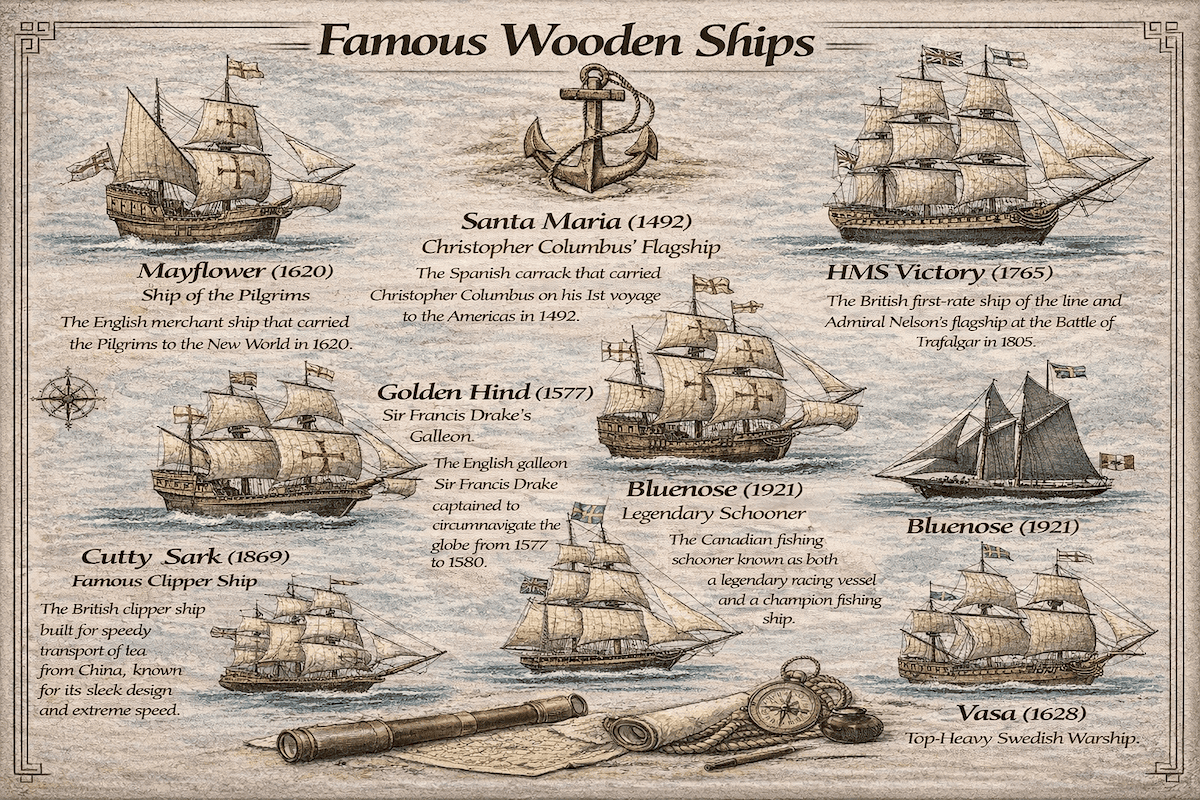

While warships demonstrated power and dominance, wooden ships built for exploration helped reshape the world. These vessels carried navigators, settlers, and visionaries across vast and often unknown oceans, relying entirely on wind, craftsmanship, and the strength of timber. Their construction demanded not only exceptional design, but also carefully selected woods—often hardwoods known for durability, flexibility, and resistance to rot in harsh marine environments.
The Mayflower is perhaps the most famous wooden ship associated with early American exploration and settlement. In 1620, this relatively modest but resilient vessel carried the Pilgrims across the stormy Atlantic Ocean to the New World. Built to endure long voyages, ships like the Mayflower depended on dense hardwood framing and tightly sealed planking to remain seaworthy. The success of its journey marked the beginning of the Plymouth Colony and a pivotal moment in American history, demonstrating how wooden ships enabled migration, trade, and cultural exchange across continents.
Another legendary exploration vessel is the Santa María, the flagship of Christopher Columbus’s 1492 expedition. This ship helped initiate one of the most consequential voyages in human history, connecting Europe to the Americas and ushering in a new era of global exploration. Like many ships of its time, the Santa María relied on strong, water-resistant timbers to withstand long ocean crossings. Shipbuilders often favored woods that resisted decay and marine organisms—qualities found in species similar to black locust, a hardwood known for its exceptional strength, rot resistance, and natural durability in wet conditions.
Captain James Cook’s HMS Endeavour, launched in 1764, represents another milestone in exploration. Originally built as a sturdy coal transport vessel, it was later refitted for long-distance scientific voyages. The Endeavour carried Cook and his crew across the Pacific, where they charted New Zealand and became the first recorded Europeans to reach the eastern coast of Australia. Its robust wooden hull allowed it to navigate reefs, shallow waters, and uncharted coastlines—conditions that demanded both flexibility and strength from the ship’s timber construction.
These exploration ships were not just vehicles of discovery—they were floating testaments to the relationship between forests and human progress. The demand for durable shipbuilding timber influenced forestry practices across Europe and the colonies, shaping landscapes and economies alike. In regions like North America, fast-growing and resilient species spread widely—some becoming so dominant that they are now classified among invasive trees in New York State. This intersection of exploration, timber demand, and ecological change highlights how wooden ships helped shape not only history, but also the forests themselves.

The success of historic wooden ships depended heavily on the selection of the right timber. Shipbuilders carefully chose wood species based on strength, flexibility, resistance to rot, and availability. Each part of a ship—from the keel and ribs to the planking and decking—required specific properties to ensure seaworthiness across long and dangerous voyages.
One of the most important materials in traditional shipbuilding was English oak. Valued for its density, strength, and natural resistance to decay, oak formed the backbone of many famous vessels. Its curved grain made it ideal for framing and ribs, allowing ships to absorb the stresses of waves and cannon fire without splitting. Oak forests were so strategically important that entire regions were managed specifically to supply naval shipyards.
White pine, particularly in North America, played a crucial supporting role in ship construction. Lightweight yet strong, white pine trees were commonly used for masts and spars because they could grow tall, straight, and relatively knot-free. These towering pines helped ships carry vast sail areas, making them faster and more efficient across long ocean crossings.
Ironwood—a term used for several extremely dense hardwood species—was prized for its unmatched strength and durability. In American shipbuilding, species such as American musclewood (ironwood) were valued for components that required exceptional toughness, including keels, frames, and structural reinforcements. This legendary strength is reflected in the nickname “Old Ironsides,” given to the USS Constitution. During the War of 1812, British cannonballs were reportedly seen bouncing off its thick wooden hull, giving the impression that the ship was armored in iron rather than timber.
Teak, a tropical hardwood, became one of the most sought-after shipbuilding materials due to its natural oils and remarkable resistance to water, insects, and decay. Widely used in ship decks and exposed surfaces, teak trees provided a long-lasting, low-maintenance surface that could endure constant exposure to saltwater and harsh weather. Even today, teak remains a premium choice in both traditional and modern boat building.
HMS Victory – Launched on May 7, 1765, HMS Victory remains one of the most celebrated warships in naval history. Built primarily from oak, this formidable vessel served as Admiral Lord Nelson’s flagship during the Battle of Trafalgar in 1805. Its design combined firepower, durability, and maneuverability, helping secure a decisive British victory. Today, HMS Victory is preserved in Portsmouth, UK, offering visitors a rare opportunity to experience an authentic 18th-century warship.
Vasa – The Swedish warship Vasa set sail on August 10, 1628, only to sink minutes into its maiden voyage due to design instability. Despite its brief time at sea, the ship was a masterpiece of craftsmanship, featuring elaborate carvings and heavy armament. Salvaged in 1961, the Vasa is one of the best-preserved wooden ships ever recovered, providing extraordinary insight into 17th-century shipbuilding techniques and materials.
Together, these ships—and the woods used to build them—highlight the deep connection between forestry and maritime history. The choice of timber was not just a construction decision; it was a matter of survival, performance, and national power. From oak-framed warships to pine-masted explorers and teak-decked vessels, the legacy of wooden shipbuilding continues to influence both modern marine design and sustainable forestry practices today.

Mayflower – The Mayflower began its historic voyage on September 6, 1620, sailing from Plymouth, England, with a group of English Separatists later known as the Pilgrims. Bound for the New World, the ship endured a difficult Atlantic crossing marked by storms, cramped conditions, and dwindling supplies. After more than two months at sea, the Mayflower finally reached Cape Cod, Massachusetts, on November 11, 1620. That journey would become one of the most significant in early American history, as the passengers went on to establish Plymouth Colony. Like many ships of its era, the Mayflower relied on strong hardwood framing and durable planking, with timbers such as oak trees playing a critical role in ship strength, stability, and long-term performance in rough ocean conditions.
Santa María – Launched in 1492, the Santa María was the largest of the three ships used by Christopher Columbus on his first transatlantic expedition. As the flagship of the voyage, it carried Columbus across the Atlantic on a journey that permanently changed world history. The ship’s successful westward crossing opened the door to sustained European exploration of the Americas and reshaped global trade, colonization, and cultural exchange. Although the Santa María ran aground on Christmas Day in 1492 near present-day Haiti, its historical legacy far outlasted its short service life. Ships of this class depended on carefully selected timber for their hulls, decks, and internal supports, and European shipbuilders often turned to hardwood species valued for strength and workability, including woods from forests containing species like beech trees and oak, depending on local supply and intended use.
HMS Endeavour – On August 26, 1768, the HMS Endeavour departed on one of the most important exploration voyages of the 18th century under the command of Captain James Cook. Originally built as a sturdy coal transport vessel and later adapted for scientific discovery, the Endeavour crossed the Pacific Ocean and helped chart the coastlines of New Zealand and Australia. The ship also carried botanists, astronomers, and naturalists, making it not only a vessel of navigation but also a floating platform for science and discovery. Its broad hull and durable wooden construction allowed it to survive long distances, unfamiliar reefs, and difficult coastal waters. The Endeavour’s journey significantly expanded European knowledge of the Pacific and stands as one of the great achievements of maritime exploration.
Together, the Mayflower, Santa María, and HMS Endeavour represent three of the most famous wooden exploration ships in history. Each vessel carried people into unknown waters, but each also depended on the practical genius of traditional shipbuilding—where the right timber could mean the difference between survival and disaster. From dense structural hardwoods like oak to other workable forest species such as beech, the forests of Europe helped make the great age of wooden exploration possible.

Jylland – Launched on November 20, 1860, the Jylland is one of the last surviving wooden warships from the transition period between sail and steam. This Danish frigate combined traditional wooden shipbuilding with early steam propulsion, representing a pivotal moment in naval engineering. Serving as a flagship of the Danish Navy, the Jylland participated in key naval conflicts and later became a training vessel for cadets. Its construction relied on strong hardwood framing and resilient planking, with European forests supplying the timber needed to support both sail rigging and steam-era reinforcements. Today, the Jylland is preserved as a museum ship in Denmark, offering a rare and immersive look into 19th-century naval life.
Cutty Sark – Launched on November 22, 1869, the Cutty Sark is one of the most famous clipper ships ever built. Designed for speed, it was part of the competitive tea trade between China and Britain, where fast delivery meant higher profits. With its sleek hull and towering masts, the Cutty Sark became a symbol of maritime innovation and global commerce during the height of the British Empire. Its wooden construction required a careful balance between strength and weight, often incorporating a mix of hardwoods and lighter timbers. Species such as birch trees—valued for their smooth grain and flexibility—were sometimes used in secondary components and interior structures, complementing stronger structural woods in the hull. Today, the Cutty Sark is preserved in Greenwich, London, where it continues to inspire visitors with its elegance and engineering.
Bluenose – Launched on March 26, 1921, the Bluenose was a Canadian racing schooner that quickly rose to international fame. Built for both fishing and racing, the ship combined practical durability with exceptional speed, dominating competitions and earning a reputation as one of the finest sailing vessels ever constructed. Its sleek wooden hull and expertly designed rigging allowed it to outperform rivals, and it became a national icon—so much so that it still appears on the Canadian dime today. Although the original Bluenose was tragically lost at sea in 1946, its legacy lives on through the replica Bluenose II and its enduring place in maritime history.
Together, the Jylland, Cutty Sark, and Bluenose highlight the evolution of wooden ships into the modern era—where craftsmanship, material selection, and design innovation reached their peak. From steam-assisted warships to record-breaking clippers and racing schooners, these vessels demonstrate how the thoughtful use of timber—from dense structural hardwoods to lighter species like birch—continued to shape performance, durability, and legacy well into the 19th and early 20th centuries.

The tales and voyages of famous wooden ships continue to captivate the imagination, reminding us of the extraordinary achievements—and dangers—faced by seafarers throughout history. From the triumphant victories of HMS Victory to the tragic sinking of the Vasa, these vessels represent a defining era of human exploration, warfare, and innovation. Their construction relied on carefully selected timbers, including durable hardwoods like oak trees, which formed the backbone of many hulls, as well as incredibly dense species such as American musclewood (ironwood), valued for strength and resilience in critical structural components.
Each ship tells a unique story shaped by both craftsmanship and purpose. The Mayflower carried settlers to a new world, the Santa María opened the door to global exploration, and the HMS Endeavour expanded scientific and geographic understanding of the Pacific. Meanwhile, ships like the Jylland, Cutty Sark, and Bluenose demonstrate how wooden shipbuilding evolved—combining speed, strength, and efficiency as maritime technology advanced into the modern era.
Beyond their voyages, these ships highlight the deep connection between forests and maritime power. Shipbuilders depended on vast supplies of high-quality timber, including not only oak and ironwood, but also prized species like black walnut trees, known for their workability, strength, and resistance to splitting. The demand for shipbuilding materials shaped entire forest economies, influencing how woodlands were managed, harvested, and preserved for future generations.
Today, the legacy of wooden ships lives on in preserved museum vessels, historical records, and modern boatbuilding traditions that still draw inspiration from these timeless designs. More than relics of the past, they stand as powerful reminders that human progress has always been closely tied to the natural world—where the strength of a forest could determine the fate of a voyage, a nation, or an era.
Copyright © All rights reserved Tree Plantation