


 INVEST
 PLANT
PLANT
 SOFTWOODS
 HARDWOODS
 CALCULATORS
 RESOURCES
 PROGRAMS

Softwoods
Learn More
NUT TREES • ORCHARD • LONG-TERM VALUE
Wondering what nut trees are and how they are used in orchards? Nut trees are long-lived perennial crops grown for edible kernels, specialty food markets, and long-term agricultural value.
🌰 Quick answer: Nut trees are planted in orchards and agroforestry systems to produce high-value nuts, long-term yields, and durable tree-based income over decades.
Examples: Common nut trees include almonds, pecans, walnuts, hazelnuts, macadamias, chestnuts, pistachios, cashews, and lychee, each with different spacing, climate needs, and management practices.
Nut trees differ significantly in growth rate, canopy size, pollination requirements, irrigation needs, harvest methods, and spacing. Choosing the right species and layout is essential for building a productive orchard that performs well over time.
Successful nut orchards are designed around long-term planning. Because these trees can remain productive for decades, early decisions about spacing, irrigation, pruning, and layout have a lasting impact on yield, efficiency, and profitability.
Nut trees stay in the ground for decades. The wrong spacing or irrigation design can limit yield for years, while a well-planned grove improves light, airflow, equipment access, and long-term productivity.
Modern orchard systems increasingly explore high-density planting, water-efficient irrigation, and alternative layouts such as spiral or Crop Circle groves to improve performance per acre while maintaining tree health and accessibility.
Key insight: The most productive nut orchards are designed for long-term efficiency, not just maximum tree count at planting.
Feel free to share this crop circle nut groves infographic on your website or blog. Please include a link back to this page as the source.
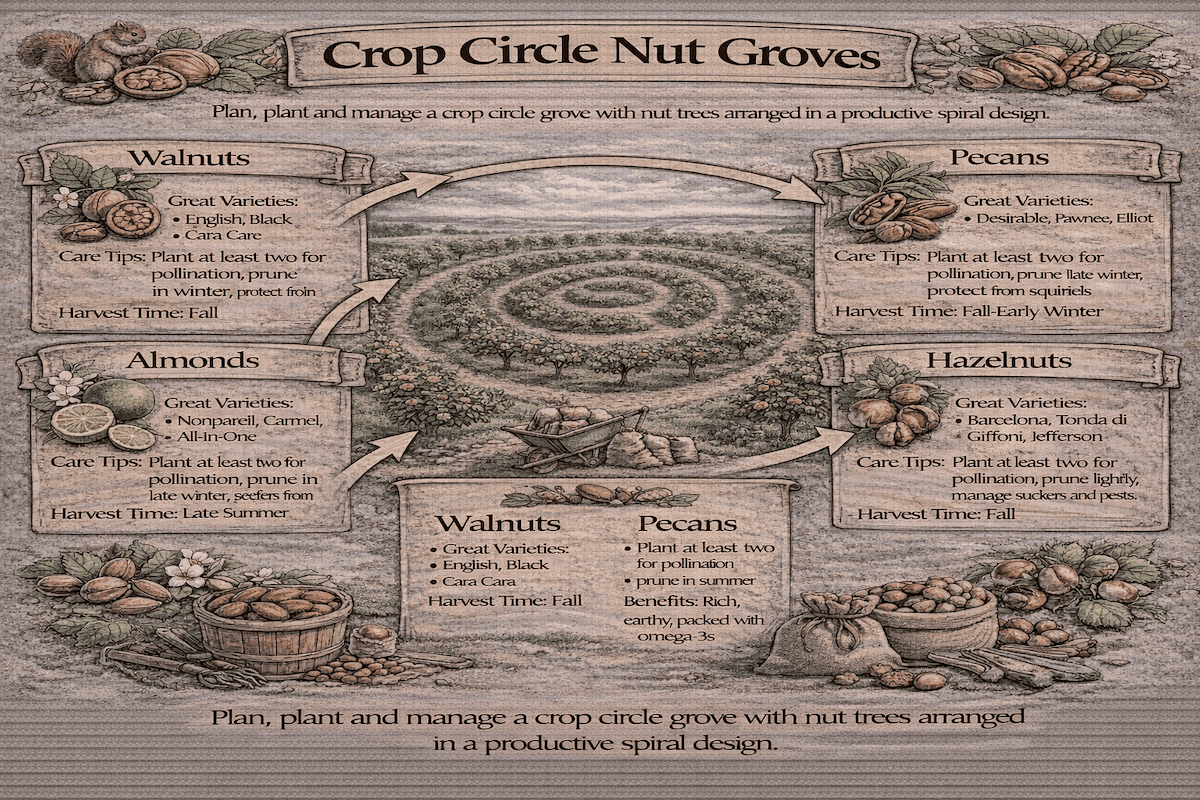
Actual spacing depends on species, rootstock, irrigation method, pruning intensity, and harvest equipment. Use the chart below as a planning reference, then fine-tune spacing based on canopy size and your orchard system.
| Nut Tree Type | Typical Tree Spacing | Typical Row Spacing | Planning Notes |
|---|---|---|---|
| Pecan | 25–35 ft | 30–40 ft | Very large mature canopy; needs wide spacing in open groves. |
| Walnut | 20–30 ft | 24–34 ft | High-value tree; good pruning and irrigation are essential. |
| Almond | 14–22 ft | 18–24 ft | Often managed more intensively in commercial orchards. |
| Hazelnut | 10–16 ft | 14–20 ft | Smaller canopy allows tighter spacing and easier training. |
| Macadamia | 18–25 ft | 20–28 ft | Warm-climate tree; spacing depends on vigor and harvest method. |
| Chestnut | 20–30 ft | 24–34 ft | Needs adequate light and airflow for long-term canopy health. |
Traditional nut orchards are usually planted in straight rows sized around machinery width and mature canopy spread. Crop Circle Nut Groves use spiral geometry to tighten organization, define irrigation paths, improve wind buffering, and reduce wasted alley space.
| Feature | Crop Circle Nut Grove | Traditional Row Orchard |
|---|---|---|
| Layout | Spiral or mirrored spiral rows | Straight parallel rows |
| Wind exposure | Reduced by circular geometry and internal buffering | More direct wind movement through alleys |
| Water efficiency | Strong when paired with drip or micro-sprinklers | Varies widely by system |
| Equipment flow | Needs careful planning, but can be efficient | Simple and familiar |
| Tree density | Potentially higher in selected species and systems | Often lower in wide-canopy nut orchards |
| Management style | More design-driven and pruning-dependent | More conventional and standardized |
The original page emphasized that layout is part science and part art. That remains true. Start by matching the grove to your climate, species, soil depth, equipment needs, pollination strategy, and irrigation layout. Then build the block around mature canopy size rather than short-term planting enthusiasm.
In broad terms, a crop-circle or spiral nut orchard tries to capture the advantages of both open orchards and intensive systems. The spiral pattern can reduce edge turbulence, help define irrigation loops, and create more controlled working lanes. On smaller and moderately vigorous nut species, tighter spacing may be possible. On very large trees such as pecans and walnuts, spacing still needs to respect mature size.
Match each crop to chill hours, heat, humidity, rainfall pattern, soil drainage, and disease pressure.
Nut production depends on canopy light, airflow, and long-term scaffold structure, not just tree count.
Reserve access for mowing, spraying, harvest, pruning, and center turnarounds before planting.

Long-lived nut trees may occupy the same ground for decades, so irrigation design and soil preparation have outsized consequences. The original page correctly stressed soil testing, drainage, organic matter, and the role of drip, micro-sprinklers, flood, subsurface, and hybrid irrigation systems.
For most modern nut groves, drip irrigation or micro-sprinklers offer the best balance of precision, water efficiency, and fertigation control. These systems place moisture close to the root zone, reduce evaporation, and make it easier to manage young orchards separately from mature blocks.
Nut fill, kernel quality, and consistent annual production all depend on matching irrigation timing to tree age, soil type, and seasonal demand.
The original page covered many strong nut crops. Here is a cleaner planning summary for orchard selection:
Estimate how many nut trees you can plant per acre based on your row spacing and in-row tree spacing.
For more detailed scenario planning, use the full Nut Grove Calculator to compare walnut, pecan, almond, hazelnut, and other nut tree spacing options, and to think through traditional row layouts versus Crop Circle spirals.
You can also compare ideas with our fruit trees and citrus trees pages.
A Crop Circle Nut Grove is a nut orchard planted in spiral rows rather than straight rows. The pattern is used to improve irrigation flow, orchard access, wind buffering, and potential production per acre.
Tree counts depend on species and spacing. A very large tree such as a pecan may need wide spacing and relatively low tree counts, while smaller or intensively managed species can support much higher densities. Use the on-page calculator to compare layout scenarios.
Spacing should reflect mature canopy size, root competition, machinery width, pruning intensity, and harvest style. Large nut trees need more room than smaller hedged or intensively managed species.
That depends on climate and market, but almonds, pecans, walnuts, hazelnuts, macadamias, chestnuts, and pistachios are among the most common commercial planning candidates.
Pruning controls canopy size and light penetration, while irrigation drives tree vigor, kernel fill, and annual consistency. In tighter orchard systems, those two factors often determine whether density becomes an advantage or a liability.
Copyright © All rights reserved Tree Plantation