


 INVEST
 PLANT
PLANT
 SOFTWOODS
 HARDWOODS
 CALCULATORS
 RESOURCES
 REFOREST

Softwoods
Learn More
A complete guide to illegal logging, including how it happens, where it occurs, its impact on forests, biodiversity, climate , and how global systems are working to stop it.
Definition: Illegal logging includes cutting trees without permits, harvesting protected species, logging in restricted areas, or falsifying documentation to sell timber through legal supply chains.
Illegal logging refers to the harvesting, transport, processing, or sale of timber in violation of laws designed to protect forests and regulate timber production. This includes logging without permits, exceeding quotas, harvesting protected species, or operating in restricted areas.
Feel free to share this illegal logging infographic explaining the causes, methods, global hotspots, environmental impacts, species at risk, and solutions to illegal timber harvesting. Please include a link back to this page as the source.
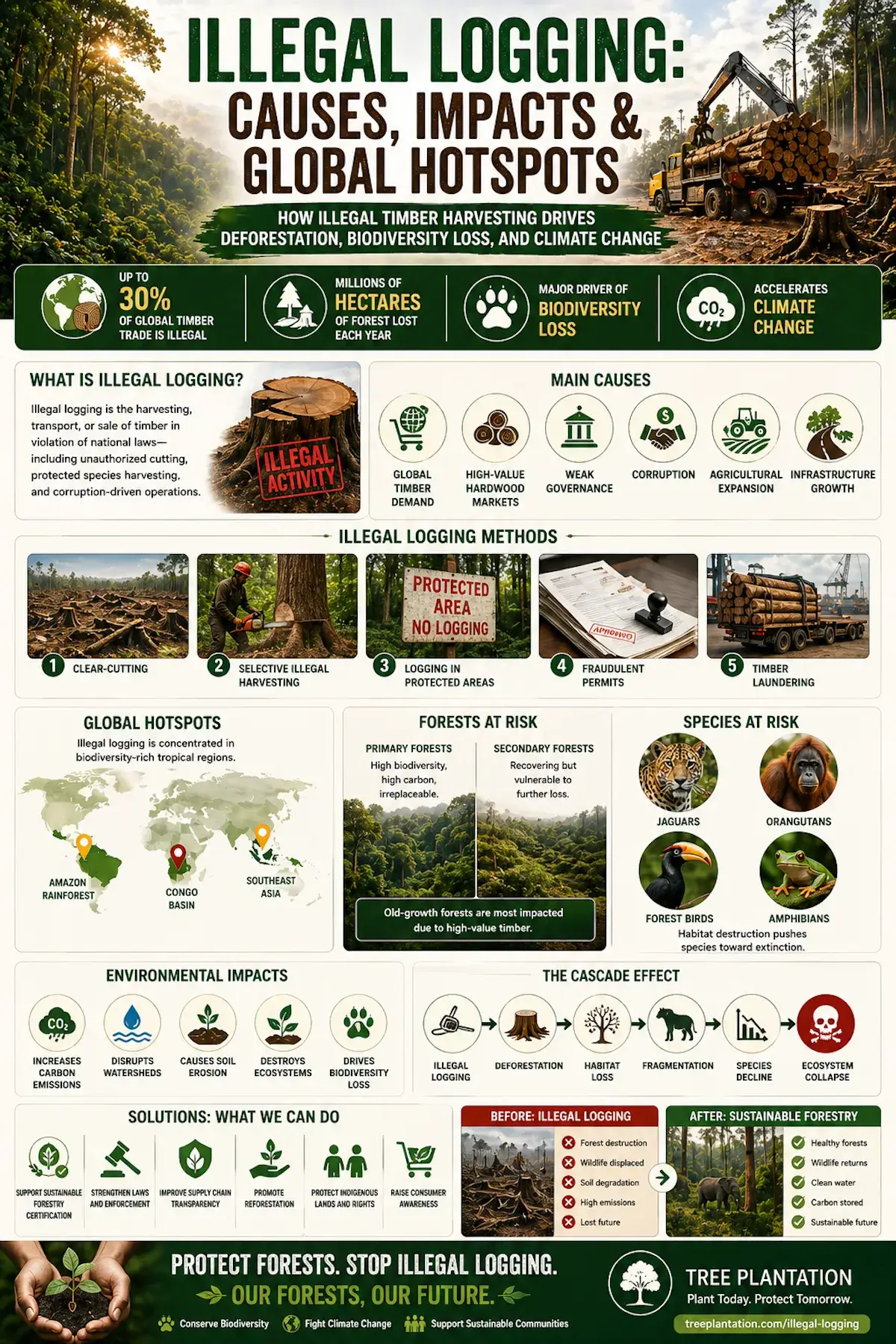
Legal logging follows forestry regulations, permits, and sustainability guidelines. Illegal logging bypasses these controls, often prioritizing short-term profit over long-term forest health.
Illegal logging is driven by a combination of economic demand, governance challenges, and global supply chain pressures. High-value hardwoods such as rosewood, teak, and mahogany create strong financial incentives for unauthorized harvesting, especially in regions where enforcement is limited.
In many parts of the world, illegal logging is not a single activity but a system influenced by local livelihoods, international markets, and weak regulatory oversight. These factors combine to make forest exploitation difficult to control without coordinated global and local action.
Because these causes are interconnected, effective solutions must address both local conditions—such as land rights and enforcement—and global drivers like consumer demand and international trade.
Illegal logging often involves selective harvesting of valuable species, unauthorized road building, and expansion into previously untouched forest areas. These practices degrade ecosystems even when full clear-cutting does not occur.
Illegal logging is concentrated in regions with high biodiversity, valuable timber species, and limited enforcement capacity. These hotspots are often located in tropical forests where demand for hardwoods intersects with weak governance and expanding land-use pressures.
These hotspots represent regions where biodiversity is highest and enforcement is most challenging. Protecting these forests is critical not only for conservation, but also for climate stability, water systems, and indigenous communities that depend on forest ecosystems.
Illegal logging contributes to deforestation, habitat fragmentation, and biodiversity loss. It is closely linked to the decline of endangered species and disruption of ecosystem services.
Explore related impacts in the endangered species and deforestation cluster.
Illegal logging feeds a global black market for timber worth billions annually. It undermines legal markets, reduces government revenue, and distorts pricing for sustainably harvested wood.
Illegal logging often occurs on indigenous lands, where communities rely on forests for livelihoods, culture, and survival. Protecting indigenous land rights is one of the most effective strategies for preventing illegal logging and preserving biodiversity.
Preventing illegal logging requires enforcement, transparency, and sustainable practices. Learn more about sustainable forestry practices.
Illegal logging accounts for a significant portion of global timber production in some regions. It is estimated that up to 10–30% of global timber trade may be illegal, with higher rates in tropical regions.
Blockchain and satellite monitoring technologies are being used to track timber supply chains, improve transparency, and reduce illegal activity by verifying origin and movement of forest products.
Consumers can help reduce illegal logging by purchasing certified wood products that verify sustainable sourcing and legal compliance through recognized certification systems.
FAQ • ILLEGAL LOGGING • TIMBER TRADE • FOREST PROTECTION
Illegal logging drives deforestation, biodiversity loss, and climate change while undermining legal markets and forest protection efforts.
Illegal logging is most common in tropical regions such as the Amazon, Congo Basin, and Southeast Asia.
Solutions include stronger enforcement, certification systems, supply chain transparency, and protection of indigenous land rights.
Certified wood is timber verified as legally and sustainably sourced through systems like FSC and PEFC.
Yes, illegal logging contributes to climate change by releasing stored carbon and reducing forest carbon sequestration capacity.
Copyright © All rights reserved Tree Plantation