 INVEST
 PLANT
PLANT
 SOFTWOODS
 HARDWOODS
 CALCULATORS
 RESOURCES
 REFOREST

Softwoods
Learn More




A complete guide to slash-and-burn agriculture, including how it drives deforestation, impacts biodiversity and climate, and the sustainable solutions shaping the future of land use
A complete guide to slash-and-burn agriculture, including how it works, why it drives deforestation, its impact on biodiversity and climate, and sustainable alternatives.
Definition: Slash-and-burn agriculture, also known as shifting cultivation, is a farming practice where vegetation is cleared, dried, and burned to prepare land for crops. After a few growing cycles, the land is often abandoned due to declining soil fertility.
Slash-and-burn agriculture is a land-use method where forests or vegetation are cut down and then burned to clear land for farming. The ash temporarily enriches the soil with nutrients, making it suitable for crops for a short period.
This practice has been used for centuries in traditional farming systems, but modern large-scale use has significantly contributed to global deforestation and environmental degradation.
Feel free to share this slash-and-burn agriculture infographic explaining how forest clearing drives deforestation, biodiversity loss, carbon emissions, soil degradation, peatland damage, and the need for sustainable land-use alternatives. Please include a link back to this page as the source.
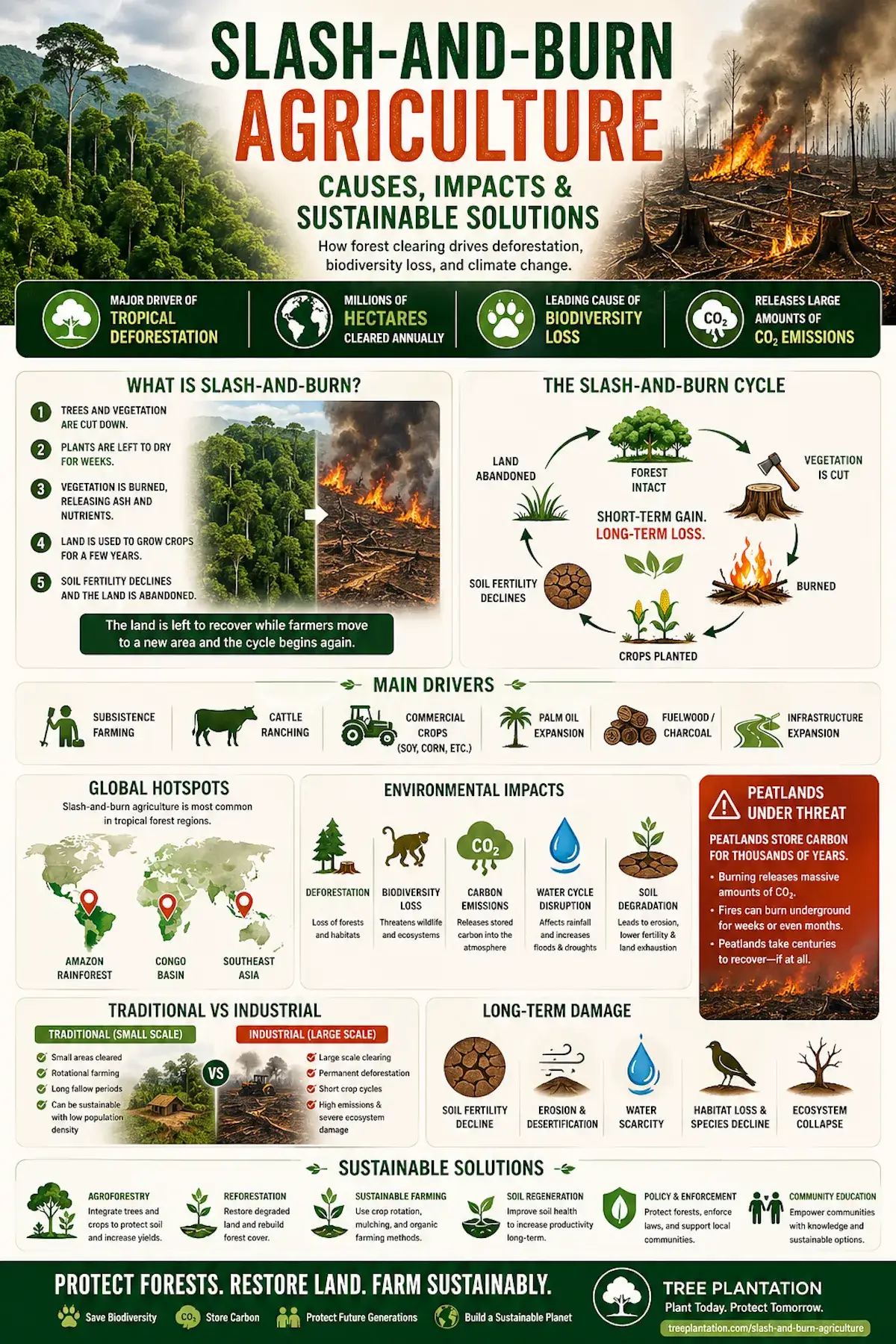
Agricultural expansion and deforestation are closely linked to slash-and-burn practices. Forests are cleared to make way for crops, livestock, and plantations, often driven by global food demand, land scarcity, economic pressures, and infrastructure development.
While some expansion occurs at small scales for subsistence farming, large-scale commercial agriculture is one of the primary drivers of permanent forest loss. Slash-and-burn is often used as the initial clearing method before land is converted to long-term agricultural use.
Together, these forms of agricultural expansion place continuous pressure on forest ecosystems. Without sustainable land management and reforestation strategies, the cycle of clearing, cultivation, and abandonment leads to long-term environmental degradation and ongoing deforestation.
Slash-and-burn contributes directly to deforestation and ecosystem loss, removing entire habitats and disrupting natural cycles such as water retention, nutrient flow, and climate regulation.
The destruction of forests leads to biodiversity loss, as species lose food sources, shelter, and breeding grounds.
It also causes habitat fragmentation, isolating populations and increasing extinction risk for many species.
Burning forests releases large amounts of carbon dioxide and other greenhouse gases into the atmosphere. This contributes significantly to climate change by reducing forest carbon storage and increasing atmospheric emissions.
Peatlands store massive amounts of carbon accumulated over thousands of years. When burned, they release extremely high levels of carbon emissions, often far greater than typical forest fires.
Peatland burning can also create long-lasting underground fires that are difficult to extinguish and can release emissions for months.
Repeated slash-and-burn cycles degrade soil quality, reduce fertility, and increase erosion. Over time, land becomes less productive, leading to further clearing of new forest areas.
This cycle contributes to desertification, water scarcity, and long-term ecosystem instability.
Traditional slash-and-burn, also known as shifting cultivation, can be sustainable when practiced at small scales with long fallow periods.
Indigenous communities often manage land carefully, allowing forests to regenerate naturally and maintaining biodiversity. These systems differ significantly from modern industrial practices.
Modern large-scale slash-and-burn is often linked to illegal land clearing, commercial agriculture, and global supply chains.
Practices such as cattle ranching and deforestation and large-scale plantation expansion often result in permanent forest loss rather than temporary land use. Once forests are cleared and converted into pasture or monoculture systems, natural regeneration becomes far more difficult, especially when soils are compacted, nutrients are depleted, or land is repeatedly burned.
In many regions, particularly the Amazon, forests cleared for cattle grazing are rarely allowed to recover. Similarly, plantations for commodities like palm oil, soy, or rubber replace diverse ecosystems with single-species systems that support far fewer plant and animal species. This shift not only reduces biodiversity but also weakens long-term ecosystem resilience and carbon storage capacity.
Cattle ranching is responsible for the largest share of slash-and-burn deforestation globally, especially in the Amazon rainforest. In many areas, forests are first cleared and burned, then converted into pastureland—making cattle production the leading driver of permanent forest loss in the region.
Sustainable alternatives to slash-and-burn agriculture are increasingly being adopted to reduce environmental impact.
FAQ • SLASH-AND-BURN • DEFORESTATION • AGRICULTURE
It provides short-term soil fertility through ash nutrients and is often used in regions with limited agricultural resources.
Traditional small-scale systems can be sustainable, but large-scale or repeated use leads to deforestation and environmental damage.
It releases stored carbon into the atmosphere and reduces the ability of forests to absorb carbon dioxide.
Long-term soil degradation and permanent loss of forest ecosystems are the biggest risks.
Agroforestry, regenerative agriculture, and no-burn techniques provide more sustainable options.
Copyright © All rights reserved Tree Plantation