


 INVEST
 PLANT
PLANT
 SOFTWOODS
 HARDWOODS
 CALCULATORS
 RESOURCES
 REFOREST

Softwoods
Learn More
ENDANGERED SPECIES • DEFORESTATION • BIODIVERSITY • HABITAT LOSS
Forest ecosystems support the majority of the world’s terrestrial biodiversity. As deforestation accelerates across tropical and temperate regions, millions of species face increasing pressure from habitat loss, fragmentation, and environmental disruption.
Understanding the connection between deforestation and endangered species is essential for protecting biodiversity, maintaining ecosystem balance, and preventing irreversible ecological damage.
🔎 On this page
QUICK ANSWER • ENDANGERED SPECIES • FOREST HABITAT LOSS
Definition: An endangered species is a species whose population has declined to critical levels due to habitat loss, environmental change, or human activity—making survival in the wild increasingly unlikely without protection.
In forest ecosystems, habitat loss is the primary driver of endangerment. As forests are cleared for agriculture, logging, and development, species lose the environments they depend on for food, shelter, and reproduction. Many forest species are highly specialized, meaning they cannot easily adapt to new conditions or relocate to different habitats.
Deforestation also breaks continuous forests into smaller, isolated patches. This fragmentation reduces access to resources, limits movement, and decreases genetic diversity, making populations more vulnerable to disease, climate stress, and long-term decline.
Because forests support the majority of terrestrial biodiversity, the loss of forest habitat is one of the most significant factors pushing species toward extinction worldwide.
Deforestation and habitat loss are closely connected. When forests are cleared, species do not simply lose trees—they lose entire living systems made up of canopy cover, nesting sites, food plants, insects, soil organisms, water sources, and protective shelter.
For many forest-dependent species, even partial clearing can be devastating. Removing trees can expose wildlife to predators, reduce food availability, disrupt breeding cycles, and separate populations into smaller isolated groups. Over time, this can lead to population decline and increased extinction risk.
The connection between forest clearing and biodiversity loss from deforestation is especially severe in tropical forests, where many species are highly specialized and cannot easily relocate when their habitat disappears.
Deforestation disrupts entire ecosystems by removing the physical structure and biological networks that species depend on. When forests are cleared, animals and plants lose nesting sites, feeding areas, breeding grounds, and protective cover. Without these essential resources, populations begin to decline rapidly.
Certain activities accelerate this process. Illegal logging often removes high-value trees without environmental safeguards, damaging surrounding habitat and opening previously intact forests to further exploitation. Likewise, slash-and-burn agriculture clears large areas of forest quickly, leaving behind degraded land that can no longer support the original biodiversity.
As deforestation continues, species populations become smaller and more isolated. This isolation reduces genetic diversity, making species more vulnerable to disease, climate change, and environmental stress. Over time, these pressures compound, pushing species closer to extinction—especially those with limited geographic range or highly specialized habitat requirements.
The loss of even a single species can trigger cascading effects throughout the ecosystem. When key species disappear, food webs break down, pollination declines, seed dispersal is disrupted, and ecosystem stability weakens—accelerating further biodiversity loss.
Feel free to share this endangered species and deforestation infographic on your website or blog. Please include a link back to this page as the source.
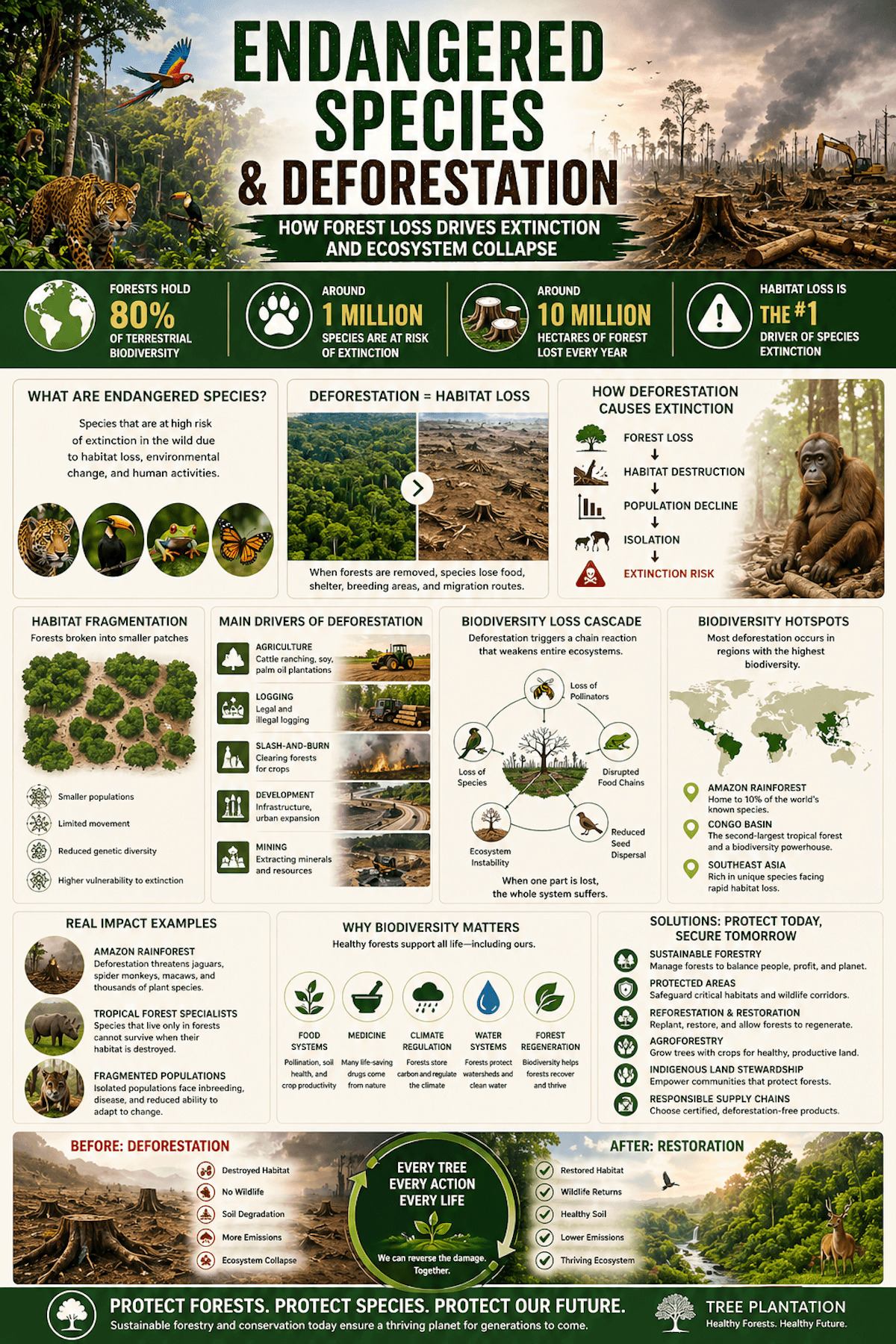
Habitat fragmentation occurs when large, continuous forests are broken into smaller, isolated patches. This creates “islands” of habitat that limit movement, reduce genetic diversity, and increase vulnerability to predators and environmental stress.
Fragmented landscapes also create edge effects, where conditions at forest edges—such as higher temperatures, wind exposure, and human activity—negatively impact species that depend on stable interior forest environments.
Biodiversity supports ecosystem stability, resilience, and productivity. When species disappear, ecosystems lose critical functions such as pollination, seed dispersal, pest control, and nutrient cycling—processes that keep forests healthy and capable of sustaining life over time.
In major forest systems like the Amazon rainforest, biodiversity operates as an interconnected network. Trees, insects, birds, mammals, fungi, and microorganisms all depend on each other. When one part of that system is removed—whether through deforestation or habitat degradation—the entire system becomes less stable and more vulnerable to collapse.
Biodiversity also has direct economic and ecological value. Forest species provide timber, medicine, food, and ecosystem services that support agriculture and human communities. For example, valuable hardwood species such as African zebrawood depend on intact ecosystems to regenerate and thrive. When biodiversity declines, these valuable natural resources become harder to sustain long-term.
In regions like Costa Rica, biodiversity conservation has been shown to strengthen both ecosystems and economies. Healthy forests attract ecotourism, support sustainable forestry, and maintain water systems and soil quality. This demonstrates that protecting biodiversity is not just an environmental priority—it is also a long-term economic strategy.
Ultimately, biodiversity loss weakens the ability of forests to recover from disturbance, adapt to climate change, and continue providing essential services. Protecting biodiversity is therefore fundamental to maintaining resilient forests, stable climates, and sustainable ecosystems for future generations.
Agriculture is one of the leading drivers of deforestation worldwide. Forests are cleared to make way for crops, livestock, and large-scale plantations, reducing available habitat for wildlife and placing increasing pressure on already vulnerable species.
This expansion often occurs in biodiversity-rich regions, where even small-scale clearing can have outsized impacts. As forests are converted into farmland, species lose access to food sources, shelter, and breeding areas. Over time, repeated clearing fragments landscapes and isolates wildlife populations, making survival more difficult.
One of the most destructive practices associated with agricultural expansion is slash-and-burn agriculture . This method involves cutting and burning forest vegetation to quickly clear land for farming. While it may provide short-term soil fertility, it often leads to long-term soil degradation, reduced forest regeneration, and repeated clearing cycles that further accelerate habitat loss.
Large-scale agriculture—such as cattle ranching, soybean farming, and palm oil plantations—can remove vast areas of forest in a relatively short period of time. These systems are typically monoculture-based, meaning they replace complex ecosystems with simplified landscapes that support very little biodiversity.
As agricultural frontiers expand deeper into forested regions, the cumulative effect is widespread habitat destruction, ecosystem fragmentation, and increased risk of species decline and extinction.
Logging removes trees that provide essential habitat structure, including canopy cover, nesting sites, and food sources. When trees are removed, the physical and biological framework of the forest begins to break down, affecting not just individual species but entire ecosystems.
Unsustainable practices such as illegal logging can accelerate this damage by removing high-value trees without environmental safeguards. This often leaves behind degraded forests, damaged soil, and fragmented habitats, while also opening access roads that lead to further deforestation, hunting, and land conversion.
The method of logging also plays a major role in ecological impact. Large-scale clearing—especially clear-cutting—can eliminate entire forest sections at once, resulting in immediate habitat loss and long recovery times. In contrast, selective logging removes specific trees but can still disrupt ecosystems if it is poorly planned or excessively intensive. Understanding the difference between clear-cutting and selective logging is critical when evaluating sustainability.
Even when forests are not completely cleared, logging can fragment habitats, alter light levels, dry out forest floors, and reduce biodiversity. Sensitive species that depend on stable, undisturbed environments may be unable to adapt, leading to population decline over time.
Without careful management, logging and forest clearing can transform diverse ecosystems into simplified landscapes with reduced ecological function, making it harder for forests—and the species that depend on them—to recover.
Biodiversity hotspots are regions with exceptionally high levels of species diversity and endemism—meaning many species found there exist nowhere else on Earth—that are also under significant threat from human activity. Because these areas contain such a large concentration of unique life, they are considered critical priorities for global conservation.
To qualify as a biodiversity hotspot, a region must meet two key criteria: it must contain a high number of endemic species and it must have lost a significant portion of its original natural habitat. This combination makes hotspots both biologically rich and highly vulnerable to extinction pressures.
Many of the world’s most important hotspots are located in tropical forest regions such as the Amazon rainforest, where vast numbers of plant and animal species depend on intact forest ecosystems. Similarly, countries like Costa Rica are globally recognized for their extraordinary biodiversity, where conservation efforts have helped protect dense concentrations of species within relatively small geographic areas.
Hotspots are not limited to forests alone, but forests make up a large portion of them because they provide complex habitats that support layered ecosystems—from canopy to forest floor. These environments often include hidden and specialized ecosystems, sometimes even extending underground into formations like the largest cave systems in the world, which can host unique tree species adapted to isolated conditions.
Because biodiversity hotspots contain such a high proportion of the world’s species in relatively small areas, their destruction has an outsized impact on global biodiversity. Protecting these regions is one of the most effective strategies for preventing species extinction and preserving ecosystem stability.
The Amazon rainforest is home to thousands of endangered species, including jaguars, macaws, amphibians, and countless plant species. Rapid deforestation in the Amazon has placed immense pressure on these ecosystems.
The Amazon rainforest supports an extraordinary range of species across multiple ecosystem layers—from aquatic environments to the forest canopy. These species play critical roles in maintaining ecological balance, supporting biodiversity, and sustaining the health of one of the most complex ecosystems on Earth.
Together, these species and systems illustrate how deeply interconnected the Amazon ecosystem is. Protecting biodiversity in the rainforest means preserving not just individual species, but the entire network of relationships that allows the forest to function, regenerate, and support life at a global scale.
Indigenous communities play a critical role in protecting forests. Areas managed by indigenous groups often have lower deforestation rates and higher biodiversity due to traditional ecological knowledge and sustainable land use practices.
A significant percentage of global species are threatened by habitat loss linked to deforestation. Tropical regions are particularly affected due to their high biodiversity and rapid forest clearing rates.
| Region / Ecosystem | Estimated % of Species Threatened | Primary Drivers | Impact on Biodiversity |
|---|---|---|---|
| Tropical Rainforests (Amazon, Congo, SE Asia) | Up to 70% of species at risk | Agriculture, logging, mining, infrastructure | High extinction risk due to habitat loss and specialization |
| Subtropical Forests | 40–60% threatened | Urban expansion, agriculture, deforestation | Fragmentation and declining species diversity |
| Temperate Forests | 20–40% threatened | Logging, development, land conversion | Moderate biodiversity loss, slower recovery |
| Biodiversity Hotspots | Up to 75% habitat already lost | Human population pressure, land clearing | Extremely high extinction risk for endemic species |
| Global Average | ~25–30% of species threatened | Habitat loss, climate change, pollution | Widespread biodiversity decline across ecosystems |
These estimates highlight how strongly deforestation is linked to biodiversity loss, especially in tropical regions where species are highly specialized and depend on intact ecosystems. As forest loss continues, the percentage of threatened species is expected to rise, making conservation and sustainable land management critical priorities.
The IUCN Red List categorizes species based on extinction risk, ranging from least concern to critically endangered. It is one of the most widely used tools for tracking global biodiversity trends.
Many tree species are now listed on the IUCN Red List due to deforestation, overharvesting, and habitat degradation. These trees are critical to forest ecosystems, providing habitat, carbon storage, and biodiversity support.
The inclusion of these species on the IUCN Red List highlights the growing pressure on forest ecosystems worldwide. Protecting endangered trees is essential not only for preserving individual species, but also for maintaining the health, structure, and biodiversity of entire forest systems.
As deforestation rates increase, species populations decline. The relationship between forest loss and biodiversity decline is well documented, particularly in tropical ecosystems.
If you are working on a project, partnership, or initiative focused on forests, conservation, or sustainable land use, we invite you to connect.
📩 Contact the team at treeplantation.com
admin@treeplantation.com
FAQ • ENDANGERED SPECIES • DEFORESTATION
Deforestation removes habitat, disrupts ecosystems, and reduces food availability, leading to population decline and increased extinction risk.
Habitat fragmentation occurs when forests are broken into smaller patches, isolating species and reducing genetic diversity.
Biodiversity hotspots contain a high number of unique species and are critical for conservation efforts.
Indigenous communities help protect forests through sustainable practices and land stewardship, often reducing deforestation.
Yes, reforestation can restore habitats and support species recovery when done with native species and ecological planning.
Copyright © All rights reserved Tree Plantation