 INVEST
 PLANT
PLANT
 SOFTWOODS
 HARDWOODS
 CALCULATORS
 RESOURCES
 REFOREST

Softwoods
Learn More




A complete guide to how palm oil production drives deforestation, destroys wildlife habitats, accelerates climate change, and the solutions shaping a more sustainable future
A complete guide to palm oil deforestation, including how it drives rainforest loss, threatens wildlife, impacts climate, and the solutions shaping sustainable production.
Definition: Palm oil deforestation refers to the conversion of forests—especially tropical rainforests—into oil palm plantations, often involving large-scale land clearing, burning, and long-term ecosystem disruption.
Palm oil is a widely used vegetable oil derived from the fruit of oil palm trees. It is found in food products, cosmetics, cleaning products, and biofuels due to its efficiency and low production cost.
Palm oil deforestation occurs when tropical forests are cleared to establish oil palm plantations. This process typically involves cutting down native vegetation, drying it, and then burning it to quickly prepare land for planting. The result is the conversion of complex, biodiverse ecosystems into single-species (monoculture) plantations.
Unlike temporary land-use systems, palm oil plantations are designed for long-term production, meaning forests are rarely allowed to regenerate. Once converted, the landscape shifts from a multi-layered rainforest ecosystem to a simplified agricultural system that supports far fewer plant and animal species.
Palm oil expansion is one of the leading causes of deforestation in Southeast Asia and is increasingly impacting regions in Africa and South America. It is closely linked to global demand for low-cost vegetable oils used in food products, cosmetics, cleaning agents, and biofuels.
Feel free to share this palm oil deforestation infographic explaining how everyday products can be linked to rainforest loss, wildlife habitat destruction, carbon emissions, biodiversity decline, and sustainable palm oil choices. Please include a link back to this page as the source.
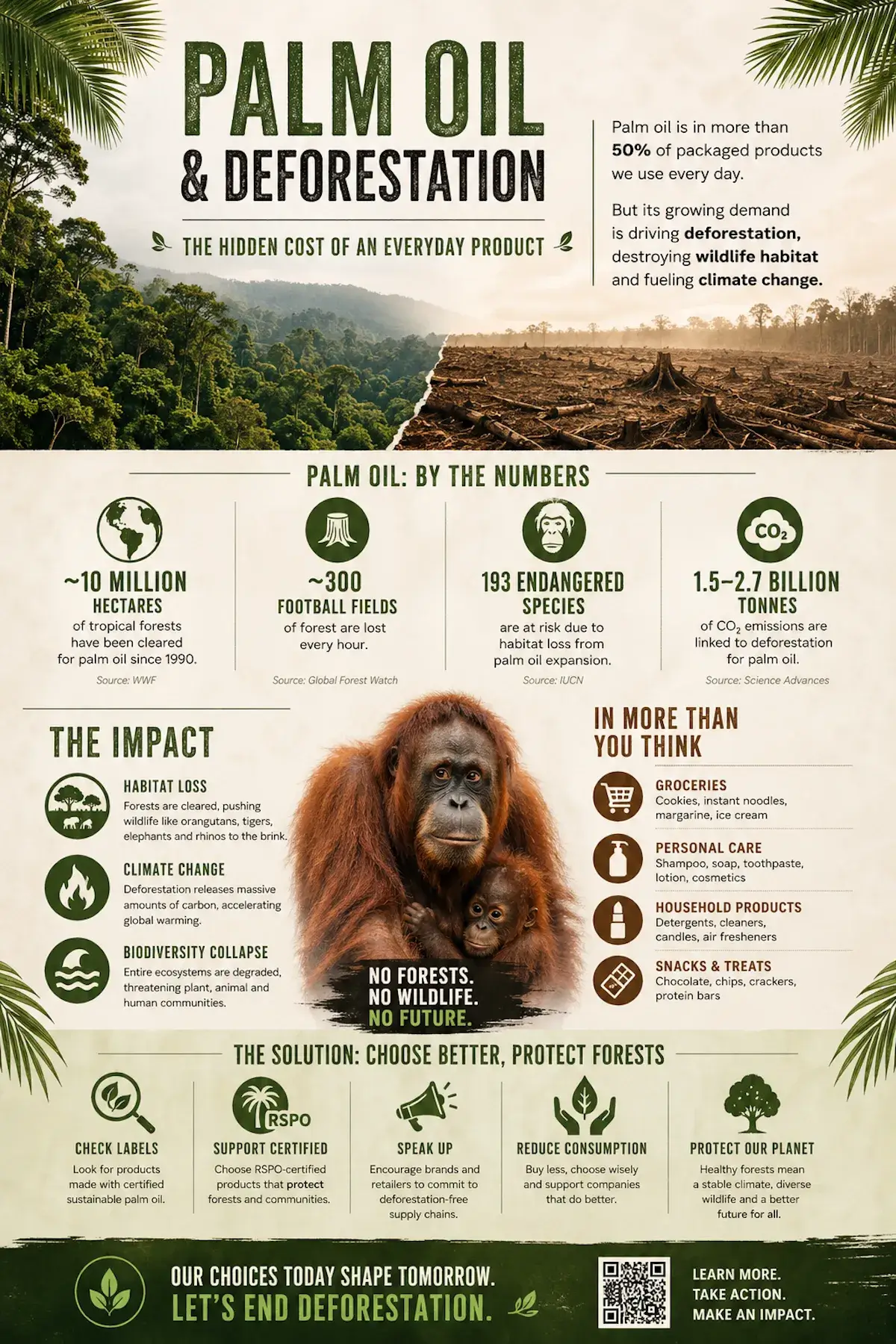
Palm oil production drives deforestation through a combination of land clearing practices, infrastructure development, and long-term land conversion. Large areas of forest are removed to create uniform plantations optimized for harvesting oil palm fruit.
These processes not only remove trees but also disrupt entire ecosystems, including soil systems, water cycles, and wildlife habitats. Over time, repeated expansion and poor land management can lead to widespread environmental degradation, increased carbon emissions, and long-term biodiversity decline.
Palm oil expansion contributes to biodiversity loss by destroying habitats.
Certification systems such as RSPO aim to reduce environmental damage and promote sustainable practices in palm oil production.
Palm oil plantations often begin with slash-and-burn clearing, but unlike traditional farming, plantations typically result in permanent forest loss rather than temporary use.
FAQ • PALM OIL • DEFORESTATION • CLIMATE
Forests are cleared to create plantations, often permanently replacing ecosystems.
Indonesia, Malaysia, Borneo, and Sumatra are the most affected regions.
It destroys habitats for species like orangutans, tigers, and elephants.
Fires in carbon-rich soils that release massive emissions and are difficult to control.
Yes, through certification systems, better land management, and deforestation-free sourcing.
Copyright © All rights reserved Tree Plantation



