


 INVEST
 PLANT
PLANT
 SOFTWOODS
 HARDWOODS
 CALCULATORS
 RESOURCES
 REFOREST

Softwoods
Learn More
BIODIVERSITY LOSS • DEFORESTATION • ECOSYSTEM COLLAPSE • HABITAT LOSS
Forests are the foundation of global biodiversity. When they are removed or degraded, the complex systems that support life—from microorganisms to large mammals—begin to break down.
🔎 On this page
Biodiversity loss refers to the decline in the variety of life across ecosystems, including reductions in species populations, genetic diversity, and ecosystem complexity. It weakens ecosystem resilience and reduces the ability of natural systems to function effectively.
Deforestation removes habitat, fragments ecosystems, and disrupts ecological relationships. As forests are cleared, species lose access to food, shelter, and breeding grounds, leading to population decline and increased extinction risk.
Biodiversity exists at three interconnected levels that together support ecosystem stability, resilience, and long-term survival of life on Earth.
Many of the world’s most important biodiversity hotspots depend on the preservation of all three levels of biodiversity. These regions contain extraordinary concentrations of life but are highly vulnerable to deforestation and habitat loss.
Deforestation impacts all three levels simultaneously—reducing population size, eliminating species, and simplifying ecosystems—making biodiversity loss one of the most significant environmental challenges facing forests today.
Each species occupies a specific ecological niche. When forests are disturbed, these niches collapse, forcing species to compete for limited resources or disappear entirely.
Forests are vertically layered ecosystems, with each level—from the upper canopy to the forest floor—supporting distinct communities of plants, animals, and microorganisms. This layered structure creates a wide range of habitats, microclimates, and ecological niches that allow high biodiversity to thrive within a relatively small area.
The canopy layer forms the top of the forest and captures most of the sunlight. It is home to birds, insects, arboreal mammals, and many flowering and fruiting plants. Below it, the understory contains smaller trees and shade-tolerant plants, providing shelter and feeding grounds for a different set of species. The forest floor supports fungi, decomposers, insects, and soil organisms that recycle nutrients and maintain soil health.
Each layer depends on the others. The canopy regulates temperature, humidity, and light levels, creating stable conditions below. Fallen leaves and organic matter from upper layers enrich the soil, while roots stabilize the ground and support water retention. Together, these layers form an interconnected system that sustains biodiversity and ecosystem function.
Deforestation disrupts this entire structure. When trees are removed, the canopy disappears, exposing lower layers to direct sunlight, wind, and temperature fluctuations. This alters microclimates, dries out the soil, and makes conditions unsuitable for many species adapted to stable forest environments.
As the structure collapses, species that depend on specific layers lose their habitat. Canopy-dwelling animals may have nowhere to go, understory plants may be unable to survive increased light and heat, and soil organisms may decline as moisture and organic matter are lost. This cascading breakdown accelerates biodiversity loss and weakens the forest’s ability to regenerate.
The forest canopy plays a critical role in regulating light, temperature, humidity, and wind within an ecosystem. It acts as a protective layer that filters sunlight, retains moisture, and stabilizes environmental conditions below. When the canopy is intact, it creates a balanced microclimate that supports a wide range of species adapted to consistent and shaded conditions.
When deforestation removes the canopy, these microclimates change rapidly. Increased sunlight reaches the forest floor, temperatures rise, humidity drops, and wind exposure increases. This shift can dry out soils, reduce water retention, and disrupt the delicate environmental balance that many plants and animals depend on for survival.
Species that rely on stable, humid conditions—such as amphibians, insects, fungi, and shade-dependent plants—are especially vulnerable. Without canopy protection, they may be unable to adapt to the new conditions, leading to population decline or local extinction. Even species that survive initial clearing often face long-term stress due to ongoing environmental instability.
The loss of canopy also affects ecological processes such as nutrient cycling and soil regeneration. Without leaf litter and organic input from above, soil quality declines, further limiting the ability of forests to recover naturally.
Regenerative systems like tree gardens demonstrate how restoring layered vegetation can help rebuild canopy cover and reestablish stable microclimates. These systems mimic natural forest structure, supporting biodiversity while improving resilience to environmental stress and long-term ecosystem recovery.
Specialist species rely on very specific habitats, food sources, or environmental conditions and are highly vulnerable to deforestation. Generalist species are more adaptable and can survive in a wider range of environments, but even they can decline as ecosystems become increasingly degraded.
When forests are cleared or fragmented, specialist species are usually the first to decline because they cannot easily relocate or adapt. Generalist species may persist longer, but the overall ecosystem becomes simplified, with fewer species and weaker ecological balance.
As deforestation progresses, ecosystems often shift from diverse, specialist-rich systems to simplified landscapes dominated by generalist species. This transition reduces biodiversity, weakens ecosystem resilience, and disrupts natural ecological processes.
When key species disappear, trophic cascades occur. This means changes at one level of the food web affect all other levels, leading to widespread ecological imbalance.
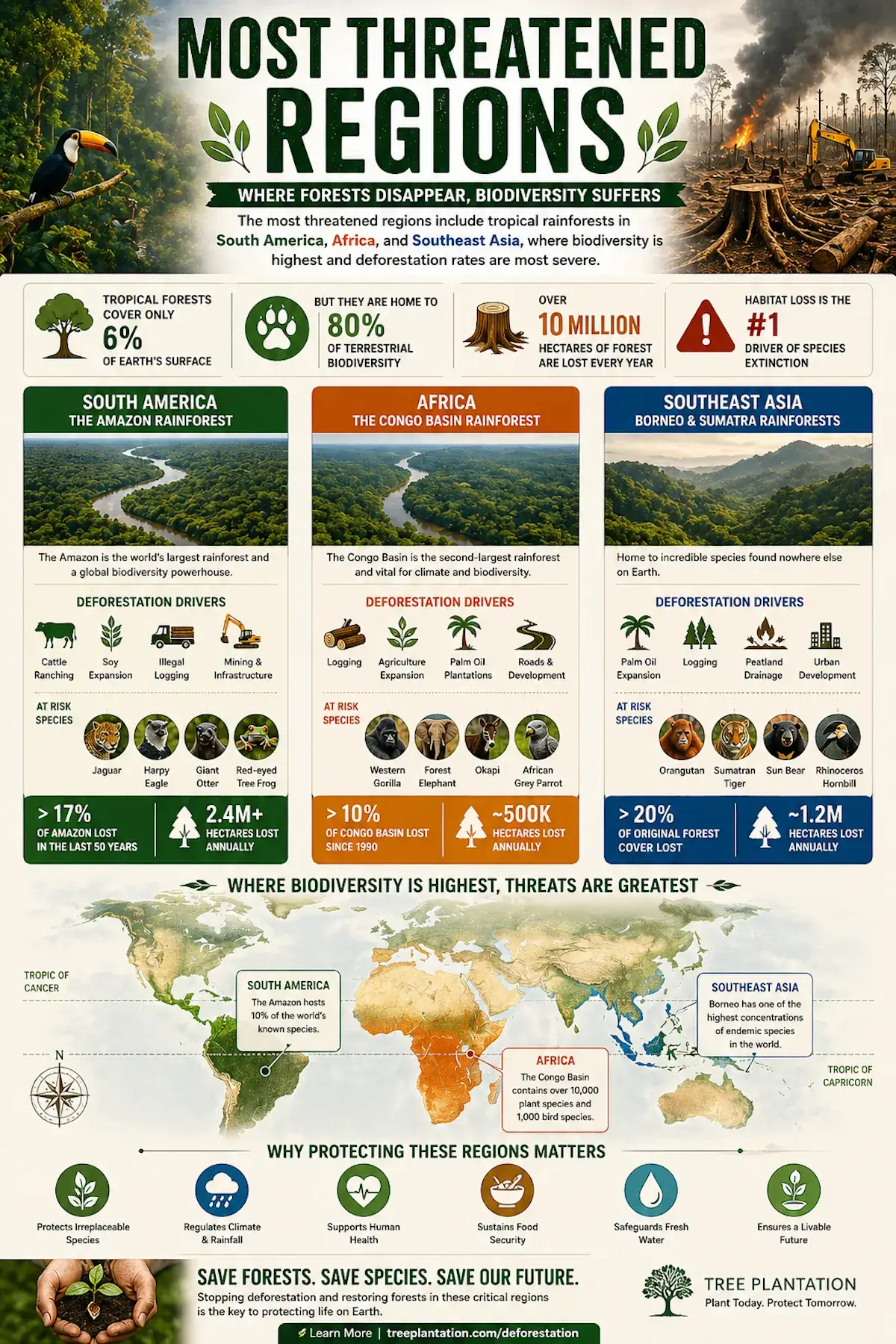
Major drivers include agricultural expansion, logging, mining, urban development, and infrastructure growth. These activities reduce habitat availability and disrupt ecosystems at scale.
Many biodiversity hotspots have already lost over 70% of their original habitat. These regions face the highest risk of species extinction due to concentrated biodiversity and intense human pressure.
Feel free to share this infographic highlighting the most threatened forest regions and their impact on global biodiversity. Please include a link back to this page as the source.
FAQ • BIODIVERSITY LOSS • DEFORESTATION
Biodiversity loss is caused by habitat destruction, deforestation, climate change, pollution, and overexploitation of natural resources.
Biodiversity supports ecosystem stability, food systems, climate regulation, and natural resilience.
Deforestation disrupts habitats, reduces species populations, and weakens ecological systems.
Trophic cascades occur when the removal of one species affects the entire food web.
Recovery is possible through reforestation and conservation, but it can take decades or longer depending on ecosystem damage.
Copyright © All rights reserved Tree Plantation