


 INVEST
 PLANT
PLANT
 SOFTWOODS
 HARDWOODS
 CALCULATORS
 RESOURCES
 REFOREST

Softwoods
Learn More
A complete guide to how deforestation accelerates climate change by releasing stored carbon, disrupting rainfall patterns, weakening carbon sequestration, and damaging regional climate systems.
Definition: Deforestation is the permanent clearing or degradation of forest land for agriculture, logging, mining, infrastructure, or development. Climate change refers to long-term shifts in temperature, rainfall , storms, drought, and atmospheric carbon levels.
Forests help regulate the climate by absorbing carbon dioxide, storing carbon in wood and soil, releasing water vapor into the atmosphere, and cooling landscapes through shade and evapotranspiration. When forests are removed, these climate-regulating functions are weakened or lost.
The result is a double impact: deforestation releases greenhouse gases while also reducing the Earth’s natural ability to remove carbon dioxide from the atmosphere.
The carbon cycle is the movement of carbon between the atmosphere, oceans, soils, plants, and living organisms. Forests are one of the most important parts of this cycle because trees absorb carbon dioxide during photosynthesis and convert it into wood, leaves, roots, and soil organic matter.
In a healthy forest, carbon is continuously exchanged. Trees absorb carbon as they grow, release some carbon through respiration and decomposition, and store large amounts of carbon in biomass and soil. This makes forests both active carbon sinks and long-term carbon reservoirs.
Deforestation interrupts this cycle. When trees are cut, burned, or left to decay, stored carbon returns to the atmosphere. At the same time, the cleared land loses its future carbon-absorbing capacity.
Carbon sequestration is the process of capturing and storing carbon dioxide from the atmosphere. Forests sequester carbon naturally by absorbing CO₂ through photosynthesis and storing it in trunks, branches, leaves, roots, soil, and dead organic matter.
Forest carbon sequestration is one of the most important natural climate solutions because it works at ecosystem scale. A single tree stores carbon as it grows, but an entire forest stores carbon across multiple layers: living biomass, root systems, leaf litter, soil, and long-lived wood.
When forests are protected, restored, or managed sustainably, they continue to function as carbon sinks. When forests are cleared, that sequestration pathway is reduced or eliminated.
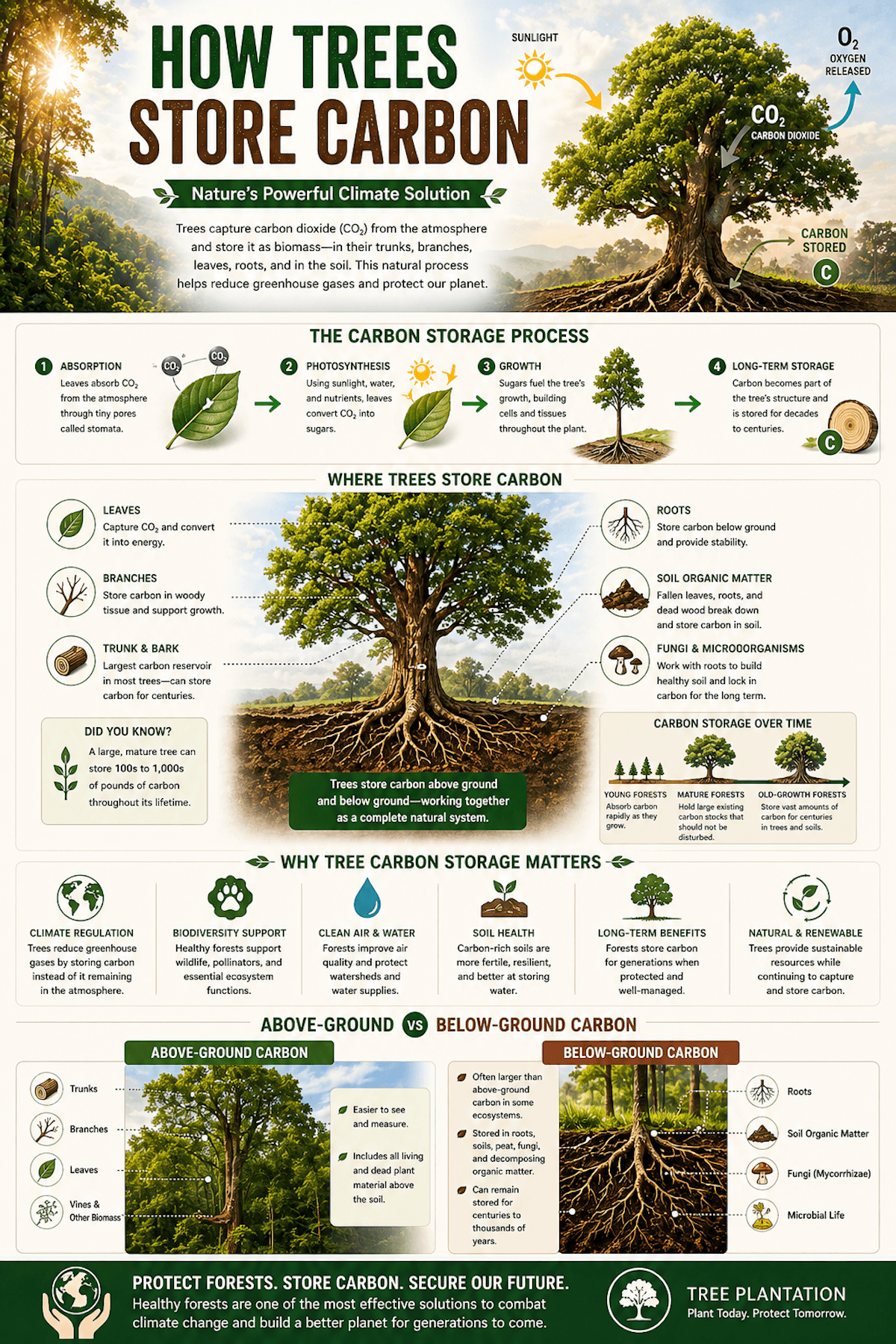
Trees store carbon by converting atmospheric carbon dioxide into plant tissue. Through photosynthesis, leaves absorb CO₂ and sunlight, then transform that carbon into sugars that fuel growth. Over time, this carbon becomes part of the tree’s trunk, branches, bark, roots, and surrounding soil.
Larger, older trees can store substantial amounts of carbon because their trunks and root systems contain dense biomass accumulated over many years. Young forests can absorb carbon quickly as they grow, while mature forests often hold large existing carbon stocks that should not be disturbed.
Forest carbon storage is not limited to visible wood. Roots, fungi, microbial life, and soil organic matter all play important roles in long-term carbon retention.
Feel free to share this infographic explaining how trees store carbon above ground, below ground, and across the full forest ecosystem. Please include a link back to this page as the source.
Peatland deforestation is one of the most climate-damaging forms of forest loss. Peatlands are wetlands where partially decomposed plant material builds up over long periods under saturated, low-oxygen conditions. This creates deep carbon-rich soils.
When peat forests are drained for agriculture, palm oil, timber plantations, or development, the peat begins to dry and oxidize. This releases carbon dioxide into the atmosphere. If drained peat catches fire, emissions can increase dramatically and create long-lasting haze, air pollution, and ecosystem damage.
Protecting peatlands is a high-priority climate strategy because avoiding peatland destruction prevents large carbon releases. Restoring peatlands often involves rewetting soils, blocking drainage canals, preventing fire, and reestablishing native vegetation.
Forests help create clouds by releasing water vapor into the atmosphere through evapotranspiration. Trees draw water from the soil and release moisture through their leaves, adding humidity to the air above the forest.
This moisture can contribute to cloud formation, local rainfall, and regional atmospheric circulation. In large forest systems, the combined effect of billions of trees can influence weather patterns across vast areas.
When forests are cleared, less water vapor enters the atmosphere. This can reduce cloud formation, increase surface temperatures, and intensify dry conditions.
Forests are closely tied to rainfall patterns. Through evapotranspiration, forests recycle moisture back into the atmosphere, helping generate rain locally and downwind. Large rainforests can function like atmospheric water pumps, moving moisture across regions.
Deforestation can weaken this cycle. As tree cover declines, landscapes become hotter and drier, rainfall may become less reliable, and drought risk can increase. This is especially serious in tropical regions where forests help sustain their own rainfall.
Changes in rainfall affect agriculture, water supplies, rivers, wetlands, and forest regeneration. Over time, reduced rainfall can push forests toward degradation, fire, and dieback.
Deforestation affects climate differently across regions. Tropical rainforests, peatlands, boreal forests, and temperate forests each store carbon and regulate climate in different ways.
Annual forest loss data helps track how much forest is being cleared, degraded, or converted each year. These measurements are often based on satellite monitoring, land-use records, and global forest assessments.
Forest loss data is important because it shows where deforestation is accelerating, which regions are most at risk, and how land-use change affects carbon emissions and biodiversity. It also helps governments, researchers, investors, and conservation groups evaluate whether forest protection policies are working.
For climate planning, forest loss data is especially valuable because it connects land-use change to carbon accounting. Every hectare of forest lost can represent both an immediate carbon release and a long-term loss of future carbon sequestration.
Climate-smart forestry is the practice of managing forests to reduce emissions, increase carbon storage, improve biodiversity, and strengthen resilience to climate stress. It goes beyond timber production by treating forests as living climate infrastructure.
Climate-smart forestry may include reduced-impact logging, mixed-species planting, longer rotation cycles, reforestation, avoided deforestation, fire prevention, soil protection, water conservation, and native species restoration.
A climate-smart forest strategy balances carbon, biodiversity, water, soil, and economic value. The goal is not only to grow trees, but to build forest systems that remain productive and resilient under changing climate conditions.
Tokenized carbon assets use digital ledger systems to represent forest carbon value, carbon credits, or climate-linked forest assets. In theory, this can improve transparency, traceability, and participation in forest finance.
A forest carbon asset may be linked to measured carbon storage, avoided deforestation, reforestation, or improved forest management. Tokenization can make these assets easier to track, divide, verify, and transfer—especially when paired with monitoring, reporting, and verification systems.
For credibility, tokenized carbon assets must be tied to real-world forest protection, accurate carbon measurement, long-term permanence, and independent verification. Without these safeguards, tokenization risks becoming a financial layer without true climate impact.
FAQ • DEFORESTATION • CLIMATE CHANGE • FOREST CARBON
Deforestation contributes to climate change by releasing carbon stored in trees and soils while reducing the number of forests available to absorb carbon dioxide from the atmosphere.
Forests absorb carbon dioxide through photosynthesis and store carbon in wood, roots, leaves, soil, and organic matter, making them essential parts of the global carbon cycle.
Carbon sequestration is the process of capturing and storing atmospheric carbon dioxide. Trees sequester carbon by converting CO₂ into biomass and soil carbon.
Peatland deforestation is highly harmful because peat soils store large amounts of carbon. When drained or burned, they can release major greenhouse gas emissions.
Forests release water vapor through evapotranspiration, helping form clouds, recycle moisture, and support regional rainfall patterns.
Yes. Climate-smart forestry can reduce emissions by protecting existing forests, improving forest management, restoring degraded land, and increasing long-term carbon storage.
Copyright © All rights reserved Tree Plantation