


 INVEST
 PLANT
PLANT
 SOFTWOODS
 HARDWOODS
 CALCULATORS
 RESOURCES
 PROGRAMS

Softwoods
Learn More
Brazilian rosewood (Dalbergia nigra) represents one of the rarest and most tightly restricted hardwood species in the global market. With natural supply effectively constrained, long-term value is increasingly tied to conservation-led cultivation and controlled plantation systems.
This page outlines a structured approach to developing rosewood as a long-duration natural capital asset, combining biological growth, land-based value creation, and sustainability-aligned forestry management.
Unlike traditional timber models, rosewood requires a multi-decade investment horizon supported by disciplined propagation, site selection, and ecosystem design. When executed effectively, this approach may offer exposure to a scarce asset class with low correlation to conventional financial markets.
Rosewood plantation development is best understood as a natural capital strategy—one that integrates long-term biological growth with land stewardship, conservation constraints, and evolving global demand for premium hardwoods.
The United States Virgin Islands (USVI) present a rare convergence of low-tax incentives, favorable business structures, and ideal growing conditions for long-term agricultural investments. Among the most compelling opportunities is the development of a rosewood plantation, supported by a tropical climate comparable to the Amazon Basin—yet with lower humidity and more stable coastal airflow. These conditions reduce disease pressure, minimize irrigation needs, and can accelerate rosewood growth by an estimated 20% compared to regions such as Florida.
Advanced crop circle planting formations further enhance productivity. Designed in spiral, environmentally protected configurations, these layouts help deflect wind forces, retain ground-level humidity, and optimize sunlight distribution, creating a microclimate that supports stronger, faster tree development. In addition, because the plantation operates on U.S. territory, harvested timber can be transported to the mainland without international import restrictions—an important advantage for high-value hardwood markets. Combined, these factors position the project for a projected $46 million in asset value by year 40.
Rosewood plantations are structured as long-horizon, asset-backed social impact investments, combining environmental restoration with wealth creation. Funding is provided through a partnership between investor participants and the managing entity, with investments secured by underlying land ownership and timber assets. This structure offers both transparency and a defined exit pathway.
Capital is strategically allocated toward seed acquisition, nursery propagation systems, land preparation, and long-term plantation management. The result is a scalable model that integrates sustainable forestry practices with measurable financial outcomes.
Rosewood cultivation begins with carefully sourced seeds from mature Amazonian mother trees. On average, approximately 10,000 seeds yield 5,200 viable seedlings , based on a 50% germination rate under controlled conditions.
Seedlings are raised in a specialized on-site nursery using proprietary pyramid pot systems. These containers are engineered to encourage vertical root development, improve structural stability, and reduce transplant shock. This approach also minimizes wind-related losses, a common issue in conventional nursery setups.
Germination typically occurs within 20 days, followed by an intensive growth phase. Within three years, seedlings can reach approximately 10 feet in height through optimized fertilization and pruning protocols. Extending the nursery phase to six years can produce 20-foot saplings, significantly accelerating plantation establishment and potentially reducing the investment horizon from 40 years to approximately 30 years.
Rosewood ranks among the most valuable exotic hardwoods in the world, with demand driven by luxury furniture, musical instruments, and high-end decorative applications. As trees mature, their value increases exponentially.
Based on a projected standing timber value of $8,896 per tree, a fully established plantation of 5,200 trees could be modeled to reach up to approximately $46 million in potential asset value over a 40-year horizon. This growth trajectory illustrates the potential of combining biological growth with long-term capital appreciation under well-managed conditions.
Projected plantation values are presented for informational purposes and are based on modeled assumptions related to tree survival, growth rates, timber pricing, stocking density, and long-term plantation management. Final outcomes will depend on biological performance, market conditions, regulatory factors, and execution over the life of the project.
The plantation is situated on a 56-acre oceanfront property, with approximately 26 acres dedicated to rosewood cultivation. The land gently rises from the coastline toward the foothills of the island’s interior, creating natural drainage and airflow advantages.
The central portion of the property features fertile, well-drained grasslands, ideally suited for plantation development. This positioning provides a balance of sun exposure, soil quality, and protection—key factors for long-term tree health and timber quality.
Feel free to share this rosewood infographic on your website or blog. Please include a link back to this page as the source.
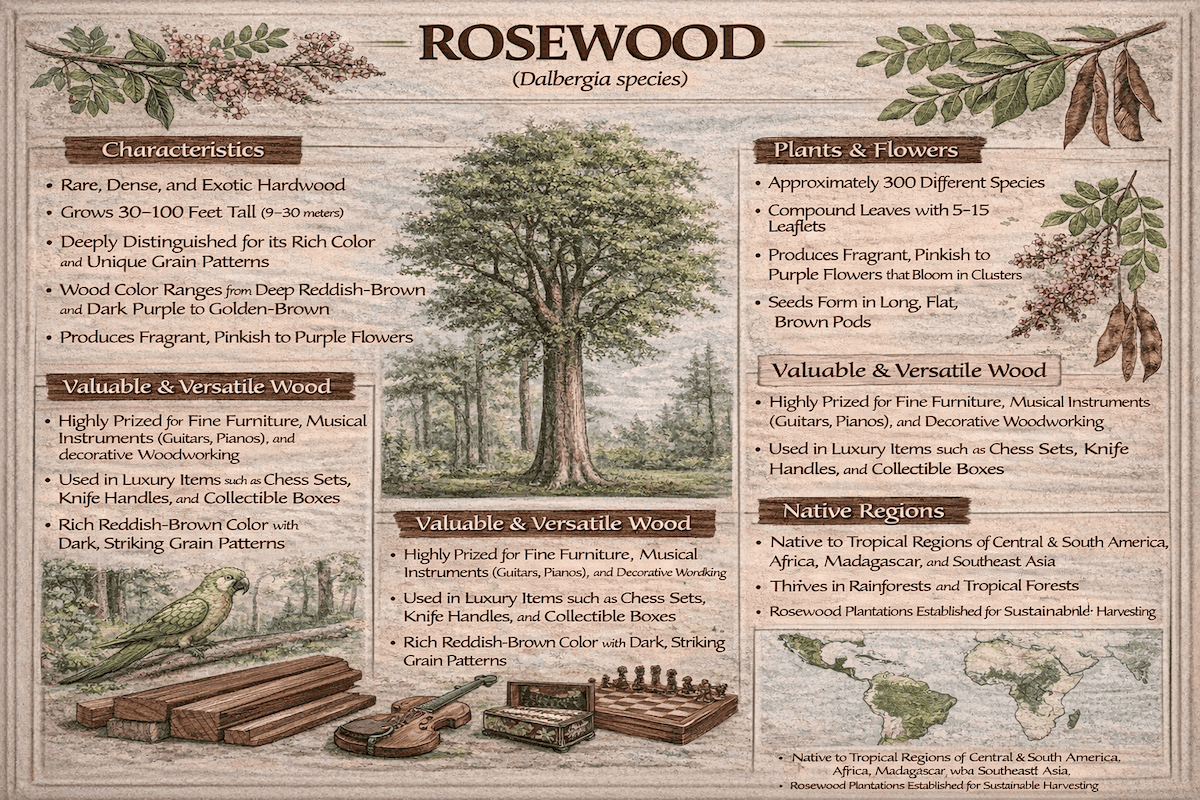
Rosewood trees belong to the Dalbergia genus, a group of tropical hardwood species found across Central and South America, Africa, Madagascar, and Southeast Asia. In South America, rosewood is most commonly associated with the Amazon rainforest, which spans more than 2 billion acres and provides the warm, humid conditions these trees require to thrive. Regions such as Amazonas, Pará, Rondônia, and Acre have historically supported significant rosewood populations.
Among all rosewood species, Dalbergia nigra—commonly known as Brazilian rosewood—is the most prized for its exceptional density, rich coloration, and striking grain patterns. Unlike many other Amazon-associated species, Dalbergia nigra is native to the Atlantic Forest biome along Brazil’s eastern coastline, extending into parts of Paraguay and Argentina. This distinction is important, as it highlights the species’ adaptability to coastal tropical environments—conditions similar to those found in parts of the United States Virgin Islands.
Over the past century, unsustainable harvesting and illegal logging have drastically reduced natural rosewood populations. Due to the high value of its timber—particularly for musical instruments and luxury woodworking— Brazilian rosewood has been heavily exploited and is now protected under international conservation agreements. Today, accurately estimating remaining old-growth populations is difficult, but experts believe that fewer than 4,500 mature trees remain in the wild.
This rarity has transformed rosewood from a widely harvested resource into a globally scarce, high-value hardwood. As a result, responsibly managed plantations are increasingly viewed as a critical pathway for both conservation and long-term timber production, helping to meet global demand while reducing pressure on remaining natural forests.
| Wood Type | Average Price / Board Foot | High-End / Premium Range | Key Value Drivers |
|---|---|---|---|
| 🌹 Rosewood | $22 – $50+ | $80 – $150+ | Rarity, CITES restrictions, exotic grain, musical use |
| 🌳 Mahogany | $6 – $22 | $30 – $50+ | Workability, availability, furniture demand |
| 🌿 Teak | $20 – $45 | $60 – $80+ | Durability, oil content, outdoor use, marine demand |
Few woods make a stronger first impression than freshly sawn rosewood. The moment a plank is cut, its surface reveals deep reddish-browns, purple undertones, dramatic black veining, and a natural luster that gives the wood a rich, almost polished appearance even before finishing. Fresh sawn rosewood is not merely lumber—it is a visual experience, prized for the way its grain seems to move, shimmer, and deepen in character as light passes across the board.
That rare beauty, combined with density, durability, fragrance, and tonal quality, makes rosewood one of the world’s most admired exotic hardwoods. Its unique characteristics make it a versatile material for a variety of applications, including:
Our patented propagation and planting methods are designed to dramatically accelerate early-stage tree growth while improving survival rates and long-term timber quality. By refining conventional plug-and-plant forestry systems, we produce tall, structurally superior seedlings that can reach 6–8 feet in just two years prior to field transplantation.
These advanced seedlings develop straight, branch-free trunks—resembling the clean form of a young palm—making them ideal for producing clear-grained sawlogs and premium veneer wood, the highest-value segment of the timber market. In tropical environments such as the U.S. Virgin Islands (USVI), selective on-site pruning further enhances trunk quality and uniformity.
A key innovation lies below the surface. Instead of traditional root balls, our seedlings develop elongated, vertical root stems that are lightweight, cost-effective to transport, and exceptionally easy to plant. These root systems are designed for rapid downward penetration, allowing trees to access deep soil moisture and anchor quickly without external support.
Using a tractor-mounted post-hole auger, planting crews can install each tree with precision and efficiency—eliminating the need for staking or wind bracing. While conventional plug seedlings often experience up to 40–50% mortality in the first year, our system consistently delivers near-total survival and rapid establishment.
Once a site is prepared, a digital mapping system lays out optimized crop circle or spiral planting patterns, maximizing light exposure, airflow, and land productivity. These coordinates are uploaded to a drone, which marks each planting location with pinpoint accuracy.
A tractor-mounted auger then drills deep, cylindrical holes matched to each root stem. Seedlings are inserted vertically, backfilled with native soil, and finished with protective ground covers that suppress weeds and stabilize the planting zone. This streamlined “drill and fill” method enables fast deployment, uniform spacing, and exceptional consistency across large-scale plantations.
These techniques are especially powerful when applied to rosewood (Dalbergia species), one of the most valuable hardwoods in the world. By carefully managing germination and early growth stages, we produce tall saplings that can reach 8–10 feet within three years, with clean, knot-free trunks ideal for veneer-grade timber.
This early structural advantage significantly shortens the pathway to high-value harvests, while maintaining the long-term integrity and density that make rosewood so desirable in global markets.
Our proprietary pyramid pot system is engineered to guide root development downward rather than outward. This creates a strong, centralized root axis that improves anchoring, drought resistance, and transplant success.
The result is a tree that establishes faster, requires less intervention, and is naturally resilient—eliminating the need for staking while improving long-term growth performance.
Plantation establishment begins with site clearing, grading, and soil preparation, followed by the implementation of digitally designed spiral or crop circle layouts. Drone-guided marking ensures precision placement, while auger drilling enables rapid installation of each tree.
After planting, each sapling is backfilled, watered, and protected with ground covers to reduce competition and moisture loss. This integrated system creates a highly efficient, scalable model for establishing high-density, high-performance timber plantations.
Rosewood represents more than timber—it is a long-term, appreciating biological asset. With global demand consistently exceeding supply, high-quality rosewood offers strong potential for capital appreciation, inflation protection, and portfolio diversification.
Unlike traditional investments, tree plantations grow in value biologically over time, compounding both volume and quality. When combined with carbon markets, land appreciation, and sustainable harvesting strategies, rosewood plantations can deliver multiple revenue streams.
Establishing plantations in the U.S. Virgin Islands (USVI) provides a powerful combination of environmental alignment and financial incentives. The territory actively supports sustainable agriculture, reforestation, and climate-positive business models.
By combining advanced propagation technology, precision planting systems, and strategic location advantages, this model delivers a rare opportunity to align profitability, scalability, and environmental stewardship in a single integrated plantation system.
From maple to oak, hardwoods whisper of centuries past, their slow growth a testament to patience and value over time.
Rosewood is prized for its dense, fine grain, striking color variation, natural oils, and exceptional finishing qualities. Freshly sawn rosewood can reveal dramatic reds, dark chocolate tones, purple undertones, and black veining that make each board visually unique. It is also valued for the clear, resonant sound it brings to musical instruments. Slow growth, limited legal supply, and strong demand from furniture makers, luthiers, designers, and collectors combine to make rosewood one of the world’s most sought-after hardwoods.
Many rosewood species in the genus Dalbergia are regulated under CITES. Legality depends on the exact species, where and how it was harvested, and whether proper export and import documentation is in place—especially for international trade. When in doubt, buy only from suppliers who can provide documented legal origin, permits where required, and a clear chain of custody.
Brazilian rosewood (Dalbergia nigra) is a rare Atlantic Forest hardwood famous for luxury furniture, veneers, and high-end musical instruments. Over-harvesting, combined with extensive habitat loss in Brazil’s Atlantic Forest, pushed the species into severe decline. It is now listed on CITES Appendix I, which means wild-harvested timber is generally prohibited from international trade. Conservation efforts today focus on protecting native habitat, restoring degraded forest areas, and encouraging legal plantation-grown alternatives.
Most commercial rosewoods are tropical or subtropical trees that prefer warm temperatures, well-drained soils, and distinct wet and dry seasons. They generally perform best in frost-free or near-frost-free climates. Successful plantation development depends on matching the right species to the right site, along with careful soil preparation, weed suppression, irrigation planning, and early pruning.
Growth rates vary by species, rainfall, soil depth, and plantation management, but high-value rosewood often takes 25–40 or more years to reach premium sawlog size. Intensive silviculture—including pruning, weed control, careful spacing, and timely thinning—can improve trunk quality and shorten the path to a higher-value harvest. Even with improved methods, rosewood remains a long-term timber investment rather than a quick-rotation crop.
Rosewood is used in fine furniture, premium veneers, luxury flooring, decorative turnings, carvings, cabinetry, and high-end musical instruments such as guitars, violins, and pianos. It is especially admired for tabletops, instrument backs and sides, fingerboards, and one-of-a-kind decorative objects. Its stability, density, and tonal qualities make it one of the most respected specialty hardwoods in the world.
Valuation depends on tree diameter, height, straightness, species, wood quality, stocking per acre, local demand, and the cost to harvest and transport logs. The end market also matters greatly, since veneer-quality logs command much higher prices than ordinary sawlogs. Tools like the Tree Value Calculator and Tree Carbon Calculator can help estimate timber and carbon value as part of a broader plantation financial model.
Wild-harvested rosewood usually comes from native or old-growth forests and is heavily restricted—or fully banned for some species—in many countries. Plantation-grown rosewood is established intentionally on private, cooperative, or community-managed land, making legal origin and traceability easier to document. Well-managed plantations can reduce pressure on natural forests while creating a more reliable long-term supply for ethical buyers.
Yes. Rosewood can be integrated with crops, fruit trees, nurse trees, or other shade-compatible species in a mixed agroforestry system, provided light, spacing, and moisture needs are respected. This can create layered production systems that combine short-term cash flow with long-term timber value. Using a tree spacing calculator can help optimize planting density and layout.
Rosewood is a true hardwood. It comes from broadleaf angiosperm trees rather than conifers. Its dense grain, fine pores, rich natural oils, and long-lasting durability place it among the most valuable hardwoods used in specialty wood markets.
Rosewood flooring is typically harder, denser, and more visually dramatic than many common flooring species such as oak or maple. Its deep color contrast and bold grain patterns create a premium appearance, while its hardness can provide excellent wear resistance. It should still be installed according to best practices for hardwood floors, including acclimation, moisture control, and the use of compatible finishes to reduce movement, surface checking, or gapping.
Well-managed rosewood plantations can store significant amounts of carbon, reduce pressure on remaining native forests, and help restore degraded land. When integrated with food crops, community forestry, or regenerative land-use systems, they can also create jobs, diversify income, improve soil stability, and strengthen long-term landscape resilience.
Key risks include regulatory changes, pests and disease, wildfire, storm damage, drought, price volatility, and inconsistent management quality. Long time horizons also require patient capital and careful legal structuring. Risk can be reduced through diversification across species and locations, strong plantation oversight, transparent reporting, and conservative financial modeling.
To discuss rosewood plantations, timber value, carbon storage, or long-term forestry investment opportunities, you can use the Tree Plantation contact form to request project details, site information, and additional modeling assumptions.
Copyright © All rights reserved Tree Plantation