


 INVEST
 PLANT
PLANT
 SOFTWOODS
 HARDWOODS
 CALCULATORS
 RESOURCES
 REFOREST

Softwoods
Learn More
A complete guide to how cattle ranching drives deforestation, impacts biodiversity, contributes to climate change, and reshapes global ecosystems.
Cattle ranching is the #1 cause of deforestation worldwide. In tropical regions like the Amazon, vast areas of rainforest are cleared each year to create pasture for livestock, making beef production the single largest driver of global forest loss.
Definition: Cattle ranching and deforestation refers to the clearing of forests to establish grazing land for livestock, often resulting in permanent ecosystem conversion and environmental decline.
Cattle ranching is the practice of raising livestock—primarily cows—for beef, dairy, and leather production. It is one of the most widespread forms of land use globally, covering vast areas of grasslands, savannas, and increasingly, former forest ecosystems.
Ranching systems range from small-scale, traditional grazing to large industrial operations where thousands of cattle are raised on extensive pastureland. In many regions, especially in South America, forests are cleared specifically to create these grazing areas, linking cattle production directly to deforestation.
Cattle require significant land resources compared to other forms of food production. As global demand for beef and dairy products continues to grow, more land is converted into pasture, often at the expense of biodiverse ecosystems such as tropical rainforests and dry forests.
In addition to meat production, cattle ranching supports global industries such as leather goods, processed foods, and agricultural exports. However, its expansion has major environmental implications, including habitat destruction, soil degradation, and increased greenhouse gas emissions.
Feel free to share this cattle ranching and deforestation infographic explaining how pasture expansion, beef production, forest clearing, wildlife habitat loss, carbon emissions, soil degradation, and water pollution are connected. Please include a link back to this page as the source.
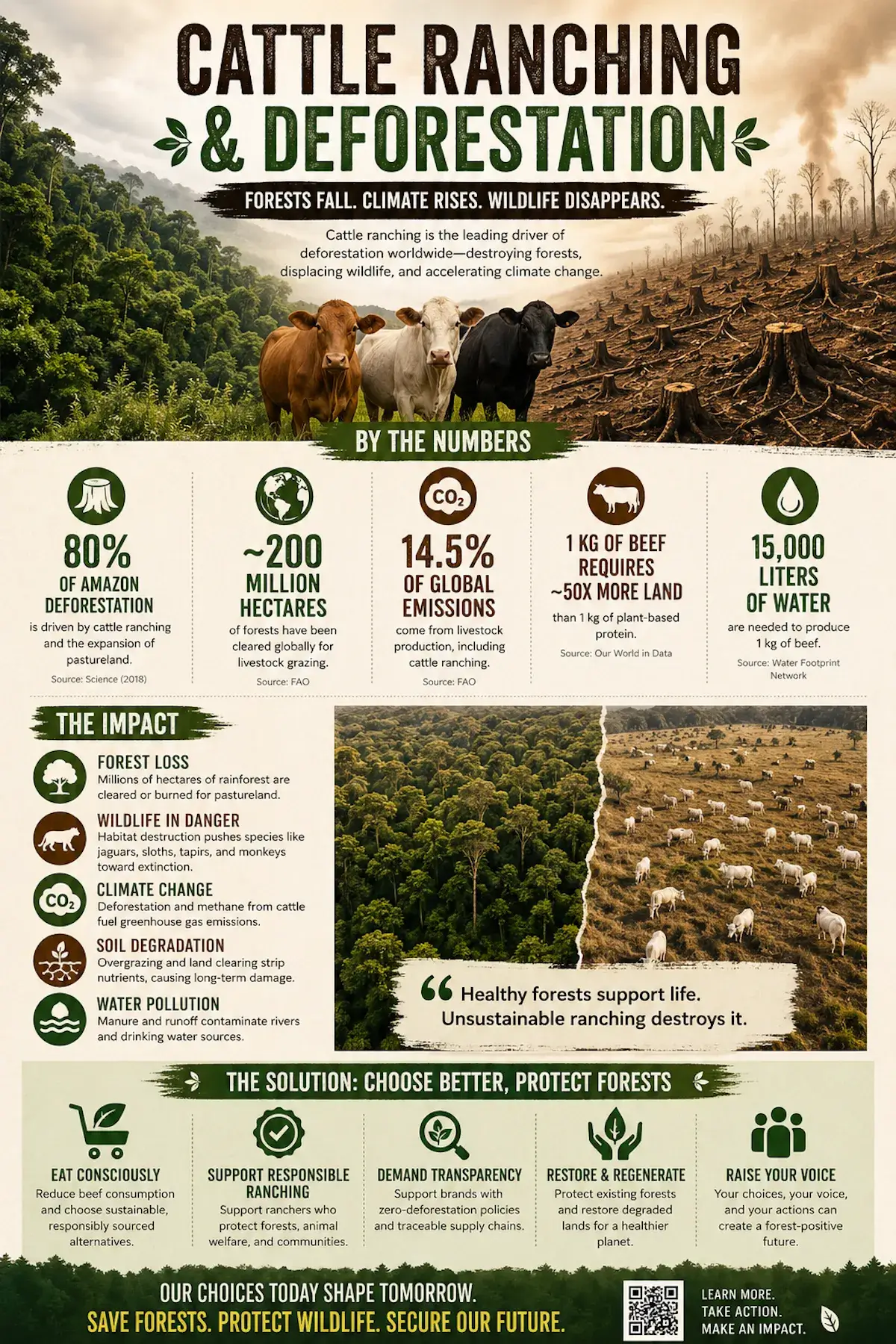
Cattle ranching drives deforestation by converting forested land into pasture for grazing. This process typically begins with large-scale tree removal, where forests are cut down and cleared to make space for livestock. In many regions, especially in the tropics, this clearing is followed by burning to quickly remove remaining vegetation and prepare the land.
Once the land is cleared, grasses are planted or allowed to grow naturally to support cattle grazing. Unlike temporary agricultural systems, pastureland is often maintained for long periods, preventing forests from regenerating. Over time, repeated grazing can degrade soil quality, making it even more difficult for native vegetation to recover.
In addition to direct clearing, cattle ranching also accelerates deforestation indirectly. New roads and infrastructure built to support ranching operations open previously remote forest areas to further expansion, logging, and agricultural development. This creates a cycle of ongoing deforestation that extends beyond the initial clearing.
The result is not just the loss of trees, but the collapse of entire ecosystems. Wildlife habitats are destroyed, carbon stored in vegetation and soils is released into the atmosphere, and natural systems that regulate water and climate are disrupted.
Cattle ranching contributes to climate change through deforestation and livestock emissions.
Cattle ranching expansion is driven by a combination of global market demand, economic incentives, and land-use dynamics. These forces encourage the conversion of forests into pasture, particularly in regions where land is inexpensive and regulation is limited.
Together, these drivers create strong financial incentives for deforestation, making cattle ranching one of the most significant forces behind global forest loss.
Overgrazing reduces vegetation cover, leading to soil erosion and long-term land degradation. In extreme cases, it contributes to desertification.
| Category | Cattle Ranching Impact | Why It Matters |
|---|---|---|
| Primary Deforestation Driver | Cattle ranching is widely recognized as the leading driver of Amazon forest clearing. | Pasture expansion converts rainforest into long-term grazing land. |
| Land Conversion | Forests are cleared, burned, and replaced with pasture grasses. | This prevents natural forest regeneration and fragments wildlife habitat. |
| Climate Impact | Deforestation releases stored carbon, while cattle produce methane emissions. | This creates a dual climate impact from both land clearing and livestock. |
| Biodiversity Impact | Pasture expansion removes habitat for forest-dependent species. | Wildlife displacement, habitat fragmentation, and species decline increase. |
| Long-Term Land Damage | Overgrazing can compact soil, reduce vegetation cover, and increase erosion. | Degraded pasture can lead to lower productivity and further forest clearing. |
FAQ • CATTLE • DEFORESTATION • CLIMATE
Yes, cattle ranching is widely considered the leading global driver of deforestation, especially in tropical regions like the Amazon.
Forests are cleared to create pasture for grazing, often permanently converting ecosystems.
It contributes through methane emissions and carbon released from deforestation.
The Amazon, Brazil, Bolivia, Paraguay, and Central America are major hotspots.
Sustainable land management, reduced demand, and improved grazing systems can reduce impact.
Copyright © All rights reserved Tree Plantation