 INVEST
 PLANT
PLANT
 SOFTWOODS
 HARDWOODS
 CALCULATORS
 RESOURCES
 REFOREST

Softwoods
Learn More




A complete guide to how water scarcity, climate change, and land use are accelerating desertification across the Middle East—and how different countries are responding
A comprehensive guide to desertification in the Middle East, including extreme water scarcity, climate pressures, land degradation, and how different countries are adapting—or struggling—to sustain ecosystems and agriculture.
Desertification is the process by which land becomes degraded in dry and semi-arid regions, reducing its ability to support vegetation, agriculture, and ecosystems. This degradation affects soil structure, water retention, and biological activity, making the land less productive over time.
It is important to understand that desertification does not mean land is turning into a desert overnight. Instead, it is a gradual decline in land quality caused by a combination of environmental stress and human activity. As soil nutrients are depleted, vegetation disappears, and erosion increases, the land becomes increasingly difficult to restore.
Desertification is driven by both natural factors—such as drought and climate variability—and human pressures, including overgrazing, deforestation, poor irrigation practices, and excessive water use. Once degradation reaches a critical point, ecosystems can collapse, leading to long-term or permanent damage.
The Middle East is one of the most water-stressed regions in the world, making it especially vulnerable to desertification. Much of the region already experiences low rainfall, high temperatures, and fragile ecosystems that are easily disrupted by environmental and human pressures.
As populations grow and demand for food, water, and land increases, natural systems are placed under greater strain. Rivers, aquifers, and soils are being used faster than they can recover, accelerating land degradation across multiple countries.
In many areas, desertification is not just an environmental issue—it is a major economic and social challenge. Reduced agricultural productivity, declining water supplies, and ecosystem damage can contribute to food insecurity, migration, and regional instability.
Desertification in the Middle East is caused by a combination of environmental stress and human activity. These factors often interact, creating a cycle of land degradation that becomes increasingly difficult to reverse.
Together, these drivers create a feedback loop where degraded land holds less water, supports less vegetation, and becomes increasingly vulnerable to further desertification.
Desertification affects countries across the Middle East differently, depending on climate, water resources, land use, and governance. Some regions are experiencing severe degradation, while others are investing in adaptation and water management solutions.
This regional variation highlights a key reality: while some areas are experiencing severe desertification, others are adapting through innovation, technology, and improved resource management.
Feel free to share this desertification in the Middle East infographic explaining how arid lands, scarce water, rising temperatures, groundwater depletion, low rainfall, soil degradation, food insecurity, biodiversity loss, and land restoration solutions are connected. Please include a link back to this page as the source.
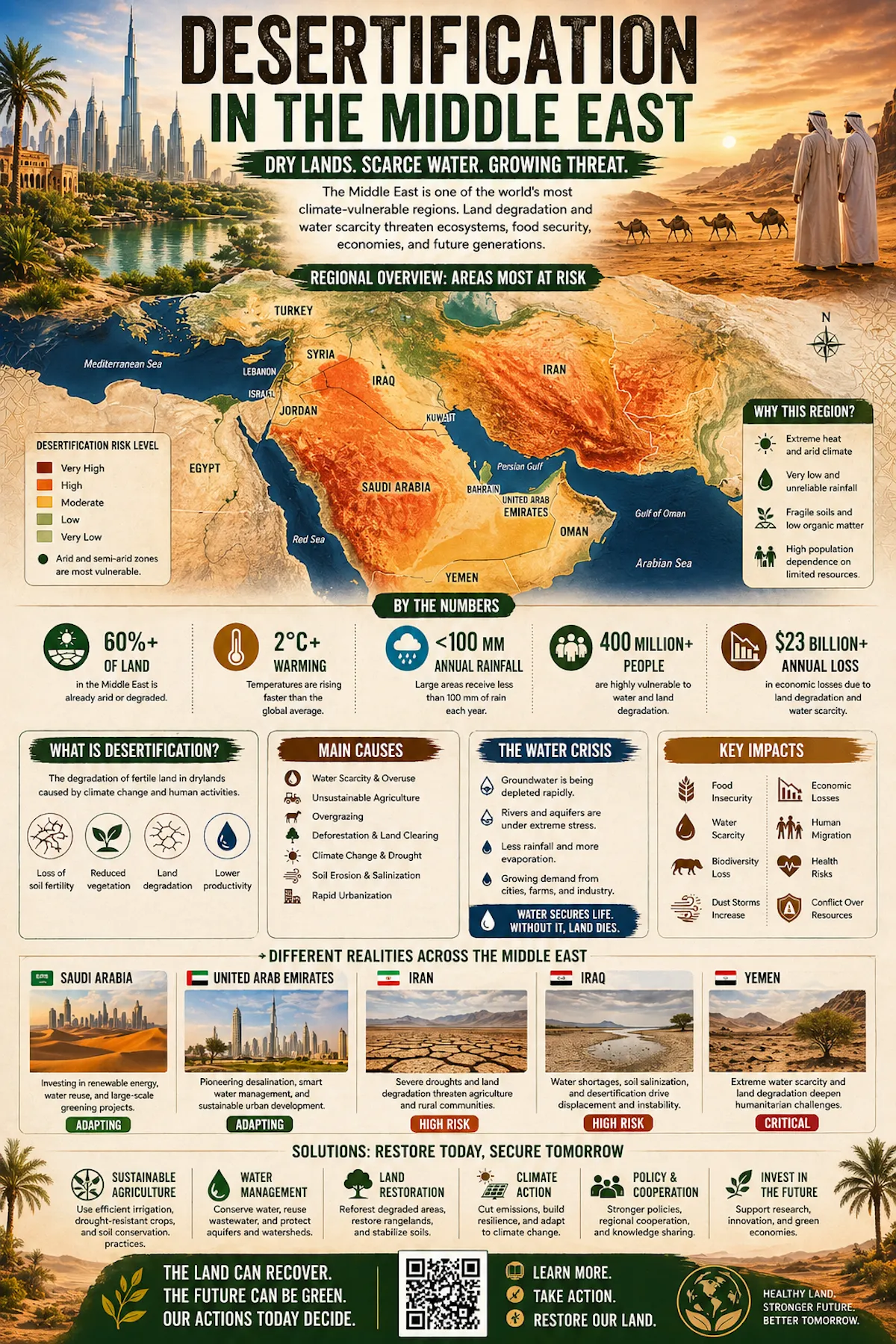
| Category | High Risk Regions | Adaptive Regions |
|---|---|---|
| Water Availability | Severely limited and declining | Managed through technology |
| Land Degradation | Rapid desertification | Stabilized or improved land |
| Management Strategy | Overuse and depletion | Efficient water systems and innovation |
| Example Countries | Iran, Iraq, Syria | Israel, UAE (partial) |
Aquifer depletion: Groundwater is being used faster than it can be replenished.
Tigris-Euphrates river crisis: Reduced flows due to upstream use and climate change.
Desalination: Increasing reliance on energy-intensive water production.
Water scarcity: Limited freshwater availability per person.
The region is becoming hotter and drier, with increasing heatwaves, reduced rainfall, and greater evaporation rates.
FAQ • MIDDLE EAST • DESERTIFICATION • WATER • CLIMATE
Due to water scarcity, climate change, land overuse, and population pressure.
Many regions face severe water shortages due to overuse and declining natural supply.
A decline in river flow affecting water availability across Iraq and Syria.
It increases heat, reduces rainfall, and accelerates land degradation.
Yes, through water management, sustainable agriculture, and restoration efforts.
Copyright © All rights reserved Tree Plantation



