A complete guide to desertification in Africa, including the Sahel crisis, water scarcity, land degradation, food security risks, and the large-scale solutions reshaping the continent’s future
Desertification in Africa: Causes, Sahel Expansion, Water Crisis & Food Security
DESERTIFICATION • AFRICA • SAHEL • FOOD SECURITY • WATER • CLIMATE
What Is Desertification in Africa and Why Is the Sahel at Risk?
A complete guide to desertification in Africa, including the Sahel crisis, water scarcity, land degradation, food security risks, ecosystem loss, migration pressure, and large-scale restoration efforts.
Quick Answer:
Desertification in Africa is the degradation of dryland ecosystems caused by climate change, drought, overgrazing, deforestation, soil erosion, and water scarcity. The Sahel is one of the most affected regions because farming, grazing, rainfall, and fragile soils are all under increasing pressure.
Definition:
Desertification in Africa refers to the decline of productive land in arid and semi-arid regions, where soil fertility, vegetation cover, water availability, and ecosystem health are reduced over time.
What Is Desertification in Africa?
Desertification in Africa is the process by which fertile land becomes degraded due to a combination of climate pressures and human activities. This leads to declining soil quality, reduced vegetation, and decreased agricultural productivity.
Africa is particularly vulnerable due to its climate, reliance on agriculture, and rapidly growing population. Many regions depend on rain-fed farming, making them highly sensitive to drought and land degradation.
Regional Breakdown
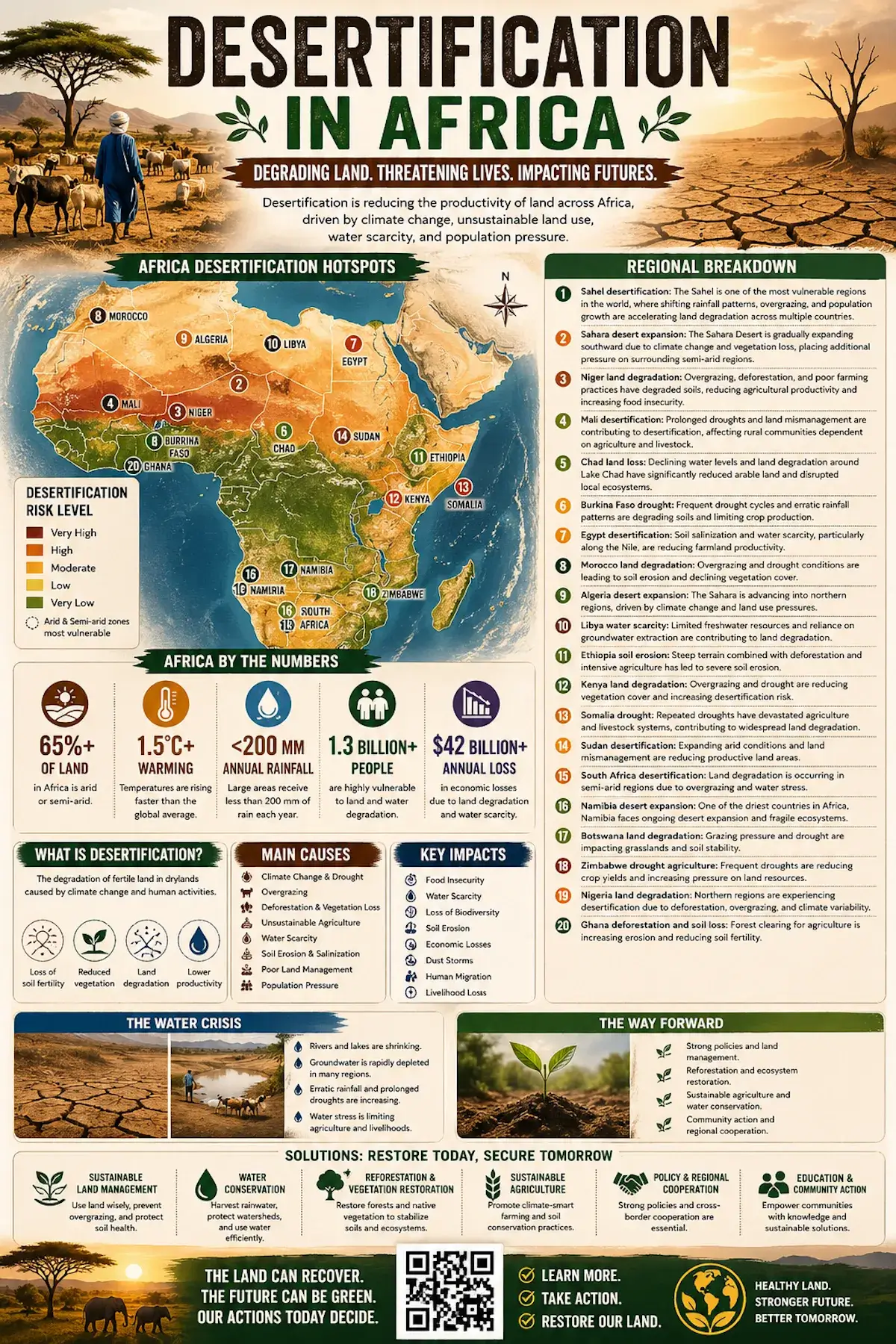
Desertification impacts regions across Africa in different ways, depending on climate, land use, water availability, and population pressure. From the Sahel to Southern Africa, land degradation is reshaping ecosystems, agriculture, and livelihoods.
Sahel desertification: The Sahel is one of the most vulnerable regions in the world, where shifting rainfall patterns, overgrazing, and population growth are accelerating land degradation across multiple countries.
Sahara desert expansion: The Sahara Desert is gradually expanding southward due to climate change and vegetation loss, placing additional pressure on surrounding semi-arid regions.
Niger land degradation:Overgrazing, deforestation, and poor farming practices have degraded soils, reducing agricultural productivity and increasing food insecurity.
Mali desertification: Prolonged droughts and land mismanagement are contributing to desertification, affecting rural communities dependent on agriculture and livestock.
Chad land loss: Declining water levels and land degradation around Lake Chad have significantly reduced arable land and disrupted local ecosystems.
Burkina Faso drought: Frequent drought cycles and erratic rainfall patterns are degrading soils and limiting crop production.
Egypt desertification: Soil salinization and water scarcity, particularly along the Nile, are reducing farmland productivity.
Morocco land degradation: Overgrazing and drought conditions are leading to soil erosion and declining vegetation cover.
Algeria desert expansion: The Sahara is advancing into northern regions, driven by climate change and land use pressures.
Libya water scarcity: Limited freshwater resources and reliance on groundwater extraction are contributing to land degradation.
Ethiopia soil erosion: Steep terrain combined with deforestation and intensive agriculture has led to severe soil erosion.
Kenya land degradation: Overgrazing and drought are reducing vegetation cover and increasing desertification risk.
Somalia drought: Repeated droughts have devastated agriculture and livestock systems, contributing to widespread land degradation.
Sudan desertification: Expanding arid conditions and land mismanagement are reducing productive land areas.
South Africa desertification: Land degradation is occurring in semi-arid regions due to overgrazing and water stress.
Namibia desert expansion: One of the driest countries in Africa, Namibia faces ongoing desert expansion and fragile ecosystems.
Botswana land degradation: Grazing pressure and drought are impacting grasslands and soil stability.
Zimbabwe drought agriculture: Frequent droughts are reducing crop yields and increasing pressure on land resources.
Nigeria land degradation: Northern regions are experiencing desertification due to deforestation, overgrazing, and climate variability.
Ghana deforestation and soil loss: Forest clearing for agriculture is increasing erosion and reducing soil fertility.
Desertification in Africa Infographic
Feel free to share this desertification in Africa infographic explaining how land degradation, drought, water scarcity, soil erosion, overgrazing, deforestation, regional hotspots, food insecurity, and restoration solutions are connected. Please include a link back to this page as the source.
Share This Desertification in Africa Infographic
Copy and paste the embed code below.
African Water Crisis
Water scarcity is one of the most critical drivers of desertification in Africa. Limited rainfall, overuse of water resources, and climate change are reducing the availability of both surface and groundwater across the continent.
Water scarcity across dry regions: Many parts of Africa receive limited rainfall, making water availability a constant challenge for agriculture and communities.
Groundwater depletion: Aquifers are being over-extracted in some regions, reducing long-term water security.
Recurring drought cycles: Droughts are becoming more frequent and severe, limiting vegetation growth and increasing land degradation.
Nile River water stress: The Nile is under increasing pressure from population growth, upstream usage, and climate variability.
Lake Chad collapse: Once one of Africa’s largest lakes, Lake Chad has dramatically shrunk due to water diversion and climate change, creating severe environmental and economic impacts.
As water becomes scarcer, land loses its ability to sustain vegetation and agriculture, accelerating desertification and increasing pressure on already vulnerable communities.
Climate Change in Africa
Climate change is increasing temperatures and altering rainfall patterns across Africa, intensifying droughts and accelerating land degradation.
 INVEST
 PLANT
PLANT
 SOFTWOODS
 HARDWOODS
 CALCULATORS
 RESOURCES
 REFOREST