


 INVEST
 PLANT
PLANT
 SOFTWOODS
 HARDWOODS
 CALCULATORS
 RESOURCES
 REFOREST

Softwoods
Learn More
A comprehensive guide to desertification in the U.S. Southwest, including climate change, water scarcity, soil degradation, ecosystem decline, and strategies for restoring dryland landscapes.
Desertification is the process by which fertile land becomes degraded, losing its ability to support vegetation, wildlife, and agriculture. Over time, soil health declines, plant life disappears, and ecosystems become less productive and more fragile.
This process is driven by a combination of natural conditions—such as drought and climate variability—and human activities, including overgrazing, deforestation , unsustainable farming, and excessive water use.
Unlike natural deserts, which are stable ecosystems, desertification represents the decline of once-productive land, often making it difficult or impossible to restore without intervention.
The U.S. Southwest—including Arizona, Nevada, New Mexico, and parts of California—is naturally arid. However, increasing water demand, rising temperatures, and land-use pressures are accelerating desertification beyond natural levels.
Feel free to share this desertification in the U.S. Southwest infographic explaining how water scarcity, climate change, rising temperatures, groundwater depletion, declining snowpack, soil degradation, biodiversity loss, and dryland restoration are connected. Please include a link back to this page as the source.
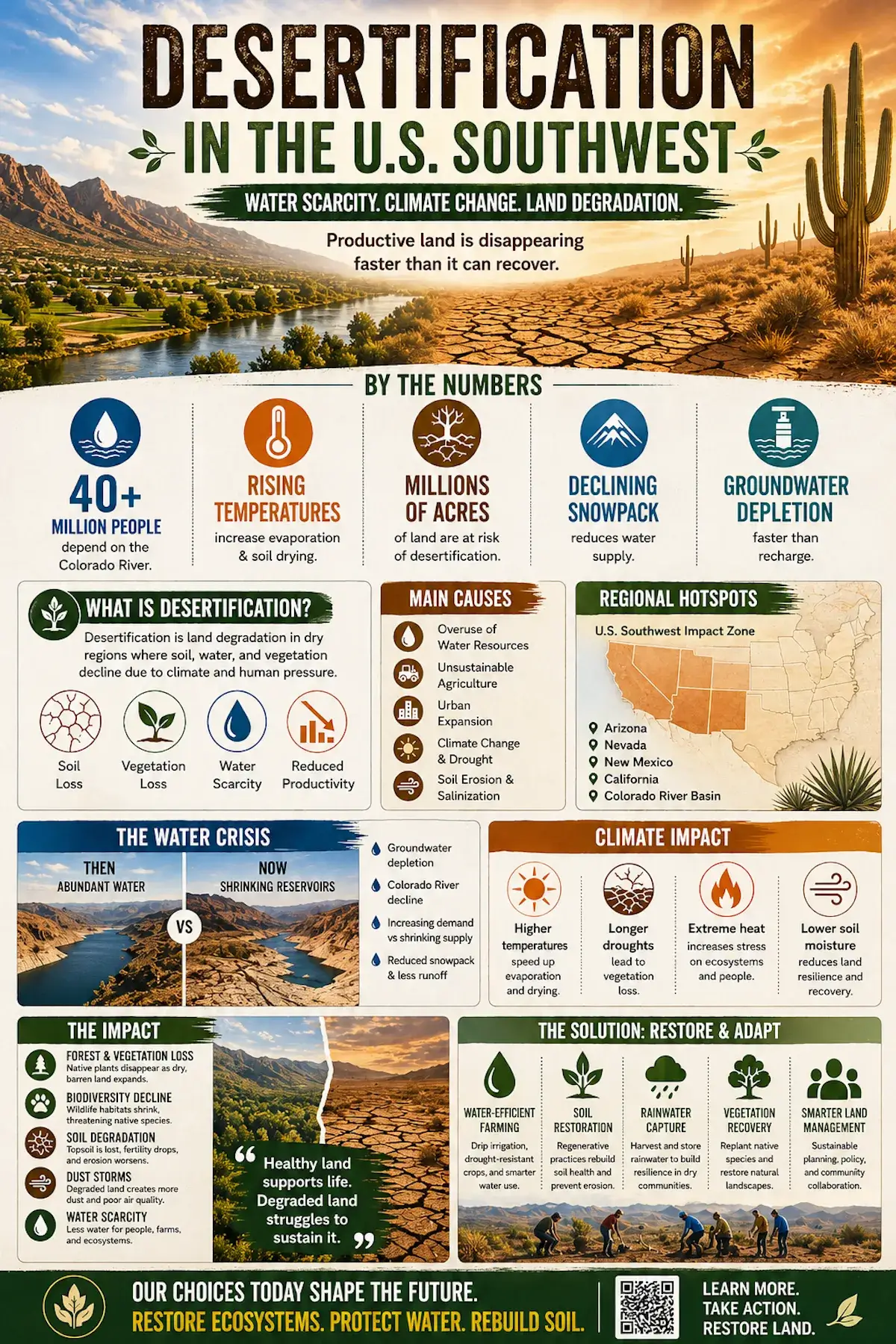
Groundwater depletion: Aquifers are being drained faster than they can recharge.
Colorado River decline: A major water source is shrinking due to overuse and drought.
Drought and water scarcity: Increasingly frequent and severe droughts reduce soil moisture and vegetation.
Rising temperatures increase evaporation rates, reduce soil moisture, and place greater stress on vegetation across the U.S. Southwest. As the atmosphere warms, land dries out faster after rainfall, droughts become more intense, and plants have a harder time surviving long periods without water.
Climate change does not create desertification by itself, but it can intensify the conditions that make land degradation worse. Heat, drought, reduced snowpack, lower streamflow, and declining groundwater recharge all combine to weaken soil systems and reduce the resilience of dryland ecosystems.
In the Southwest, the result is often described as a shift toward hotter, drier conditions. When these climate pressures combine with overgrazing, groundwater depletion, poor irrigation, urban expansion, and vegetation loss, desertification risk increases significantly.
Aridification refers to long-term drying trends due to climate change, while desertification involves land degradation caused by both climate and human activity.
Natural deserts are stable ecosystems adapted to low rainfall. Desertification, however, represents the degradation of once-productive land due to human and environmental pressures.
The Colorado River is one of the most critical water systems in the United States, supplying water to cities, farms, and ecosystems across the Southwest. However, long-term drought, climate change, and over-allocation have placed the river under extreme stress, making it a central factor in regional desertification.
As water availability declines, the ability of land to support vegetation, agriculture, and ecosystems is reduced. This accelerates soil drying, vegetation loss, and land degradation—key components of desertification in the Southwest.
Real-world examples across the U.S. Southwest show how water scarcity, land use, and climate pressures combine to accelerate desertification. These case studies highlight both the risks and the need for better land and water management strategies.
These examples illustrate how desertification is not just an environmental issue, but a combined challenge involving water management, land use, agriculture, and urban development across the Southwest.
FAQ • DESERTIFICATION • SOUTHWEST • WATER • CLIMATE
The region is naturally arid, but land degradation and water stress are increasing desertification risks.
Water overuse, drought, climate change, and land mismanagement are key drivers.
Higher temperatures and reduced precipitation intensify drought and soil degradation.
The river is overused and declining, threatening water supply across the Southwest.
Yes, through sustainable land management, water conservation, and restoration practices.
Copyright © All rights reserved Tree Plantation