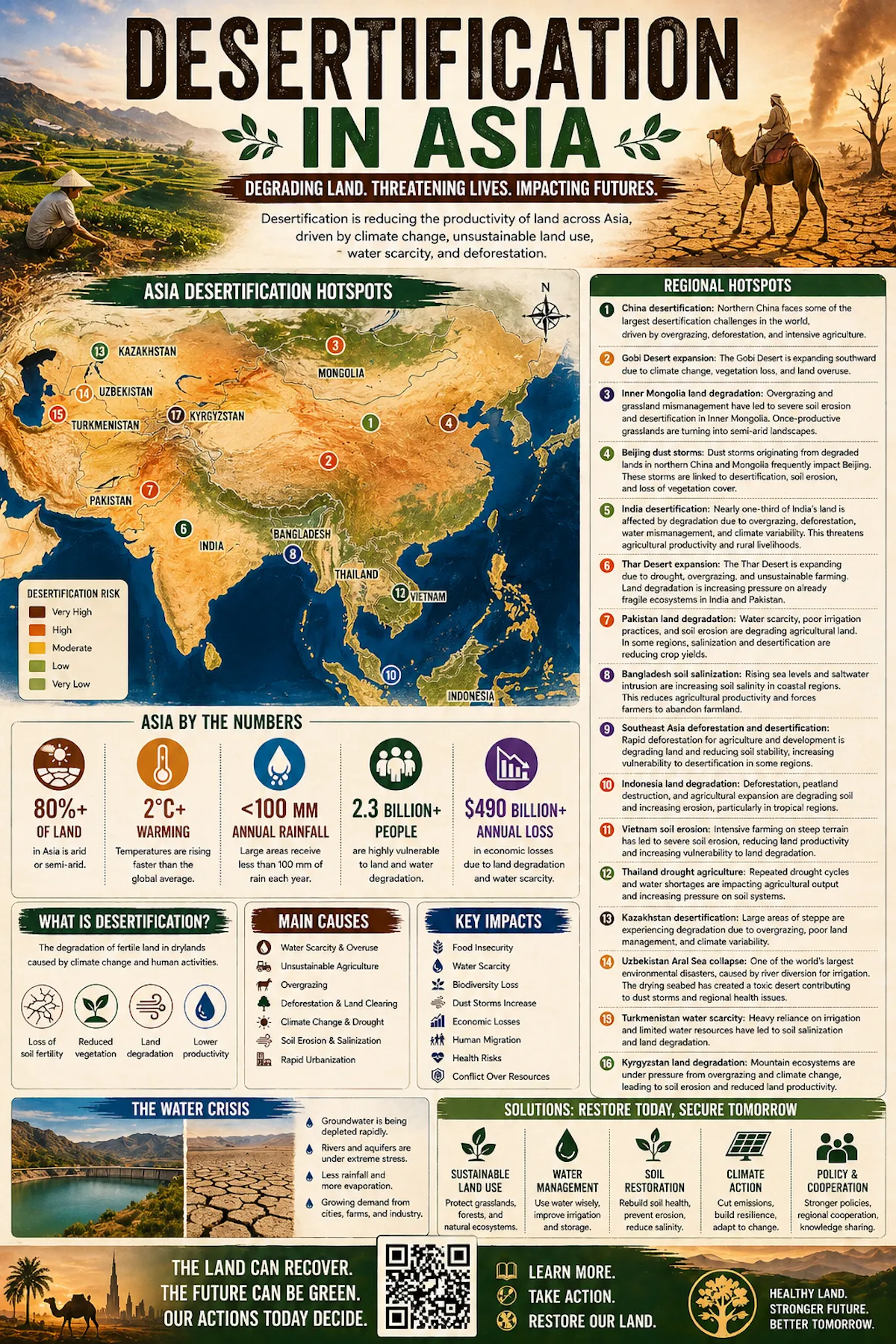
A complete guide to how climate change, water scarcity, and land use are driving desertification across Asia—and what it means for food, ecosystems, and the future
Desertification in Asia: Causes, Hotspots, Water Crisis & Land Degradation
DESERTIFICATION • ASIA • WATER CRISIS • AGRICULTURE • CLIMATE PRESSURE
What Is Desertification in Asia and Why Are Land and Water Systems Under Pressure?
A comprehensive guide to desertification in Asia, covering regional hotspots, soil degradation, water scarcity, agricultural collapse risks, and the large-scale restoration efforts shaping the future of the region.
Quick Answer:
Desertification in Asia is driven by climate change, water scarcity, deforestation, and intensive land use. As population growth increases pressure on land and water systems, soil fertility declines, ecosystems weaken, and agricultural productivity becomes less stable across many regions.
Definition:
Desertification in Asia is the long-term degradation of land in dry and semi-arid regions, where soil health, vegetation cover, water retention, and ecosystem stability are progressively reduced.
Desertification in Asia
Asia is one of the most affected regions globally when it comes to desertification. Large populations, climate variability, and intensive land use have placed enormous pressure on soil, water, and ecosystems.
Why Asia Is High Risk
High population density and land demand
Climate extremes and drought cycles
Water scarcity and river depletion
Unsustainable agriculture and deforestation
Soil Degradation and Land Loss
Soil degradation reduces fertility, increases erosion, and limits the ability of land to support crops and vegetation. In many regions of Asia, land is being degraded faster than it can recover.
Regional Hotspots
China desertification: Northern China faces some of the largest desertification challenges in the world, driven by overgrazing, deforestation, and intensive agriculture. Large areas of farmland have been degraded, prompting major government-led restoration efforts such as the Great Green Wall.
Gobi Desert expansion: The Gobi Desert is expanding southward due to climate change, vegetation loss, and land overuse. This expansion threatens agricultural regions and contributes to regional dust storms affecting millions of people.
Inner Mongolia land degradation:Overgrazing and grassland mismanagement have led to severe soil erosion and desertification in Inner Mongolia. Once-productive grasslands are turning into semi-arid landscapes.
Beijing dust storms: Dust storms originating from degraded lands in northern China and Mongolia frequently impact Beijing. These storms are linked to desertification, soil erosion, and loss of vegetation cover.
India desertification: Nearly one-third of India’s land is affected by degradation due to overgrazing, deforestation, water mismanagement, and climate variability. This threatens agricultural productivity and rural livelihoods.
Thar Desert expansion: The Thar Desert is expanding due to drought, overgrazing, and unsustainable farming. Land degradation is increasing pressure on already fragile ecosystems in India and Pakistan.
Pakistan land degradation: Water scarcity, poor irrigation practices, and soil erosion are degrading agricultural land. In some regions, salinization and desertification are reducing crop yields.
Bangladesh soil salinization: Rising sea levels and saltwater intrusion are increasing soil salinity in coastal regions. This reduces agricultural productivity and forces farmers to abandon farmland.
Southeast Asia deforestation and desertification: Rapid deforestation for agriculture and development is degrading land and reducing soil stability, increasing vulnerability to desertification in some regions.
Indonesia land degradation: Deforestation, peatland destruction, and agricultural expansion are degrading soil and increasing erosion, particularly in tropical regions.
Vietnam soil erosion: Intensive farming on steep terrain has led to severe soil erosion, reducing land productivity and increasing vulnerability to land degradation.
Thailand drought agriculture: Repeated drought cycles and water shortages are impacting agricultural output and increasing pressure on soil systems.
Kazakhstan desertification: Large areas of steppe are experiencing degradation due to overgrazing, poor land management, and climate variability.
Uzbekistan Aral Sea collapse: One of the world’s largest environmental disasters, caused by river diversion for irrigation. The drying seabed has created a toxic desert contributing to dust storms and regional health issues.
Turkmenistan water scarcity: Heavy reliance on irrigation and limited water resources have led to soil salinization and land degradation.
Kyrgyzstan land degradation: Mountain ecosystems are under pressure from overgrazing and climate change, leading to soil erosion and reduced land productivity.
Desertification in Asia Infographic
Feel free to share this desertification in Asia infographic explaining how land degradation, water scarcity, climate change, drought, soil erosion, deforestation, agricultural pressure, regional hotspots, and restoration solutions are connected. Please include a link back to this page as the source.
Share This Desertification in Asia Infographic
Copy and paste the embed code below.
Asia Drought and Water Scarcity
Water scarcity is a major driver of desertification across Asia. Rivers, aquifers, and glaciers are under increasing stress due to overuse and climate change.
Desertification and Agriculture Collapse
As soil quality declines and water becomes scarce, agricultural productivity drops. This leads to crop failures, food insecurity, and economic instability.
 INVEST
 PLANT
PLANT
 SOFTWOODS
 HARDWOODS
 CALCULATORS
 RESOURCES
 REFOREST