


 INVEST
 PLANT
PLANT
 SOFTWOODS
 HARDWOODS
 CALCULATORS
 RESOURCES
 PROGRAMS

Softwoods
Learn More
Identify • Report • Remove • Replant
This page is your North Carolina companion to our national guide: Invasive Tree Species (Weed Trees). Use it to spot common invasive trees, confirm identity, report sightings using North Carolina tools, and remove invasives in a way that prevents the dreaded cut-and-sprout thicket.
Fast path: photos → confirm ID → check SC lists/maps → report → remove to stop resprouting → replant with natives → follow-up.
Shortcut: jump to the 3-example playbook if you need a “what do I do next?” answer fast.
These are the fastest paths to “Is this invasive here?” and “Who should I tell?” in North Carolina — plus key Southeast mapping tools.
NCDA&CS Plant Industry: reporting contacts — state reporting options (phone + email) for new pests and invasive species.
North Carolina EDDMapS state lists — check presence by category and view verified observations statewide.
Forest Health: Invasive Plants — NC Forest Service overview + forest-focused context.
Invasive, non-native exotic species list (NCNPS) — ranked invasive plant list for NC (good for “is this on the list?” checks).
Tree-of-heaven (ID + management) and Callery pear / Bradford pear — practical, NC-focused guidance.
Invasive Tree Species (Weed Trees) — prevention, red flags, and national context.
Fast path: photos → confirm ID → check NC lists/maps → report → remove to stop resprouting →
replant with natives → follow-up.
Shortcut: jump to the 3-example playbook if you need a “what do I do next?” answer fast.
These are three “most-likely” encounters across North Carolina. Use them as a practical flow: identify → remove correctly → replant.
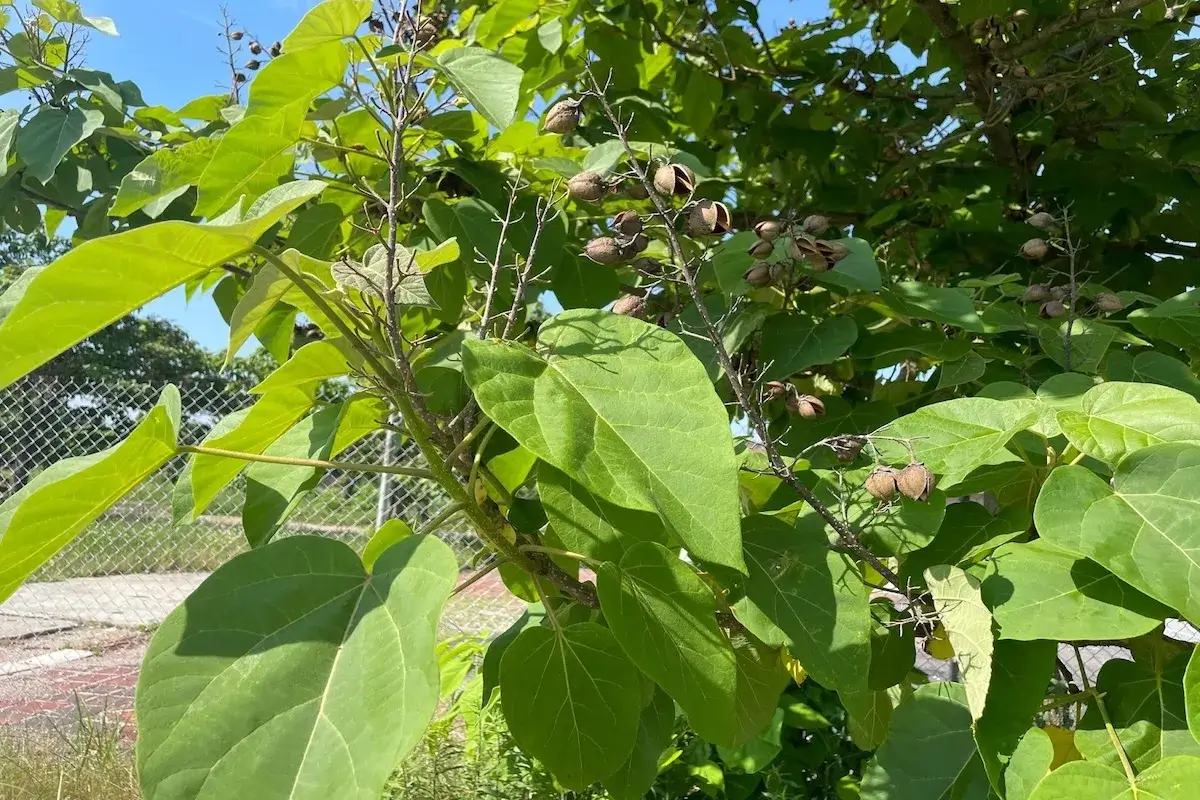
What to do once identified: look for very large, fuzzy, heart-shaped leaves, showy spring flowers, and many small seeds that blow into disturbed soil. Flag seedlings around driveways, fill dirt areas, and forest edges.
How to remove properly: remove seedlings early (hand-pull when small). For larger stems, avoid “cut-only” — plan follow-up so resprouts don’t rebound. Recheck the site after warm-season rains when new shoots appear.
Replant in its place: re-establish fast, competitive natives that close canopy quickly (tulip poplar where appropriate, river birch in moist sites, native oaks for long-term structure) plus understory shrubs for shade and soil cover.
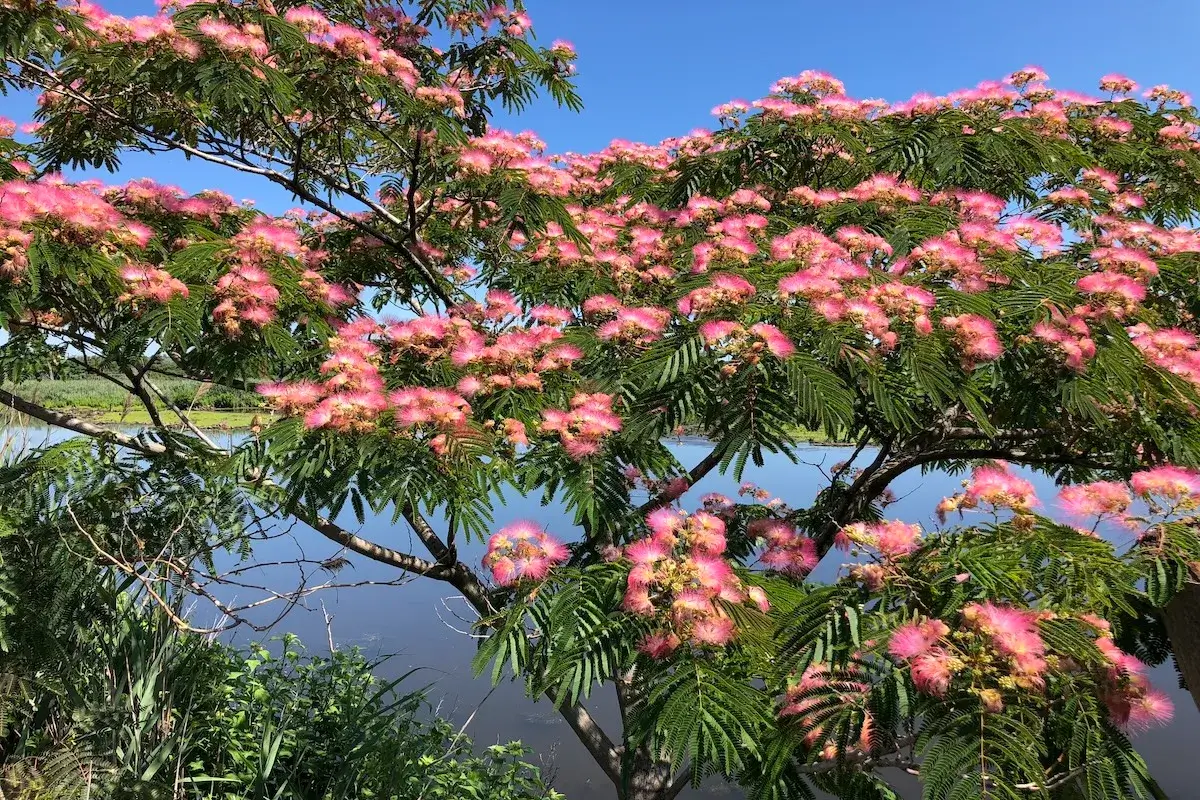
What to do once identified: scan sunny edges and creek corridors for umbrella-shaped trees with fernlike leaves and pink “powder puff” blooms. Note seedlings beneath mature trees and along water where seed washes downstream.
How to remove properly: pull seedlings when soil is moist. For mature trees, cut and prevent regrowth by monitoring the stump area and nearby seedling flushes for at least a full season.
Replant in its place: swap to native pollinator/edge trees and shrubs (redbud, serviceberry, dogwood—site dependent) and add a few canopy natives (oaks/hickories) so the site gains shade and stability instead of reopening for reinvasion.
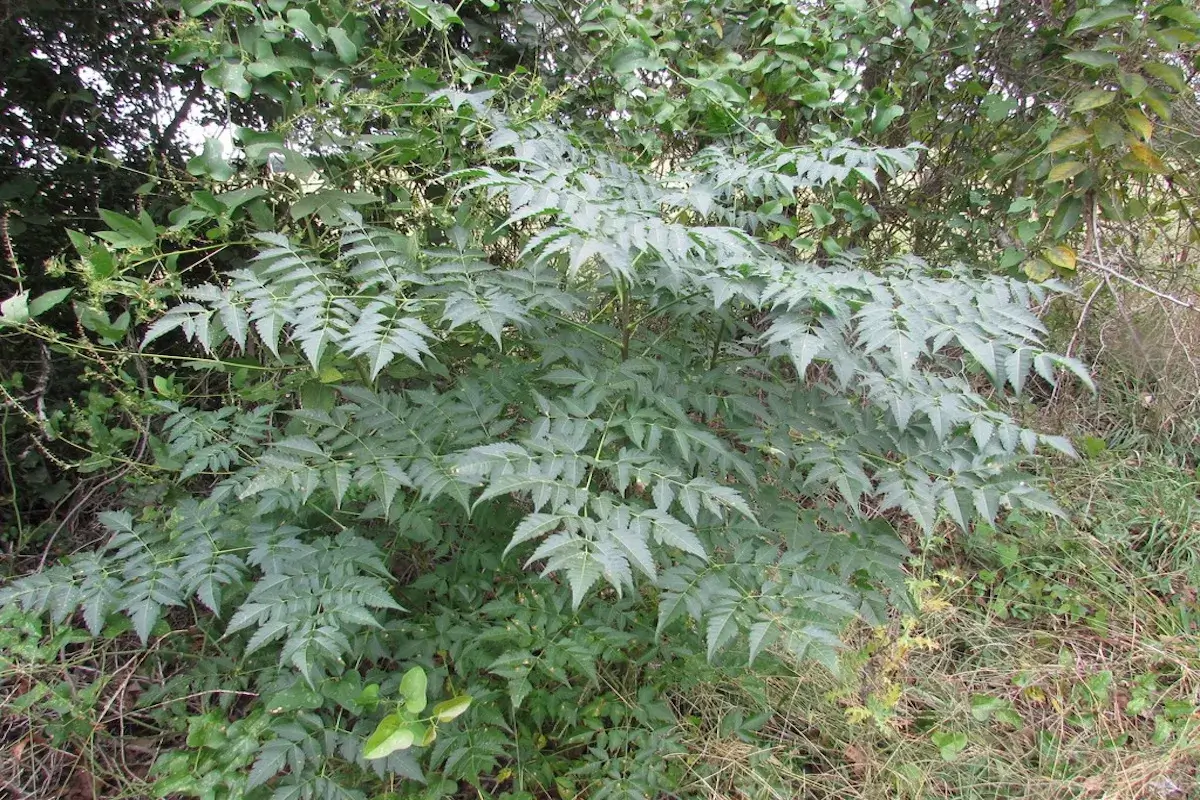
What to do once identified: watch for compound leaves, clusters of lilac-tinted flowers in season, and yellowish berries that can persist and spread via birds. Seedlings often appear under fence lines and around old homesteads.
How to remove properly: remove seedlings early and do not leave berry-laden branches on-site where wildlife can carry seed. For larger trees, remove and revisit for seedlings the following spring.
Replant in its place: replace with native shade and wildlife trees suited to your site (blackgum, red maple, southern red oak, swamp chestnut oak—site dependent) and add native shrubs for understory competition.
Rule of thumb: if you remove invasives and don’t replant (or don’t encourage natives), the site often gets reinvaded. The fastest “control” is frequently shade + competition from well-chosen natives.
Invasives don’t stop at state lines. North Carolina shares spread pathways with Georgia through major corridors and river systems, plus ornamental escape routes. Keep your internal linking cluster tight by using the Georgia hub as the “anchor page.”
Invasive Trees That Grow in Georgia — Southeast hub + roadmap.
Invasive Tree Species (Weed Trees) — definitions, prevention, and national context.
Invasive Tree Species in Texas — Gulf corridor overlap + southern spread dynamics.
| State page (internal) | Why it matters for the cluster | Status |
|---|---|---|
| North Carolina | Blue Ridge + Piedmont gradients; corridor and watershed connectivity; coastal plain introductions. | State Wide |
| South Carolina | Coastal Plain + Piedmont invasions; ornamental escape pathways; riparian spread. | State Wide |
| Alabama | Forest edge invasions + riparian spread across Mobile / Tennessee River corridors. | State Wide |
| Tennessee | Ridge & Valley spread; highway corridors; Appalachian foothills. | State Wide |
| Mississippi | Bottomland hardwoods and river systems; Gulf coastal spread. | State Wide |
Lists can vary by agency and over time. Use this as a practical shortlist of “check these first” species/groups, then confirm with SC lists/maps (see Verify & Report).
Often forms dense understory thickets—especially along creeks, floodplains, and forest edges.
Fast spreader by seed + root suckers; thrives in disturbed sites, rights-of-way, and edges.
Ornamental escape—seedlings spread into fields and edges; thorny, quick to dominate.
Common in warm regions; spreads along edges and disturbed ground.
Often escapes cultivation; spreads readily along roadsides and disturbed soils.
Can colonize disturbed sites; confirm locally before removal due to look-alikes.
If you’re unsure whether a tree is invasive (or you suspect a native look-alike), don’t rely on a single photo. Use the verification links below and confirm before transporting or dumping debris.
North Carolina’s invasion pressure isn’t uniform. These “win zones” are where invasive trees most often establish, spread, and become expensive to reverse.
Warm, long growing season; edges around wetlands, ditches, and disturbed sandy soils can spread quickly.
Field/forest margins and suburban corridors—ornamental escapes + edge effects drive expansion.
Corridors + riparian zones are key; invasives often follow disturbance and re-establish after clearing.
| High-risk site | Why it matters | What to do |
|---|---|---|
| Creek edges / floodplains | Seeds move downstream; disturbed banks establish easily. | Prioritize early removal + replant with native shrubs/trees that stabilize banks. |
| Roadsides & rights-of-way | Constant disturbance + open sun = invasion launchpads. | Report populations, avoid spreading debris, and plan repeated follow-ups. |
| Abandoned lots / old fields | Open sun favors fast invasives and seed rain from nearby ornamentals. | Remove seedlings early; establish native cover fast to prevent reinvasion. |
The most useful reports include photos + exact location. Reporting also helps agencies and local land managers prioritize control work—and it strengthens your internal SEO cluster by connecting users to authoritative resources.
Report invasive species (NCDA&CS) — public reporting portal partnered with EDDMapS.
North Carolina lists and references — see which lists are recognized and browse categories.
NC invasive plant lists (via SE-EPPC) — regional invasive plant context and listings.
Tip: When you report, add a short note about the site: “creek edge,” “right-of-way,” “abandoned lot,” or “landscape escape.” That single phrase dramatically improves how useful the report is to land managers.
Most invasive tree control fails for one reason: the plant comes back. Your plan should prevent resprouting and stop new seedlings.
Many invasives respond to cutting by resprouting into thicker growth. Plan for follow-up.
Seeds and fragments spread. Bag seed-bearing material and avoid hauling loose debris.
Open, sunny ground is an invitation. Shade + competition from natives is often your best long-term defense.
| Size / situation | Best first move | Follow-up |
|---|---|---|
| Seedlings < 2 ft | Pull when soil is moist; remove roots; minimize soil disturbance. | Recheck after rains for new flushes; mulch or replant quickly. |
| Saplings / multi-stem thickets | Remove in phases by patch; avoid spreading seed-bearing material. | Return for resprouts and seedlings; keep pressure for a full season+. |
| Large trees | Consider professional removal—especially near structures/lines/water. | Monitor stump zone and nearby soil for sprouts; replant with natives. |
Want the national overview of invasive “weed trees” and prevention strategy? Go back to: Invasive Tree Species.
Replacement choices depend on your site (wet vs dry, sun vs shade, coastal plain vs piedmont vs upstate) and your goal (shade, pollinators, privacy, wildlife, stabilization). Below are “safe starting points” that are commonly used as native replacements in the Southeast.
Eastern redbud, serviceberry, native dogwoods (site dependent), native plum (where appropriate).
Native oaks (white oak group + red oak group), hickories (where suitable), and other durable canopy species.
River birch, sweetbay magnolia (coastal/plain), native willows (managed), and other moisture-tolerant natives.
Replanting tip: If you remove invasives along a creek, replant quickly with a mix of native shrubs + a few canopy trees. Shrubs stabilize banks fast; canopy trees win long-term.
Typically: non-native trees that spread aggressively outside cultivation and cause harm (ecological, economic, or safety). Confirm using SC lists/maps and local guidance when in doubt.
Use the NCDA&CS reporting (partnered with EDDMapS), or report via EDDMapS tools. Include photos and an exact location.
Many invasive trees are adapted to disturbance. Cutting can trigger vigorous resprouting, so successful control usually requires timing + follow-up and careful disposal.
Choose native replacements matched to your site. A mix (shrubs + canopy seedlings) is often best. If you’re replacing an ornamental invasive, pick native flowering substitutes that don’t escape into wild areas.
Copyright © All rights reserved Tree Plantation