Topsoil loss is one of the most critical drivers of declining agricultural productivity—stripping away nutrients, organic matter, and the biological foundation needed for healthy, resilient soils
Topsoil Loss and Productivity Decline: Causes, Impacts and Restoration Solutions
DEFORESTATION • DESERTIFICATION • SOIL LOSS • WATER CYCLE COLLAPSE
Deforestation and Desertification: Causes, Impacts, and Solutions
Deforestation and desertification are closely connected. When forests are cleared, the land loses shade, roots, organic matter, rainfall support, soil protection, and water-holding capacity. Over time, cleared land can become hotter, drier, more eroded, and less able to support vegetation.
What Is Deforestation and Desertification? Quick Answer
Deforestation is the removal of forests or tree cover. Desertification is the long-term degradation of drylands where soil, water, vegetation, and productivity decline. Deforestation can accelerate desertification by exposing soil, disrupting the water cycle, reducing rainfall support, increasing heat, weakening roots, and causing erosion, fertility loss, and vegetation collapse.
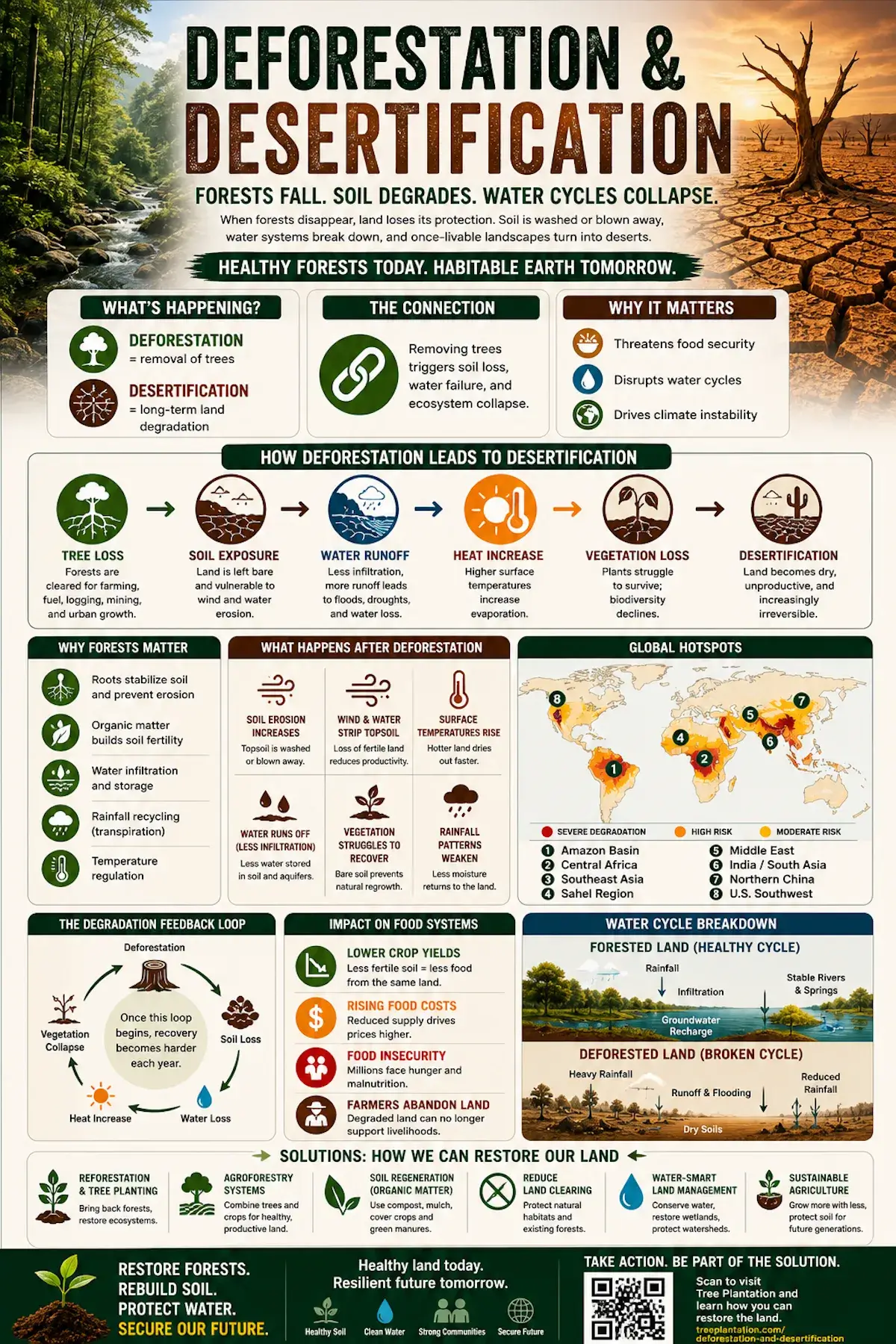
How Deforestation Causes Desertification
Trees are removed, leaving soil exposed to sun, wind, and heavy rainfall.
Root systems disappear, reducing soil stability and infiltration.
Leaf litter and organic matter decline, weakening soil fertility.
Water runs off instead of soaking into the ground.
Heat rises, soil moisture falls, and vegetation recovery becomes harder.
Why This Matters
Forest removal can turn a living landscape into a degraded one. Once soil structure breaks down, water cycles weaken, and vegetation cover disappears, the land can enter a feedback loop of erosion, drought stress, fertility loss, and desertification.
What Is Deforestation and Desertification?
Deforestation and desertification describe two different but connected land degradation processes. Deforestation removes trees and forests from a landscape. Desertification occurs when drylands lose soil health, vegetation cover, water function, and productivity over time.
The connection is simple: forests help keep land alive. Trees shade soil, hold it in place, recycle moisture, feed soil organisms, slow runoff, and build organic matter. When trees are removed, the land becomes more exposed to heat, wind, erosion, drought, and fertility loss.
Deforestation: The clearing or removal of forest cover for agriculture, logging, roads, grazing, mining, fuelwood, or development.
Desertification: Long-term land degradation in drylands where soil, vegetation, biodiversity, and water systems decline.
Key connection: Forest loss removes the natural systems that protect soil, cycle water, cool land, and support vegetation recovery.
Main risk: Cleared land can become hotter, drier, more eroded, less fertile, and less productive over time.
Deforestation and Desertification Infographic
Feel free to share this deforestation and desertification infographic explaining how forest loss drives soil exposure, water runoff, heat increase, vegetation loss, food insecurity, water cycle breakdown, and long-term land degradation. Please include a link back to this page as the source.
Share This Deforestation and Desertification Infographic
Copy and paste the embed code below.
What Is Deforestation?
Deforestation is the permanent or long-term removal of forests and tree cover. It can happen through cutting, burning, clearing, grazing expansion, road building, settlement, mining, or agricultural conversion. While some tree removal may be part of managed forestry or restoration, deforestation becomes destructive when forests are removed faster than they can regenerate.
Deforestation definition: The removal of forest cover that reduces tree density, canopy protection, habitat, carbon storage, and ecosystem function.
Industrial vs subsistence clearing: Industrial clearing often happens at large scale for commodities, while subsistence clearing may occur for local farming, fuel, or survival needs.
Global deforestation trends: Forest loss is concentrated in tropical regions, agricultural frontiers, dry forests, savannas, and areas under pressure from commodity production.
What Is Desertification?
Desertification is not simply the spread of sand dunes. It is the decline of land function in drylands. Productive land becomes less able to grow vegetation, absorb water, hold soil, cycle nutrients, and recover after drought.
Desertification definition: Land degradation in arid, semi-arid, and dry sub-humid regions caused by climate stress, vegetation loss, soil degradation, and human pressure.
Dryland vulnerability: Drylands recover slowly because rainfall is limited, evaporation is high, and plant cover may be fragile.
Natural vs human-driven desertification: Drought and climate variability can stress land naturally, but deforestation, overgrazing, poor irrigation, and soil disturbance can push it toward long-term collapse.
How Deforestation Leads to Desertification
Deforestation can lead to desertification because trees regulate the systems that keep land stable. Removing forests exposes soil, reduces infiltration, increases runoff, disrupts local moisture cycling, and weakens the biological foundation that supports vegetation growth.
Once the land is exposed, the process can accelerate. Topsoil erodes, organic matter declines, roots disappear, surface temperatures rise, and rainfall becomes less effective because water runs off instead of soaking in. This creates the conditions for long-term degradation.
Vegetation removal and soil exposure: Without canopy cover, soil is exposed to direct sun, raindrop impact, wind, and rapid moisture loss.
Root loss and soil instability: Tree roots hold soil together, create channels for infiltration, and reduce slope failure and erosion.
Water-cycle disruption: Forests help recycle water through transpiration, shade, infiltration, and groundwater recharge.
Rainfall-reduction feedback: Large-scale forest loss can reduce atmospheric moisture recycling, weakening local or regional rainfall patterns.
Major Causes of Deforestation That Drive Desertification Risk
Deforestation becomes especially dangerous when land is cleared in drylands, steep slopes, fragile soils, tropical forest margins, or regions where rainfall is already variable. The way land is used after clearing often determines whether it remains productive or begins degrading.
Agricultural expansion: Forests are cleared for crops, plantations, grazing, and commodity production, often leaving soil exposed after harvest or during dry seasons.
Cattle ranching: Clearing forest for pasture can reduce biodiversity, compact soil, lower infiltration, and increase erosion if grazing is not managed carefully.
Logging and timber harvest: Poorly managed logging can open roads, disturb soils, fragment habitats, and increase fire risk.
Infrastructure development: Roads, settlements, mining, and utilities fragment forests and open access for further clearing.
Fuelwood and charcoal: In some regions, repeated wood harvesting removes tree cover faster than natural regeneration can replace it.
Unsustainable farming practices: Clearing land without soil cover, crop rotation, organic matter return, or careful water management can rapidly accelerate erosion, fertility loss, and desertification. Once forests or native vegetation are removed, bare soil is exposed to heat, wind, and rainfall impact. Repeated tillage, monocropping, overgrazing, poor irrigation, and heavy machinery can further weaken soil structure, reduce infiltration, compact the root zone, and lower biological activity. Over time, the land loses its ability to hold water, support vegetation, and recover after drought, creating a cycle of declining productivity and long-term degradation.
The Land Degradation Chain Reaction
Deforestation often starts a chain reaction. Tree loss leads to soil exposure. Soil exposure leads to erosion and moisture loss. Erosion removes fertility. Fertility loss reduces vegetation recovery. Weak vegetation leaves the soil even more exposed.
Deforestation to soil erosion: Once roots and canopy are removed, wind and water can more easily detach and transport topsoil.
Fertility loss cycle: Erosion removes nutrients, organic matter, microbes, and fine soil particles needed for plant growth.
Compaction and structure loss: Cleared land often receives machinery, livestock, or repeated traffic that compresses soil and reduces infiltration.
Forests are part of the water cycle. They intercept rainfall, slow runoff, feed groundwater, reduce evaporation from the soil surface, and release moisture back to the atmosphere. When forests are removed, water moves through the landscape faster and less effectively.
Reduced infiltration: Without roots and organic matter, less rainfall soaks into the soil profile.
Increased runoff: Water moves across the surface more quickly, increasing erosion, flooding, and sediment loss.
Groundwater decline: Reduced infiltration and recharge can weaken groundwater supplies over time.
River-flow disruption: Forest loss can increase flash runoff during storms while reducing dry-season flow stability.
Drought intensification: Cleared land stores less moisture, making dry periods more severe for crops, vegetation, and communities.
Climate Impact of Deforestation and Desertification
Deforestation affects climate by releasing stored carbon, reducing future carbon uptake, increasing land surface temperatures, and weakening moisture recycling. Desertification adds to the problem by reducing vegetation and soil carbon while making landscapes less resilient to climate extremes.
Carbon release from deforestation: Trees store carbon in wood, roots, leaves, and forest soils. When forests are cut or burned, much of that carbon is released.
Reduced carbon sequestration: Cleared land usually stores less carbon than healthy forest, especially when soils are degraded or vegetation remains sparse.
Heat-island effect in cleared land: Open land often becomes hotter than forested land because it lacks canopy shade and evapotranspiration cooling.
Climate feedback loops: Forest loss can intensify warming, drying, soil moisture loss, and ecosystem stress by removing the natural systems that cool and stabilize the landscape. Trees store carbon, shade soil, release moisture through transpiration, and help regulate local rainfall patterns. When forests are cleared, stored carbon is released, land surface temperatures rise, evaporation increases, and soils dry out faster. Drier soils support less vegetation, which further reduces cooling, carbon storage, and moisture recycling. This creates a self-reinforcing cycle where deforestation contributes to climate stress, and climate stress makes it harder for forests and degraded lands to recover.
Impact on Agriculture and Food Systems
Deforestation may create new farmland in the short term, but if soil and water systems are not protected, productivity can decline. Cleared land often becomes more vulnerable to drought, erosion, compaction, pest pressure, and fertility loss.
Soil productivity decline: Once topsoil and organic matter are lost, crops may require more fertilizer, irrigation, and amendments to maintain yield.
Crop failure risk: Hotter, drier, compacted, or eroded soils make crops more vulnerable to drought and heat stress.
Pasture degradation: Cleared land used for grazing can degrade quickly if vegetation cover is overused and soil becomes compacted.
Food security impact: Long-term land degradation can reduce local food production, increase costs, and make communities more dependent on imports.
Biodiversity Loss and Ecosystem Collapse
Forests are habitat networks. When they are cleared, species lose food, nesting sites, shade, moisture, migration corridors, and genetic connectivity. Biodiversity loss weakens pollination, pest control, seed dispersal, soil life, and ecosystem recovery.
Habitat destruction: Forest clearing removes the physical structure that supports plants, animals, fungi, insects, and microbes.
Species decline: Species that depend on forest cover may decline, migrate, or disappear locally.
Ecosystem collapse: When vegetation, water cycles, soil biology, and wildlife decline together, recovery becomes much harder.
Pollinator loss: Forest edges, flowering trees, understory plants, and habitat corridors often support pollinators that agriculture also depends on.
Global Hotspots for Deforestation and Desertification
The deforestation-desertification connection is strongest where forest clearing overlaps with fragile soils, dry climates, steep slopes, drought risk, fire, grazing pressure, and agricultural expansion.
Amazon rainforest: Large-scale clearing can disrupt rainfall recycling, biodiversity, carbon storage, and regional moisture patterns.
Sub-Saharan Africa drylands: Fuelwood harvest, grazing pressure, drought, and land clearing can accelerate degradation in vulnerable regions.
Southeast Asia forests: Plantation expansion, logging, peatland drainage, and fire can cause severe carbon and habitat loss.
Australia degraded land: Clearing, grazing, salinity, drought, and fragile soils contribute to land degradation risk.
Middle East and North Africa: Water scarcity, dryland pressure, overuse, and vegetation decline increase desertification vulnerability.
Feedback Loops That Push Land Toward Desertification
The danger of deforestation is not only the initial tree loss. The greater risk is the feedback loop that follows. Once land becomes exposed and dry, it can become harder for vegetation to return, which makes the land even more exposed and dry.
Vegetation loss cycle: Fewer trees and plants mean less shade, fewer roots, less organic matter, and weaker soil protection.
Erosion and bare-soil loop: Bare soil erodes more easily, and eroded soil supports less vegetation, creating more bare ground.
Heat and moisture-loss loop: Exposed soil heats quickly, loses moisture faster, and becomes less favorable for seedling establishment.
Desert expansion cycle: Vegetation loss, soil erosion, water loss, and heat reinforce one another until recovery becomes difficult.
Comparison: Forested Land vs Cleared Degrading Land
The table below shows why forests protect against desertification and why cleared land can degrade quickly without soil cover, water management, and restoration.
Category
Forested / Tree-Covered Land
Cleared / Degrading Land
Soil Protection
Canopy, roots, leaf litter, and understory protect soil from rain impact, wind, heat, crusting, and erosion.
Bare soil is exposed to erosion, crusting, compaction, and rapid moisture loss.
Water Infiltration
Roots, organic matter, fungi, and soil organisms create channels that help rainfall soak into the ground.
Water often runs off quickly, carrying sediment, nutrients, and organic matter away.
Soil Fertility
Leaf litter, roots, fungi, microbes, and decomposing biomass recycle nutrients and build organic matter.
Nutrients decline as topsoil erodes, microbial activity weakens, and organic matter inputs disappear.
Temperature
Shade and evapotranspiration cool the land surface and help protect soil moisture.
Exposed land heats faster, dries sooner, and becomes more vulnerable during drought and heatwaves.
Habitat becomes fragmented, simplified, degraded, or lost entirely.
Desertification Risk
Lower risk when forests are intact and soil-water systems remain functional.
Higher risk when vegetation loss, erosion, drought, heat, and fertility decline reinforce one another.
Prevention and Solutions
Preventing deforestation-driven desertification requires protecting tree cover, improving land management, restoring degraded areas, and designing agriculture that works with water and soil systems instead of exhausting them.
Sustainable land management: Match land use to soil, water, slope, rainfall, and ecological limits so production does not exceed recovery capacity.
Reforestation and afforestation: Replanting trees can restore shade, roots, organic matter, habitat, carbon storage, and water-cycle function.
Agroforestry systems: Integrating trees with crops or livestock keeps land productive while restoring shade, roots, fertility, and resilience.
Regenerative agriculture: Cover crops, compost, reduced tillage, soil armor, living roots, and managed grazing rebuild soil function.
Controlled grazing: Rotational grazing and proper stocking rates protect plant cover and reduce erosion.
Water harvesting: Swales, terraces, basins, check dams, and contour planting slow runoff and increase infiltration.
Restoration Strategies for Deforested and Desertifying Land
Degraded land can often be restored if the damage has not crossed severe thresholds. The most effective restoration strategies rebuild vegetation, soil structure, organic matter, water infiltration, and biological activity at the same time.
Assisted natural regeneration: Protect existing seedlings, roots, seed banks, and native regrowth instead of relying only on planting new trees.
Soil-rebuilding practices: Compost, mulch, cover crops, manure, biochar, and root systems help rebuild organic matter and soil structure.
Native plant restoration: Native trees, shrubs, grasses, and groundcovers are often better adapted to local rainfall, soils, wildlife, and recovery cycles.
Erosion-control techniques: Terracing, contour planting, check dams, vegetative barriers, and groundcover reduce runoff and hold soil in place.
Global Data and Indicators
Deforestation and desertification are tracked through forest cover change, vegetation decline, soil erosion, land productivity, rainfall patterns, soil moisture, biodiversity loss, and carbon storage. These indicators help show where landscapes are temporarily stressed and where they are entering long-term degradation.
Indicator
What It Measures
Why It Matters
Forest Cover Loss
How much tree canopy or forest area is removed over time.
Shows where carbon storage, habitat, and soil protection are declining.
Vegetation Cover
How much land remains protected by plants.
Signals erosion risk, habitat health, and desertification pressure.
Soil Moisture
Water available in the root zone.
Shows whether land can support plant recovery after drought or clearing.
Soil Erosion
Loss of topsoil by wind, water, or surface runoff.
Indicates fertility loss and reduced long-term productivity.
Land Productivity
The ability of land to support crops, grazing, forests, and ecosystems.
Helps identify whether land is recovering or degrading.
Carbon Storage
Carbon held in trees, roots, vegetation, and soil.
Shows climate impact and ecosystem recovery potential.
Tipping Points: When Forest Loss Becomes Desertification
A tipping point is reached when land no longer recovers naturally after clearing, drought, fire, erosion, or grazing pressure. At that stage, rainfall may return, but the soil may no longer absorb enough water or support enough vegetation to rebuild itself.
Irreversible land degradation: Severe erosion, compaction, salinity, or organic matter loss can make recovery extremely slow or costly.
Rainfall-collapse threshold: Large-scale forest loss can reduce moisture recycling and weaken rainfall patterns in vulnerable regions.
Ecosystem failure: Soil biology, vegetation, wildlife, water cycles, and food webs decline together.
Land abandonment risk: Cleared land may become too dry, eroded, infertile, or expensive to keep productive.
FAQ: Deforestation and Desertification
Deforestation is the removal of forests or tree cover. Desertification is the long-term degradation of drylands where soil, water, vegetation, and productivity decline.
Deforestation removes roots, canopy cover, organic matter, shade, and water-cycle support. This exposes soil to heat, erosion, runoff, drought stress, and fertility loss, increasing desertification risk.
Yes, many deforested areas can be restored with assisted natural regeneration, reforestation, agroforestry, soil rebuilding, erosion control, water harvesting, and native vegetation recovery.
Sometimes. Recovery depends on severity. Restoration may require rebuilding soil structure, improving water infiltration, replanting vegetation, reducing grazing pressure, and controlling erosion.
Major causes include agricultural expansion, cattle ranching, logging, infrastructure development, mining, fuelwood collection, fire, and settlement expansion.
Forests recycle moisture through evapotranspiration and help support local and regional rainfall. Large-scale forest loss can reduce moisture recycling and contribute to drier conditions.
Deforestation exposes soil to erosion, heat, compaction, organic matter loss, fertility decline, crusting, runoff, and reduced biological activity.
High-risk regions include tropical forest margins, dry forests, savannas, Sub-Saharan Africa, Amazon frontier zones, Southeast Asia, Australia, and drylands under agricultural pressure.
It can be prevented by protecting forests, improving land-use planning, using agroforestry, restoring degraded land, managing grazing, reducing erosion, harvesting water, and supporting regenerative agriculture.
Reforestation helps, but it is not always enough by itself. Successful restoration usually also requires soil rebuilding, water management, erosion control, grazing management, and native plant recovery.
The best solution combines forest protection, agroforestry, assisted natural regeneration, regenerative agriculture, water harvesting, erosion control, and long-term land stewardship.
 INVEST
 PLANT
PLANT
 SOFTWOODS
 HARDWOODS
 CALCULATORS
 RESOURCES
 REFOREST